The UAE Personal Data Protection Law has been in force since 2 January 2022. That date comes from the UAE government's official portal, u.ae, which confirms the law came into force then and already bars processing personal data without the owner's consent. The "1 January 2027 full enforcement" date most operators have filed away circulates only in vendor blogs and appears in no official UAE instrument. The real mechanism sits in Article 29 of Federal Decree-Law No. 45 of 2021 (the law firm Amereller publishes the English translation we link throughout): once the Executive Regulations are issued, businesses get six months, extendable by the Cabinet, to bring their processing into line. And as the UAE chapter from Chambers and Partners, updated in March 2026, confirms, those regulations had yet to be issued and the federal Data Office was not yet fully operational.
That combination should worry you more than a fixed date would. A published deadline lets you schedule a compliance project for the quarter before it. A six-month clock that starts on an unannounced day rewards only the businesses whose records already stand up. Consent is retrospective evidence. You cannot manufacture it after the regulations land for a customer who walked into your clinic in 2023 and gave a phone number to a receptionist who wrote it on a pad. Either you captured proof at the time, or you go and get it now, while asking is still normal rather than suspicious.
That is why database reactivation, the thing most UAE service businesses treat as a revenue tactic, is quietly the most important compliance work available to them right now. Done properly, a reactivation campaign is a consent refresh that happens to generate bookings. Done carelessly, it is a bulk broadcast to people who never agreed to hear from you, sent on a platform that continuously scores your number on user feedback (blocks, reports and the reasons people give when they block you) and cuts your reach when that score stays low.
What WhatsApp database reactivation under UAE PDPL actually requires
WhatsApp database reactivation under UAE PDPL means messaging your dormant customer list over the WhatsApp Business API only where you hold documented, demonstrable consent for marketing contact. Article 6 of the law requires consent to be given "in a clear, simple, unambiguous and easily accessible manner, whether in writing or electronic form", and requires the business to be able to prove it, which is why an undocumented verbal yes will not protect you. DLA Piper's UAE guide to electronic marketing adds the channel-specific rule: under Cabinet Decision No. 56 of 2024, consent must be obtained before marketing messages are sent over social media platforms, and the TDRA treats marketing sent without the recipient's consent as spam. In practice that requires three things for every number you message: a record of when and how the person agreed, the wording they agreed to, and a functioning opt-out that is honoured across every future campaign. Because Article 29's six-month grace period only starts when the Executive Regulations are issued, lists rebuilt and documented before the regulations land are the ones that remain usable once that clock runs out.
Read that again if you run a salon, a clinic, a property management office or a home services company with four thousand old numbers in a spreadsheet. The asset is not the phone numbers. The asset is the phone numbers plus the evidence.
Why verbal consent stopped being enough
Almost every UAE service business we work with built its list the same way. A customer books, gives a number, ticks nothing, signs nothing. Somebody at the front desk says we will send you offers sometimes, and the customer nods. Under PDPL that nod leaves no trace, cannot be produced when a complaint is filed, and cannot be tied to a specific time, a specific wording, or a specific channel.
Think of how a food-safety inspection works. The inspector does not take the chef's word that the fridges ran cold last month. A kitchen that holds its hygiene certificate keeps temperature logs, delivery records and cleaning schedules, dated and initialled, precisely so that a stranger can reconstruct what happened long after everyone has forgotten the shift. Consent under PDPL works on the same logic. What matters is whether you can show, to someone who was not there, what a customer agreed to and when.
The four fields that make a consent record defensible
- Timestamp. When the person opted in, to the minute, stored where it cannot be edited casually.
- Wording. The exact text they saw. If your opt-in language changed in 2024, you need both versions and you need to know who saw which.
- Mechanism. Web form, in-chat confirmation, signed intake form, tick box on a booking page. Say which.
- Scope. Marketing, appointment reminders, or both. These are not the same permission and treating them as one is the mistake we correct most often.
That last point deserves emphasis. A patient who consented to appointment reminders has not consented to promotional offers. UAE operators collapse the two constantly, because the messages travel down the same WhatsApp thread. The platform does not care, but the law singles marketing out: Article 17 of the PDPL gives every person the right to object to and stop processing for direct marketing purposes, a right with no equivalent for a routine appointment reminder, so your database should store the two permissions separately.
Reactivating a list you are not sure about
Here is the situation almost everyone is actually in: a list of a few thousand numbers, mixed provenance, no consent field at all, and a nagging sense that some of these people would be delighted to hear from you and some would report you. You cannot separate them by looking.
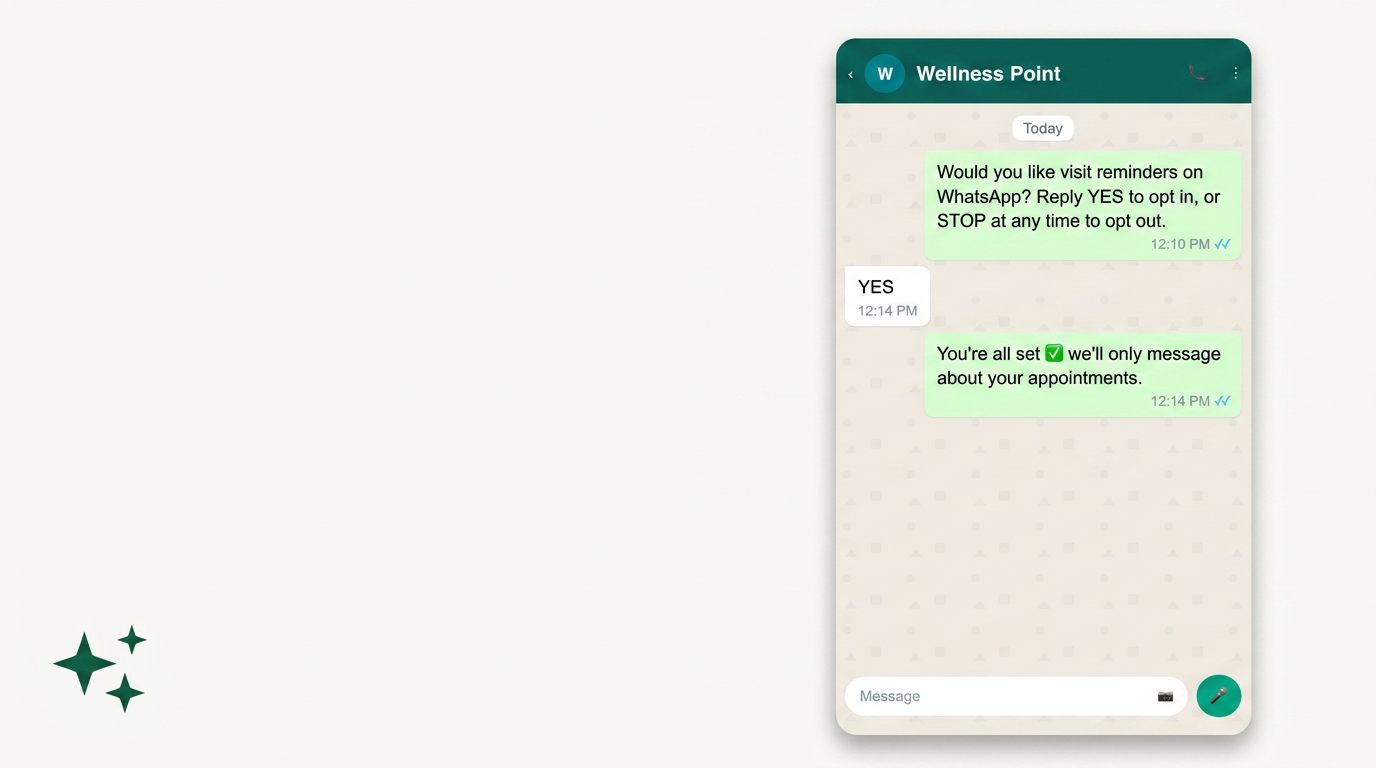
The approach we install is a permission-first reactivation, and it inverts the usual campaign logic. The first message is not an offer. It is a re-permission message that gives the recipient something useful, says in plain terms who you are and why you have their number, and makes opting out one tap rather than a reply-STOP-and-hope arrangement. Only people who engage with that first message enter the actual reactivation sequence.
Operators hate this on first hearing because it visibly shrinks the list. In truth the exercise has simply revealed the list's real size. The rest was liability sitting in a spreadsheet pretending to be an asset.

How the WhatsApp platform itself constrains you
WhatsApp enforces its own rules on top of PDPL, and they pull in the same direction. Meta's own pricing documentation states that template messages are the only message type a business can send outside the 24-hour customer service window that opens when a customer messages first, so cold reactivation runs on approved templates or it does not run. Templates get rejected for pushy marketing language. And AWS's platform documentation for WhatsApp lays out the quality rating mechanics: Meta scores each number on the past seven days of user feedback (blocks, reports and the reasons people give when they block a business), and a flagged number that does not recover within seven days has its business-initiated conversation limit lowered a tier. In other words, the platform financially punishes exactly the behaviour PDPL prohibits.
We treat that as a gift. It means the compliant campaign and the high-performing campaign are the same campaign, which is not true on email or SMS. A business that sends a careful, relevant, easy-to-exit reactivation message keeps its sending capacity. A business that blasts twelve thousand numbers with a discount code loses the channel, and in this market WhatsApp is the front door: clients expect replies there, and a service business that cannot be reached there is effectively invisible to large parts of the market.
Template design that survives review and reads like a person wrote it
Reactivation templates fail approval for predictable reasons: too many variables, no clear identification of the sender, and copy that reads like a mass mailer. The ones that pass and perform share a shape. They name the business in the first line. They reference something specific and true (the service the person last used, the location they visited). They ask one question. They carry an opt-out that works.
A worked example, for a dermatology clinic reactivating patients who have not booked in over a year:
- Line one: identify the clinic and the branch by name.
- Line two: state why you have the number, referencing the visit or booking.
- Line three: one useful, specific offer of value, phrased as a question the person can answer with a tap.
- Line four: the opt-out, in plain language, with no penalty implied.
Notice what is absent. No countdown timer. No "we miss you". No emoji stack. The message that respects the reader is also the message that keeps your quality rating intact.
Opt-out mechanics, and the part everyone under-builds
Capturing an opt-out is trivial. Honouring it across systems is where UAE businesses fail, and it is the failure most likely to become a complaint. Under Article 24 of the PDPL, customers can complain directly to the UAE Data Office, the federal regulator, and Article 19 requires you to give people clear and appropriate ways to contact you and exercise their rights. The practical goal is a route that resolves those requests before the regulator ever hears about them.
The typical setup has a customer's number living in three or four places at once: the booking software, the WhatsApp Business platform, a marketing tool, and a staff member's personal phone. Someone opts out of the marketing tool. Two weeks later the booking system sends them a promotional reminder, or a stylist messages them directly from a shared handset. The customer experiences this as being ignored, because they were.
An opt-out is only real when it propagates to every system that can initiate a message. That means a single source of truth for contact permission, and every sending system reading from it rather than keeping its own copy. This is the same principle behind why we say most AI implementations fail on dirty data rather than weak models. A system pulling from four contradictory records will confidently do the wrong thing, at scale, without hesitating. We have watched an otherwise excellent clinic automation message a bereaved family because one record said active and another said closed.
Suppression lists never expire
When someone opts out, move their number to a suppression list that every future campaign checks before it sends. Deleting the record entirely feels tidy and is dangerous, because the number will re-enter through the next import and you will message them again. The kitchen parallel holds: an allergen note stays pinned to the recipe card permanently, precisely so that no new cook serves the dish to the customer it once harmed. A suppression entry deserves the same permanence.
For teams already running compliant campaigns
If you already hold documented consent and a working suppression list, the remaining gains are in segmentation discipline and in what happens after someone replies.
Recency, value and reason-for-dormancy beat blanket segments
Most reactivation lists get split by date last seen and nothing else. That is too crude. The customer who stopped coming because they moved to Abu Dhabi, the one who had a bad experience, and the one who simply forgot all need different messages, and your records usually contain enough to tell them apart if anyone bothered to look. Complaint history, cancelled appointments, and last service type carry more signal than the calendar does.
The reply is where reactivation campaigns actually break
A reactivation campaign that works generates a burst of inbound conversation, often within an hour of sending. If the business cannot answer that burst, the campaign converts worse than one that failed. We have seen a well-built list produce a wave of replies into an inbox nobody was watching until the following afternoon, by which point the intent had cooled.
This is why we sequence reactivation after the booking layer is solid, not before. If your team is already losing enquiries to slow responses, fixing the appointment bottleneck comes first. Reactivation is an amplifier, and an amplifier applied to a broken process makes the break louder. Businesses that have already rebuilt their operational capacity get compounding returns from the same list.
Consent renewal as a standing process
The teams furthest ahead have stopped treating consent as a one-time capture. They refresh it on a rolling basis: at booking, after a service, at the point a customer updates their details. The list never goes stale because the permission never goes stale. This is the state to be in before the Executive Regulations are issued, because Article 29's six-month clock starts the day they land, and nobody knows which day that will be.
Where reactivation fails and who should skip it
We have built these campaigns across clinics, salons and property firms, and we know where they do not work; pretending otherwise would waste your time.
Permission-first reactivation is a poor fit for very small lists. If you hold four hundred numbers, the re-permission step can cut the reachable core to a fraction of that, and the campaign cost per booking stops making sense. Those businesses are better served by having staff message their top customers individually with genuine one-to-one messages, which sit outside bulk campaign logic entirely and, frankly, convert better.
It does not work where the underlying relationship was transactional and forgettable. A one-off airport transfer from two years ago does not create a customer you can reactivate. No amount of template craft rescues a list of people who never formed an impression of your business. We have run campaigns like this. The open rates look fine and the bookings do not come.
Highly regulated health messaging carries risk beyond PDPL. Clinics dealing in specific treatments face rules about what can be advertised and to whom, and a reactivation message referencing a patient's prior treatment can cross into disclosing health information on a device the patient may share. We advise clinics to reference the visit rather than the condition, and where the treatment is sensitive, we advise against naming it at all. Reasonable people in this industry disagree about how far that caution should go. Some operators consider a generic follow-up perfectly safe; we take the more conservative line because the downside is asymmetric.
At scale, the model strains in two places. The first is quality rating: past a certain volume, even a low complaint rate produces enough absolute reports to drag the score down, so large lists must be sent in waves with rating checks between them, which stretches a campaign over weeks. The second is human capacity, as above. A list of twenty thousand produces far fewer conversations than twenty thousand, and still more than a two-person front desk can hold, and the honest answer for many businesses is to reactivate in segments they can actually serve rather than all at once.
The scenarios described here are composites drawn from work across clinics, salons and property firms, with details changed.
What to fix before you send anything
The order matters, because each step makes the next one cheaper.
- Deduplicate and normalise the numbers. UAE lists are full of the same person stored three ways: with the country code, without it, and with a space in the middle.
- Add a consent field and populate it honestly. Record unknown where you genuinely do not know; a guessed yes collapses the first time anyone checks it.
- Build the suppression list before the first send, and pull in every historic opt-out anyone can find, including screenshots of people who asked staff to stop messaging them.
- Decide who answers the replies, and during which hours, before you schedule the send.
- Write your complaint route. Customers can take a complaint straight to the UAE Data Office under Article 24, and Article 19 obliges you to offer clear channels for people to contact you about their data. The campaign will surface complaints. Know where they land.
At Learnmind, the Dubai consultancy that builds WhatsApp automation and AI receptionists for service businesses, most of our week is spent in exactly this kind of unglamorous data work rather than in the automation itself. The automation is the easy part. The list underneath it decides whether the automation helps or embarrasses you. The same permission questions surface when businesses automate public-facing replies, which we worked through in our piece on the Meta comment manager.
Compliance questions, answered
Can I message my old customer list on WhatsApp in the UAE without written consent?
No. Article 6 of the UAE PDPL requires consent a business can prove, given clearly in writing or electronic form, so an undocumented verbal agreement will not stand up. If you do not hold a record, run a permission-first message that re-establishes consent before any promotional sequence.
When does the UAE PDPL start being enforced?
The law has applied since 2 January 2022. Penalties and detailed rules wait on the Executive Regulations, which had not been issued as of early 2026; once they arrive, Article 29 gives businesses six months, extendable, to comply. Consent records therefore need to be in order before the regulations land, whenever that is.
Does an appointment reminder count as marketing under PDPL?
No, appointment reminders and promotional messages are different permissions and should be stored as separate fields in your database. A customer who agreed to reminders has not agreed to offers, even though both arrive in the same WhatsApp thread, and Article 17 gives customers a specific right to stop direct marketing.
If you want a concrete starting point, send us the one artifact that decides most of this: the exact opt-in wording you use today, whether that is the sentence on your booking form, the checkbox label on your website, or the line your front desk says out loud. We will give it a free read against the PDPL's consent requirements and tell you whether it would stand up before you reactivate anything.