A real estate agency in Business Bay came to us last month with a decision on the table. Their top-billing agent handles 300-plus active leads. The proposal on his desk was to clone his voice, generate personalised WhatsApp voice notes at scale, and send every new portal enquiry a fifteen-second audio greeting that names the caller, names the tower, and sounds exactly like the man whose face is on the billboard. The vendor's demo was convincing. The agent listened to a clone of himself describing a unit he had never seen and could not tell it was synthetic. He asked us the only question that matters: should we do this, and if we do, what breaks?
That is the fork this article is about. Voice cloning has crossed from novelty to production-grade, and the decision is no longer technical. It is a judgement about consent, disclosure, and which parts of your funnel deserve a human larynx.
The short answer, up front
AI voice cloning has become believable enough for WhatsApp voice notes that listeners cannot be relied on to spot it: in controlled testing published on arXiv, people distinguishing real voices from AI-powered voice clones on naturalness scored a mean accuracy of 76.7%, and that accuracy was asymmetric, with 85.5% sensitivity for correctly identifying a real voice. In practical terms, about one in four judgements about an unscripted cloned voice goes the wrong way. For a business sending WhatsApp voice notes, that means believability is no longer the constraint. Consent, disclosure and regulatory exposure are the constraints, and they are the things nobody demos.
So our answer to the Business Bay agency was: yes to cloned audio for a narrow, disclosed, low-stakes band of messages, and no to using it anywhere a client is being asked to make a financial or emotional decision. The rest of this piece explains why that line sits where it does, what the acoustics actually do, and where reasonable people in this industry disagree with us.
What changed in the audio, technically
Why older clones sounded wrong and these do not
The old failure mode was prosody. Early text-to-speech got the timbre of a voice approximately right and the rhythm entirely wrong: even stress on every word, breaths in the wrong places, no hesitation. Human speech is full of irregularity. The current generation of models learned the irregularity, not just the tone.
The industry's yardstick for this is mean opinion score. As Wikipedia's audio deepfake entry describes, MOS is the arithmetic average of listener ratings in perceptual evaluations of generated speech, and it shows that audio generated by algorithms trained on a single speaker scores higher than multi-speaker systems. That single detail explains why cloning one named agent for one agency produces better results than a generic synthetic voice: the model is not being asked to generalise. MOS for naturalness in voice cloning still sits below a perfect score, so the technology has not achieved indistinguishability in a laboratory sense. It has achieved indistinguishability in a fifteen-second WhatsApp voice note played once, through a phone speaker, in a car.
The acoustic fingerprints that remain
Detection systems still find the seams, even when ears do not. According to Paladin Tech's detection guide, review systems study pitch range, frequency patterns and breath spacing, because synthetic voices show repeated patterns while real voices hold more variation. Background noise is itself a signal: when the ambient noise does not match the room acoustics implied by the voice, the system flags the file. Detection accuracy across such tools is reported at around 99%, though benchmarks vary considerably between systems, which is the polite way of saying the number is only as good as the test set.
Think of it the way a pharmacist handles two boxes of the same generic. To a customer at the counter they are identical. To someone checking the batch number, the excipients and the blister foil, they are traceably different products. The clone passes the customer. It does not pass the batch check. That asymmetry is the whole strategic picture: your leads will not catch it, and Meta, a bank's fraud team, or a court-appointed analyst very likely will.
Where cloned voice notes earn their place in a WhatsApp funnel
We install these systems every week and we have watched enough of them work and fail to have a firm view about placement. Cloned audio belongs in the band of messages that are repetitive, informational, and impossible to get wrong.
- Viewing confirmations. Name, tower, time, parking instruction, in the agent's voice. Nobody makes a decision on this message; they act on it.
- Post-viewing summaries. A short recap of the three units seen, delivered as audio because people replay audio in traffic and skim text.
- Document walkthroughs. Explaining what an Ejari or an NOC is, once, well, in a voice the lead already associates with the agency.
- Reactivation of cold leads. A specific, factual update on a building the lead once enquired about.
What does not belong there: price negotiations, anything responding to a complaint, anything after a lead has said no, and anything that answers a question the lead asked in their own voice note. That last one is the tell. When a lead sends audio, they are asking for a person. Answering a human voice note with a synthetic one is the fastest trust-destroying move available in this channel, and we have watched a live sale conversation go cold within the hour after exactly that.
This is our standing position on the whole category: automate the repetitive, personalise the meaningful. Cloned voice covers reminders and recaps. A real human handles the first call after a viewing where the lead went quiet.
Consent, disclosure and the legal floor
Whose voice is it, and who can prove it
The single most common gap we find in vendor setups is a missing consent record. Camb.ai's voice cloning ethics guidance is direct about the standard: never clone a voice without documented consent from the voice owner, build consent verification into the technical workflow so cloning cannot start without a consent record on file, make consent revocable, and delete the voice model when consent is withdrawn. Purpose limitation follows: the cloned voice is used only for the purposes named in the consent agreement.
Read that against how agencies actually run. Agents leave. They leave with their client relationships and sometimes with a grievance. If your CRM is still sending voice notes in the voice of a man who resigned in March, you have a live problem, and it is a contractual one before it is a technical one. Every voice-clone deployment we build includes a written, revocable consent artefact tied to the employment relationship, and a documented kill switch that deletes the model. That is not caution for its own sake. It is the difference between a clean handover and a claim.
The regulatory direction of travel
Resemble AI's regulation resource describes where credible vendors have landed: consent-first voice AI, API-based integrations with access controls, speaker identity verification, and a requirement that users confirm they hold legal rights to any voice they upload or clone. If a vendor you are evaluating does not ask you to attest to those rights, that absence is information about them.
The policy debate goes further. A CIGI paper on voice cloning argues that the most important step is ensuring input data is approved by the original author, performer or artist, and proposes that cloning systems train only on banks of stock recordings supplied by the voice owners themselves. Reasonable people disagree about whether that is workable at scale. We think the underlying principle, provenance of training audio, is where enforcement eventually lands, and businesses that can document where their voice samples came from will have a far easier decade than those who scraped a founder's podcast appearances.
What WhatsApp itself permits, and where the account risk sits
WhatsApp does not have a rule that says "no synthetic audio". It has rules about consent to be messaged, template approval, and what happens when recipients block and report you. Audio notes sent outside the customer service window still require an approved template as the opener, and the practical mechanics of that are covered in our WhatsApp platform reference. The risk does not arrive as a policy violation notice about voice cloning. It arrives as a quality rating drop caused by people reporting messages they found creepy, which is the same path that produces most of the account problems we see, and we have written separately on what triggers an account review.
Separately, Meta's own AI voice features run on different rules from your business messaging. WhatsApp's Meta AI page states that AI messages and prompts are different from personal messages and calls: when you interact with Meta AI, Meta receives your messages and prompts to generate responses and improve AI quality, while personal messages and calls remain end-to-end encrypted. Do not confuse the two categories when a client asks you what happens to their data.
Disclosure that does not kill the effect
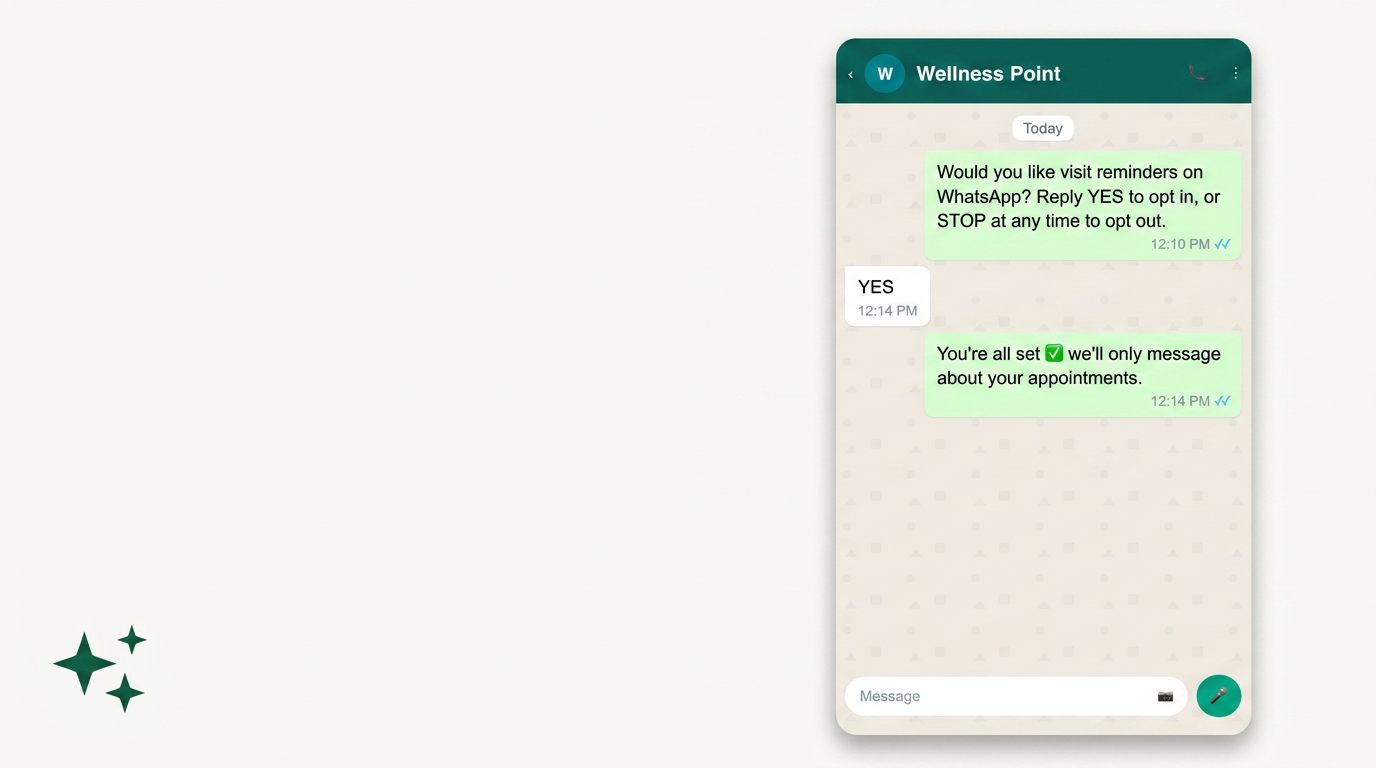
Everyone asks whether disclosing the voice is synthetic ruins the point. In our deployments it does not, because the value of a cloned voice note was never deception. It was familiarity and information density. A closing line noting the message was generated using the agent's recorded voice, with a real number to reply to, costs three seconds and removes the entire category of complaint where someone feels tricked. Agencies that skip disclosure are optimising for a conversion lift they cannot measure against a reputational risk they can.
For teams already running voice at scale
If you have moved past the pilot, the interesting problems change shape.
Model drift and the sample library
A voice model trained on twenty minutes of studio audio produces a version of the agent that is calmer and more articulate than the agent actually is. Over months, leads who meet the person notice the gap. Our practice is to refresh sample libraries with real recorded call audio, with consent, so the clone tracks the human rather than freezing a flattering version of him in amber. Refresh cadence is a judgement call and we do not pretend there is a researched optimum.
Detection asymmetry and inbound fraud
The same technology aimed at you is the bigger operational threat. Drapari's voice cloning guide recommends three defences that translate directly into business process: verify before acting by calling back on a known number or switching to video when a voice message requests money, limit how much voice data you publish publicly, and agree a code word for verification. Any agency where a WhatsApp voice note can trigger a deposit transfer or a key handover needs a callback rule written down. We now put one into every deployment, and it costs nothing.
Where you host the voice model
This is where we get argumentative. A voice model is a business asset, and the cheapest cloning platform is usually the one that will not export it. When the vendor owns the model, the voice of your top biller lives inside somebody else's account, and the migration cost is re-recording, re-training, re-approving, re-consenting. Platform lock-in is a bigger long-term risk than implementation cost. Pay more for a vendor with open APIs and an export path, or accept that you have rented your own founder's voice.
The economics, honestly stated
Cloned voice notes are cheap to generate and expensive to govern. The generation cost per message is trivial. The real budget lines are consent documentation, disclosure copy, a callback verification policy, and a human who reads the replies, because voice notes generate voice replies and those cannot be parsed by your existing keyword routing. Agencies that budget only for the first line end up with a beautiful outbound machine and an inbox nobody answers.
Compare that honestly against the alternative. For many service businesses the answer is a live agent handling the same volume, and we have run those numbers in our receptionist cost comparison. Voice cloning wins on outbound reach at scale. It does not win on anything that requires a decision to be made inside the conversation.
What people ask us
Can customers tell if a WhatsApp voice note is AI?
Usually not, and the research bears it out: mean accuracy at distinguishing real from cloned unscripted voices was 76.7% in the arXiv study, meaning about a quarter of judgements are wrong. Detection software performs far better than human ears, at around 99% accuracy in reported benchmarks that vary between systems.
Is cloning an employee's voice legal in the UAE?
The governing issue is documented, revocable consent from the voice owner, and vendors operating responsibly require you to confirm you hold the legal rights to any voice you clone. Cloning a former employee's voice after they leave, without a consent agreement that survives their departure, is the exposure we see most often.
Will WhatsApp ban my account for sending AI voice notes?
WhatsApp does not ban accounts for synthetic audio as such; accounts get restricted when recipients block and report messages, which drives the quality rating down. Disclosure and tight opt-in lists protect the account far more effectively than avoiding AI voice altogether.
Should I disclose that the voice is AI-generated?
Yes. A single closing line stating the message used the agent's recorded voice removes the entire complaint category around deception, and in our deployments it has not suppressed reply rates in any way we could observe.
What should never be sent as a cloned voice note?
Never send price negotiations, complaint responses, payment or transfer instructions, or replies to a lead's own voice message. Anything that asks for money should also carry a callback rule, since voice cloning is now a standard scam vector on WhatsApp.
Deciding for your own agency
Do not hire us for this if what you want is a way to sound present to 300 leads while giving none of them a real conversation; the technology will do that and the outcome will be worse than silence. Hire us if you want cloned voice on the repetitive band of your funnel, consent and export rights documented from day one, and a human waiting where the money is. Learnmind is an AI customer-communication consultancy in Dubai, and voice deployments are the ones we argue hardest about before we build them.