There is a habit we see in almost every clinic and salon we visit: someone at the front desk writes a name and a number on a paper pad, then transfers the caller, then throws the pad page away at the end of the shift. Nobody thinks of the pad as a system, just the thing you do when the phone rings while you are already dealing with someone at the counter. But that pad is where most of the business's revenue intelligence goes to die. The caller who asked about a treatment you do not offer yet, the one who wanted Saturday evening and was told there was nothing, the one who hung up during hold music: none of that is anywhere by Tuesday.
When operators come to us asking about an AI receptionist, they usually frame it as a coverage problem. Nobody picks up after 7pm. Somebody picks up but is mid-treatment. Fair enough. But "have something answer" is only half a fix. The other half is deciding, in advance and on purpose, what gets asked of every single caller, in what order, and what happens to the answers. That is what the paper pad never did.
What questions should an AI receptionist ask, at minimum?
An AI receptionist should ask, at minimum, three things: the caller's name, the service or reason they are calling about, and how urgent it is. Those three answers are enough to book, route, or escalate almost any inbound call in a service business, and every other question you add should earn its place against them. Name gives you a human handle and a record; service tells you which calendar, room, or specialist is involved; urgency tells you whether this is a booking, a same-day squeeze-in, or something that needs a person right now.
Everything past those three is business-specific. A dental clinic wants to know whether the caller is an existing patient, because that changes the appointment length. A real estate agency wants to know budget and whether the caller is buying or renting, because that decides which agent gets the lead. A salon wants to know which stylist, because half the time the answer is a specific name and the whole booking depends on it. The mistake we watch people make is treating the qualification questionnaire from their sales team as if it belongs on an inbound call at 9pm. It does not. In our live deployments, inbound callers rarely tolerate more than about three questions in a row before they start feeling processed, which is why the complete flows we ship stay within the three-to-five range you will see recommended at the end of this piece.
What order should the questions come in?
Reason for calling first, then name, then the details. This feels backwards to people who were trained on phone etiquette, where you greet and take a name before anything else, but on an automated line the caller is already slightly on guard and wants to know immediately whether they are in the right place. Let them say what they want. Then confirm you can help. Then take the name.
Watch an airport check-in desk for a minute. The first question is always which flight you are on, because that single answer decides which queue you join, which baggage rules apply, and which of the agent's remaining questions are even relevant. Sorting first is what makes everything after it cheap. A call flow behaves the same way: once you know this is a rescheduling call rather than a new booking, you have eliminated most of the questions you would otherwise have asked. Ask the sorting question first and the rest of the flow gets shorter for everyone.
One ordering rule we hold to firmly: never ask for a phone number before you have taken the reason for the call. If the caller drops off at that point, you have nothing. If you have the reason and the name and they drop off, you still have a callback-worthy record if their number came through on caller ID.
How does an AI receptionist know when a call is urgent?
You have to define urgency for it in plain business terms, because the system will not infer your clinical or commercial thresholds on its own. In practice we sit with the owner and write a short list of trigger phrases and conditions specific to their trade: for a dental clinic that might be swelling, bleeding, or trauma; for a property manager it might be water, electricity, or a lock. When one of those appears, the flow stops asking about appointment preferences and moves straight to a handover or an emergency line.
The question itself should be asked directly and once. Something along the lines of whether this needs attention today or whether they are looking for the next convenient slot. Callers are honest about this in our experience, far more honest than the operators expect. People are not trying to game your triage. The second layer is keyword detection running underneath the conversation, so that if the caller volunteers something alarming while answering an unrelated question, the flow reacts anyway.
MindyOne, the AI receptionist we deploy, treats any unresolved urgency signal as a reason to escalate rather than to keep asking questions. That bias is deliberate. A false escalation costs a staff member a few minutes. A missed one costs you a patient, and sometimes a great deal more than that.
What is this actually costing us right now?
Here is where we ask operators to sit down and do the arithmetic with us, because the number is almost never the one they carry in their head. It is a rare day when we meet an owner who knows how many calls went unanswered last month, and rarer still when someone knows what happened to the ones that were answered badly.
The ledger has four lines, and only one of them is obvious.
- The unanswered calls. Every call outside opening hours, plus the ones during hours when both staff were busy. Most phone systems can tell you this figure; almost nobody has looked. Pull it before you buy anything.
- The answered-but-unrecorded calls. The paper pad problem. Someone answered, gave an accurate response, and left no trace. These do not feel like losses because the caller was helped. But nobody followed up with the ones who said they would think about it, and speed of follow-up is where leads live or die: Harvard Business Review's audit of 2,241 companies found that 23 per cent never responded to a web lead at all, and that firms making contact within an hour were nearly seven times as likely to qualify the lead as those waiting even an hour longer. A call that leaves no record cannot be followed up within an hour, or ever.
- Staff hours spent on questions that never needed a person. Opening times, parking, whether you take a particular insurance, how much a standard service costs. Count how many of these your front desk absorbs in a day, in minutes, and multiply by the hourly cost of the person absorbing them. That is a real AED figure and it is usually the one that makes owners quiet.
- The interruption tax. Harder to price, and we will not pretend to have a number for it. But a receptionist interrupted repeatedly during a single check-in makes booking errors, and a booking error can cost a chair-hour.
We deliberately do not put a headline percentage on any of this, because your numbers are not our other clients' numbers and the honest answer is that the size of the loss varies enormously by trade and by how good your existing front desk already is. What we can say without hedging is this: the operators who run this ledger before they automate build much better call flows than the ones who skip it, because they know which of the four lines they are actually trying to fix.
Should the AI receptionist ask qualifying questions, or just book the appointment?
It depends entirely on whether an unqualified booking costs you anything. For a salon, a booking is a booking; take the name, the service, the stylist preference and be done. For a real estate agency, an unqualified viewing request costs an agent a wasted trip across the city, so the flow has to ask about budget, area, and timeline before it puts anything in a diary.
The test we give clients is simple: if a caller books and then turns out to be a poor fit, who absorbs the cost? If the answer is "nobody much", stop qualifying and start booking. If the answer is "a senior person's afternoon", then two or three qualifying questions are worth the friction. Anything beyond three and you are running a survey, and callers will hang up on a survey.
Aesthetic and medical clinics sit awkwardly in the middle. A consultation booking is cheap to make and expensive to waste. Our usual approach there is to book generously but ask one filtering question about what the caller has already tried or been told, which quietly separates the researchers from the ready.
What should it ask before transferring to a human?
Before any handover, the flow should have captured the caller's name, a callback number, and a one-line summary of what they want, so the human picks up a call that is already sorted rather than starting from zero. This is the single highest-value habit in the whole design, and it is the one most implementations skip.
An airport check-in desk never sends you to the gate empty-handed; the boarding pass travels with you, and nobody at the gate asks where you are flying. A transferred call without a summary is a passenger with no boarding pass: the next person has to start the questioning again, in front of a caller who has already explained themselves once and does not want to do it again.
There is a second rule here that matters more in the UAE than people expect. Ask which language the caller would prefer for the handover, and route accordingly. Arabic is the official language, and the UAE government's official portal notes in its country fact sheet that Bengali, Farsi, Malayalam, Turkish and Urdu are all widely spoken alongside English. We have watched perfectly good call flows fall apart because an Arabic-preferring caller was handed to an English-only agent at the last second, and the whole careful sequence was wasted in the final ten seconds.
What happens when the caller does not answer the question you asked?
The flow should accept the information sideways and move on rather than repeating the question. Real callers answer the question after next, give three pieces of information at once, or ask their own question in reply. A flow that insists on its own sequence sounds interrogative and callers disengage fast.
This is where most of the design effort actually goes, and where the demo you saw at a trade show tells you nothing. Demos run happy paths. Live deployments run into the caller who says she needs to move Thursday to Friday but Thursday is fine actually if you have the evening, and the caller who opens with a long complaint that is not a booking at all. We build three behaviours for these moments: capture whatever was volunteered, ask only for what is still missing, and escalate to a person after two consecutive failures to understand. Two. Not five. The third confused exchange is where goodwill dies.
We also insist on a plain sentence early in every deployment that tells the caller they can ask for a person at any point, and we make sure that sentence is honest. If they ask, they get one, or they get a callback commitment with a stated timeframe. This is not a compliance detail. It is the thing that keeps callers relaxed enough to answer your three questions properly.
Should the AI receptionist ask the same questions on WhatsApp as on the phone?
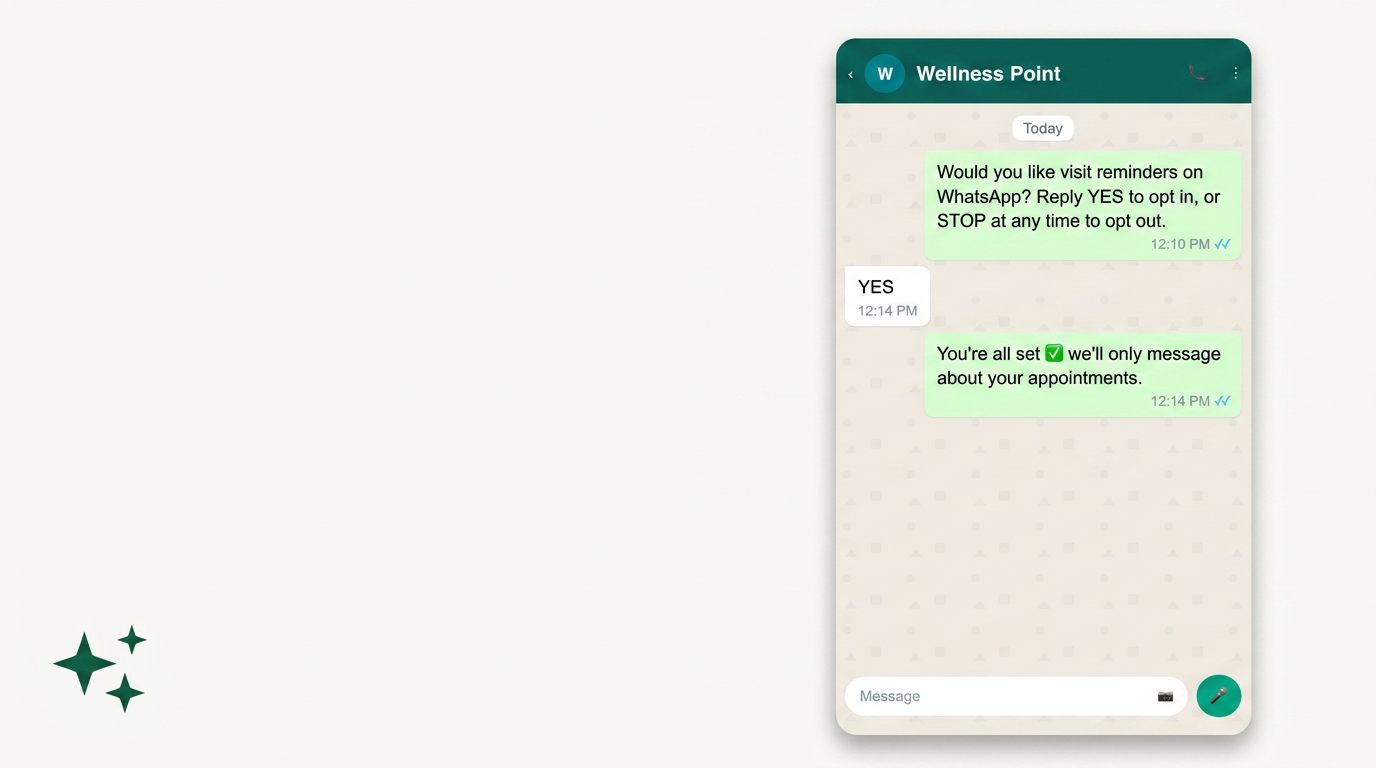
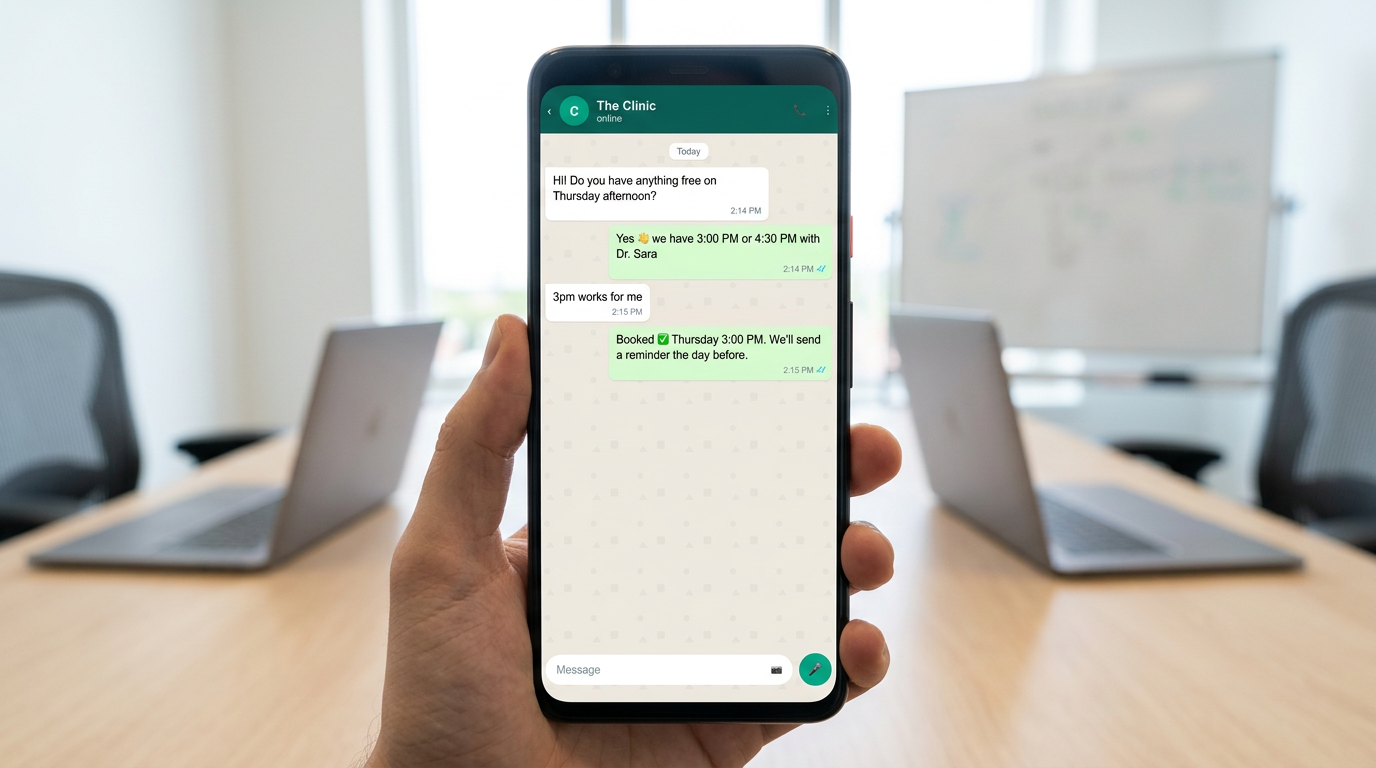
No, and treating the two channels identically is one of the most common mistakes we clean up. A phone caller has limited patience and no ability to scroll back, so you ask fewer questions and confirm more. A WhatsApp thread is a written record the customer can review, so you can ask more and offer buttons or lists instead of open-ended prompts; Meta's Cloud API documentation on interactive list messages lets you present up to ten selectable options and hands the customer's choice back to your system as structured data.
The other difference is timing. On WhatsApp, a caller who goes quiet for two hours is usually at work and will come back. Your flow should tolerate that gap and resume politely instead of restarting, and the platform is built for exactly this: Meta's customer service window stays open for twenty-four hours from the customer's last message, so a two-hour pause costs the conversation nothing. On the phone, silence means the call is over.
What we advise, and we are stubborn about it, is to get one channel genuinely working before you extend the same logic to the second. We have written elsewhere about the channel stacking trap, and the pattern is the same every time: a business that runs a good phone flow and a mediocre WhatsApp flow gets worse results than one running only the good phone flow, because the mediocre channel trains customers to expect less. The same discipline applies to social comments, where question design has its own rules; we cover that in our notes on Meta comment automation.
How do we test the question set before it goes live?
Route a small, low-risk slice of real calls through it first, listen to every one, and change the questions weekly for the first month. That is the whole method. Big-bang rollouts fail here not because the technology breaks but because the staff have no time to build trust in it while also learning what it does to their day, and staff adoption is what decides whether an AI receptionist survives its third week.
Concretely, we usually start with after-hours calls only. Nobody is answering those anyway, so the downside is bounded and the upside shows up in the booking log immediately. Then we add lunch-hour coverage. Then overflow during peak. By the time the flow handles a Tuesday morning rush, the front desk team has heard dozens of recordings and has strong, specific opinions about which question is phrased badly. Those opinions are the most valuable input in the whole project and you only get them by going slowly.
One thing worth saying clearly: the goal is never to remove the human from the conversation. At Learnmind, the Dubai consultancy that builds WhatsApp automation and AI receptionists for service businesses, we design every system we put into clinics, salons and agencies so that the person at the front desk spends their attention on the patient in front of them rather than on the fourth caller asking about parking. Clients pay premium prices for human expertise. Automation earns its place by protecting the hours in which that expertise gets delivered.
What should it never ask?
Never ask for payment card details, medical history, or identity document numbers in an automated inbound flow. On WhatsApp this is written into the platform rules: Meta's Business Messaging Policy tells businesses not to ask people to share "full length individual payment card numbers, financial account numbers, personal ID card numbers, or other sensitive identifiers", and it restricts health-related information wherever regulations require heightened handling. UAE law points the same way: under the UAE data protection law, Federal Decree-Law No. 45 of 2021, summarised on the same government portal, processing personal data without the owner's consent is prohibited outside narrow legal exceptions. There is a practical reason stacked on top of the legal ones: the caller has no way to verify who they are talking to, and every sensitive question you automate trains customers into a habit that scammers will exploit against your own brand. Collect sensitive data through a channel the customer initiated and can verify.
Two smaller prohibitions we hold to. Do not ask a caller to repeat information they have already given in the same conversation; if the flow does this, the flow is broken and no amount of polite phrasing fixes it. And do not ask satisfaction or feedback questions at the end of an inbound call the customer made for their own reasons. They rang you with a need. Answer it and let them go. Feedback belongs in a separate follow-up message where the customer is not standing in a car park with a screaming child.
If you are still weighing whether to move at all, the objections we hear most often from operators considering the switch are collected in our piece on the questions buyers ask before they commit.
What people ask us
How many questions should an AI receptionist ask before booking?
Three to five for most service businesses: reason for calling, name, service or staff preference, preferred time, and contact number. Anything beyond that needs a specific commercial justification, because caller patience on an inbound line is short.
Should an AI receptionist ask if the caller is a new or existing customer?
Yes, if that answer changes the appointment length, price, or which calendar is used, which it usually does in clinics. Ask it right after the reason for calling, because it often removes several later questions.
Can an AI receptionist handle emergency calls?
An AI receptionist should identify urgency and escalate immediately rather than attempt to manage an emergency itself. Define the trigger words for your trade in advance and make escalation the default whenever a signal is ambiguous.
What does an AI receptionist ask outside business hours?
The same core questions, with one addition: whether the caller wants a callback when you open or is happy to book directly into a future slot. Twenty-four hour operation is only useful if the after-hours conversation ends in a committed next step.
How long does it take to get the question flow right?
Expect the first version to go live within days and to be revised weekly for about a month as real calls expose the gaps. Flows built entirely in a meeting room and launched at full volume are the ones we get called in to repair.
How would the questions your own line asks today stand up next to the ones in this piece? If the comparison turns up gaps, closing them is exactly what we can help with at Learnmind.