An empty treatment room does not send you an invoice, which is why most clinics never price the loss properly. The owner already knows the fix in principle: contact people the day before. The question they cannot answer is whether the contacting costs less than the empty chairs.
That is a maths problem, not a philosophy problem. Below is the arithmetic, including where a WhatsApp voice reminder genuinely does reduce no-shows and where the numbers stop working.
The no-show bill: what missed appointments really cost
The cleanest public figure comes from primary care. NHS Nottingham and Nottinghamshire ICB reported that patients failing to attend GP appointments cost more than £9.25m in a single year, across 308,538 missed appointments between October 2024 and September 2025.
Those are public-sector numbers, and they are the wrong ones for you. A GP slot is a short block of salaried time. A private clinic's missed appointment is a treatment room, a practitioner on a day rate, and a revenue line that does not reappear. The right way to price your own no-show is not "lost revenue" but this:
- Contribution, not turnover. Take the average ticket, subtract consumables and any practitioner commission that is only paid when the treatment happens. What remains is what the empty chair actually took from you.
- Add the fixed slice. Rent, rota and reception cost the same whether the patient walks in or not. Divide monthly fixed cost by bookable slots per month and add that per empty slot.
- Subtract salvage. If your waitlist genuinely fills half of the gaps, halve the total. Most clinics say they do this and do not.
Run those three steps and you have one number: contribution lost per no-show. Everything below is measured against it, because no published benchmark can tell you what your own chair is worth.
Why patients no-show, and why most reminders miss the reason
Research by the messaging firm Esendex, based on freedom of information data from NHS trusts, groups the causes into two families. One is logistics: carers, transport and time off work. The other is informational: patients unaware or forgetful, given unclear information, or unable to cancel or reschedule easily.
Read that second list again, because it defines what a reminder can and cannot fix. A reminder repairs "forgot" and "unclear". It does nothing at all for "my shift changed". And the last item, difficulty cancelling, is the one most clinics actively make worse: they send a no-reply SMS, so the patient who genuinely cannot come has no cheap way to say so, and simply does not turn up.
This is the whole argument for using WhatsApp rather than SMS. A reminder the patient can answer in seconds converts a silent no-show into a cancellation you can refill. The channel matters less than the reply path.
Confirmation contact remains, on the available evidence, one of the most effective safeguards against missed appointments. What is not established by any figure worth quoting is how much better a recorded human voice performs than well-written text. No published trial settles it. Anyone selling you a percentage uplift for voice specifically is selling you a guess. What voice buys is attention and warmth where a text block gets scrolled past, and clarity for patients who read poorly or read in a second language.
How to reduce no-shows with a WhatsApp voice reminder without hiring anyone
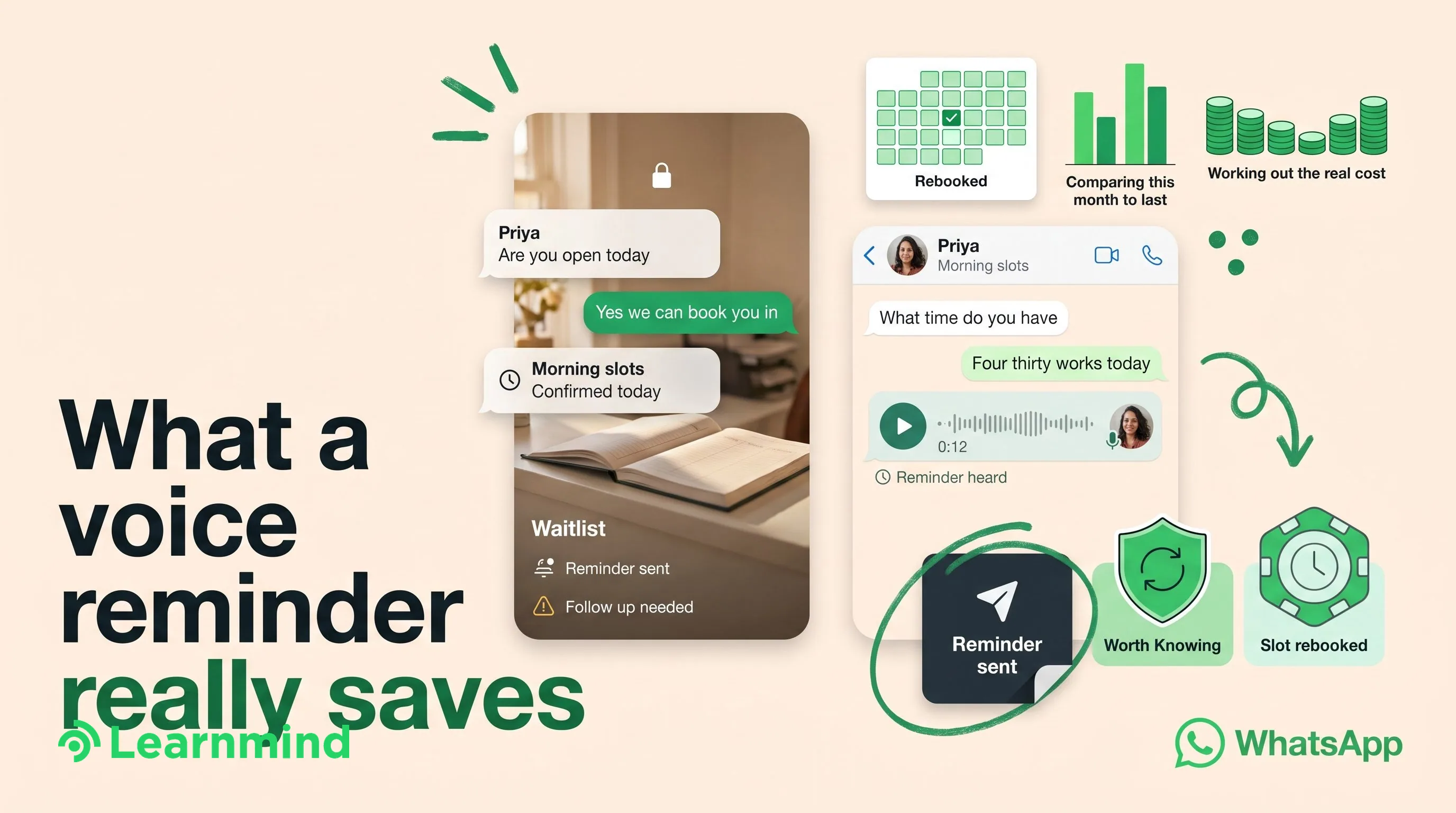
The mechanics are plain in the best way. A template message goes out the day before with the date, time, practitioner and address. Beneath it sits a short recorded voice note in the voice of someone the patient has actually met at the desk. Then one line: reply YES, or reply MOVE and we will find you another slot.
The reply is the point. Under Meta's rules, once the patient responds you are inside an open customer service window, and as of 1 November 2024 Meta does not charge for non-template messages sent inside it. So the rescheduling conversation, the one that recovers the revenue, is free. You pay for the knock on the door, not the conversation behind it.
Two operational rules make the difference between a sequence that works and one that annoys people. Send from a number that a human monitors during business hours, because a voice note invites a voice note back. And keep the number of scheduled touches small: one confirmation, one nudge on the day. Anything more and patients start muting the thread.
Reminder sequences of this shape are standard practice in scheduling tools; workflow automation that fires notifications at set intervals before an appointment is the baseline feature, not the differentiator. The differentiator is what happens when someone replies.
Voice reminders versus a human receptionist: the honest ledger
The alternative to automation is a person on the phone, and the person is genuinely better at some things. Here is the ledger with both columns filled in rather than one.
| Dimension | Automated voice/WhatsApp reminders | Human calling the list |
|---|---|---|
| Annual cost | One industry pricing analysis puts an AI receptionist at $1,700 to $9,200 per year | The same analysis puts a human receptionist at $44,000 to $64,000 per year, of which $8,000 to $12,000 is payroll tax and benefits |
| Cost structure | Platform subscription $1,200 to $6,000 plus one-time setup of $500 to $2,000 | Base salary $32,000 to $45,000, US average, plus on-costs |
| Coverage | Every booking, evenings and weekends included | Whoever is left on the list when the phone stops ringing, which on a busy day is nobody |
| Handles the awkward case | Poorly. A patient who is anxious, hesitant or wants clinical reassurance needs a person | Well. This is the entire reason to keep the person |
| Fails by | Sending confidently wrong information at scale | Not getting to the bottom of the list |
The published gap is $35,000 to $55,000 a year, but treat that as a US staffing comparison, not a promise about your rota. Most clinics we work with do not remove the receptionist. They move her off the reminder list and onto the inbound calls she was missing. The saving shows up as recovered bookings, not as removed salary, and that is the honest version. The same logic applies to an AI receptionist more broadly: it buys coverage, not headcount reduction.
The worked sum you can run on your own numbers
No credible published figure gives a private clinic's no-show rate or the share of no-shows a reminder recovers, so do not import someone else's. Build the sum from three inputs you already hold and one you will measure.
- A. Appointments per month, from your calendar.
- B. No-show rate over the last 90 days, counted, not estimated.
- C. Contribution lost per no-show, from the three-step method above.
- D. Recovery rate: the share of previously silent no-shows that now confirm, or cancel early enough for you to refill. You do not know this yet. Four weeks of running the sequence will tell you.
Monthly value recovered is A × B × C × D. Against it sits the platform cost. Using the industry pricing analysis above, a subscription in the $1,200 to $6,000 band works out at roughly $100 to $500 a month, plus a one-time $500 to $2,000 setup, plus per-message template fees for the outbound reminder only, since Meta has charged per message since 1 July 2025 and the replies inside an open window are free.
The shape of the decision follows from one relationship: a single recovered appointment is usually worth more than a month of messaging fees, so the programme pays for itself at low recovery volumes and scales from there. Where it stops being obvious is at low appointment volume with a modest ticket, because the subscription is fixed while the recoverable loss is not. Run A × B × C × D before you sign anything.
Where WhatsApp pricing changes the maths
Two Meta rulings define the cost model, and both are in force. Businesses are charged per message for templates as of 1 July 2025, so the old per-conversation arbitrage where you crammed several updates into one 24-hour window is gone. And non-template messages inside an open service window have been free since 1 November 2024.
The practical consequence for a reminder programme: every extra scheduled template is a line item, every reply-driven message is not. So design sequences that open a window early and do the work inside it. Send one template, get the patient to reply, then handle confirmation, rescheduling, directions and prep instructions free of charge in the same thread. Clinics that instead fire four scheduled templates per appointment are paying four times for a conversation they could have had once. This is also the core of sensible WhatsApp automation design.
Keeping the volume without losing the number
Reminders touch three separate rule sets: Meta's messaging policy, telecoms regulation on automated voice calls, and health data rules. They are not the same thing and they do not fail the same way. In the United States, automated and pre-recorded voice calls fall under FCC rules made under the TCPA, and healthcare data sits under HIPAA. In the United Kingdom, Ofcom governs automated calling. In the UAE, the TDRA licenses telecoms services and Dubai clinics answer to DHA, with DoH in Abu Dhabi, on patient data. A WhatsApp voice note is a message, not a call, which is precisely why it sidesteps the automated-calling regime; an AI agent dialling out does not.
Moves that are both safe and effective:
- ✅ Capture explicit consent to be messaged on WhatsApp at booking, logged with a timestamp against the record. It is the single artefact that resolves a complaint in your favour.
- ✅ Put the reply path in the first line, not the last. "Reply MOVE" recovers the slot that "do not reply to this message" loses.
- ✅ Use one approved template per appointment and do the rest inside the free service window, per Meta's non-template pricing rule.
- ✅ Keep clinical detail out of the reminder. Date, time, practitioner first name, location. No treatment names, no diagnoses, which keeps you clear of DHA, DoH and HIPAA exposure if the phone is shared or lost.
- ✅ Route any reply containing a clinical question to a human within business hours, and say so in the message.
Moves that reliably cost you something:
- ❌ Messaging a list you bought or scraped. Recipients block, quality rating falls, and Meta throttles your messaging limits, which cripples the reminder programme you just paid for.
- ❌ Auto-dialling patients with a pre-recorded or AI voice in the US without proper consent. That is squarely TCPA territory and the liability is per call, not per campaign.
- ❌ Naming the treatment in the reminder. "Reminder for your hair transplant consult" is a data incident waiting for the wrong screen to light up.
- ❌ Running outbound voice campaigns from an unlicensed telecoms setup in the UAE. Telecoms provision there is licensed by TDRA, and the exposure is regulatory, not merely commercial.
Moves real operators use that carry genuine risk:
- ⚠️ Cloning a staff member's voice for the reminder note. Gains consistency and lets you scale one warm voice across thousands of messages. The risk is legal and contractual, not platform: you need that person's written, revocable permission, and it should survive their resignation. Suits clinics with a settled front-of-house lead, not those with churn.
- ⚠️ Marketing-adjacent phrasing inside a utility reminder, such as adding an upsell line. Gains revenue per message. The risk is platform policy: templates are categorised, and repeatedly slipping promotional content into a utility template invites rejection or recategorisation. Suits operators willing to monitor template approval status weekly.
- ⚠️ Messaging patients from a personal WhatsApp number to avoid template fees entirely. Gains near-zero messaging cost. The risk is dual: it breaches the terms of consumer WhatsApp for business use, and it puts patient data on an unmanaged device, which is the harder problem under DHA or HIPAA. Suits nobody handling health data, whatever the saving looks like on a spreadsheet.
What to do this week
Pull the last 90 days of bookings. Count no-shows, calculate contribution per slot using the three steps at the top, and multiply. That number is your ceiling. Then record one short voice note at the front desk, attach it to your existing reminder, add a reply instruction, and run it for four weeks against the previous four. You will know your own recovery rate, which is worth more than anyone else's benchmark.
Does a WhatsApp voice reminder really reduce no-shows?
Partly, and only for certain causes. Confirmation contact is one of the most effective safeguards against missed appointments, and the NHS evidence shows a large share of no-shows stem from patients being unaware or forgetful or unable to cancel easily, all of which a two-way reminder addresses directly. It will not fix transport or carer problems. No published trial isolates the effect of a recorded voice note against plain text, so treat voice as a way to be heard rather than a proven uplift, and measure your own recovery rate over four weeks.
If you would like to sanity-check your no-show sum, or work out how a reminder sequence should be built so the free service window carries most of the conversation, Learnmind is happy to go through your numbers with you.
Related reading
- WhatsApp Reminder A/B Testing for Gym No-Shows
- Measuring WhatsApp Voice Notes: Metrics That Predict Revenue
- From No-Shows to Revenue Recovery: Building Bulletproof Appointment Systems That Actually Work
Sources
- NHS Nottingham and Nottinghamshire ICB
- Esendex
- Hexalevel
- Zeeg
- Meta for Developers
Related reading: WhatsApp's October Charges: What They Cost You