It is early morning at a small-group fitness studio in Dubai. The roster is full. The room is not. The instructor waits a few extra minutes, then starts, and by mid-morning the front desk is working through cancellation requests from people who were charged for a class they never intended to attend. This scene is a composite of fitness client projects we have worked on, not a single verified account, and we are flagging that up front because the useful part of this article is the method, not the anecdote.
Nobody in that room was missing information. Everyone booked got a reminder the night before and another one closer to the class. The messages were delivered and read. The seats stayed empty anyway.
So the operator asked a fair question: if the reminders land and people still do not come, what is the reminder actually for? The only honest way to answer that is to test it, and testing WhatsApp templates properly is a narrower discipline than most studios expect.
The either/or the industry hands you, and why both sides are wrong
Ask around and you get two answers, presented as opposites.
The first camp says the problem is tone. Your reminders are too transactional. Add warmth, add a motivational line, make the member feel seen. Template libraries are built on this premise; Chatix's fitness templates lean heavily on encouraging phrasing for class reminders at the 24-hour and 1-hour marks.
The second camp says tone is decoration and the real lever is cadence: when you send and how many times. There is evidence behind that too. Kuba Labs' A/B guide reports that in abandoned cart recovery, moving the first message from one hour after abandonment to three hours later can produce meaningfully better results, because the recipient is no longer in the middle of something else.
Both framings share the same flaw. They treat the reminder as a persuasion problem, so both tests end up comparing two versions of the same job. Warm reminder versus terse reminder. Early reminder versus late reminder. Small differences in, small differences out. The variant pairs that actually move attendance are the ones where the two messages are asking the member to do different things.
What a WhatsApp reminder template A/B test is
A WhatsApp reminder template A/B test for a gym means sending two separately approved WhatsApp Business API template variants to randomly split halves of the same booking population, holding send time and audience constant, and scoring the variants on class attendance rather than on delivery, read or reply rates. Both variants must be submitted to Meta and approved as distinct templates before the test starts, because a business-initiated message needs an approved template. The winning variant is the one that puts more people on the floor, which is frequently not the one the owners prefer reading.
That last point is where most in-house tests fail. Read rates on WhatsApp are so high that they discriminate between almost nothing. A variant can win on engagement and lose on attendance, and if your dashboard shows only the first number you will roll out the losing template with confidence.

One platform constraint shapes everything else. Meta's template messages documentation sets out that business-initiated messages use approved templates, with rules covering categories, variables and buttons. Practically, this means you cannot tweak a live template halfway through a test and pretend it is still the same variant. Freeze both, leave them alone for the full runtime, and log the approval dates. Our WhatsApp platform reference covers the wider ruleset, including what each category costs to send.
Designing variants that are actually different
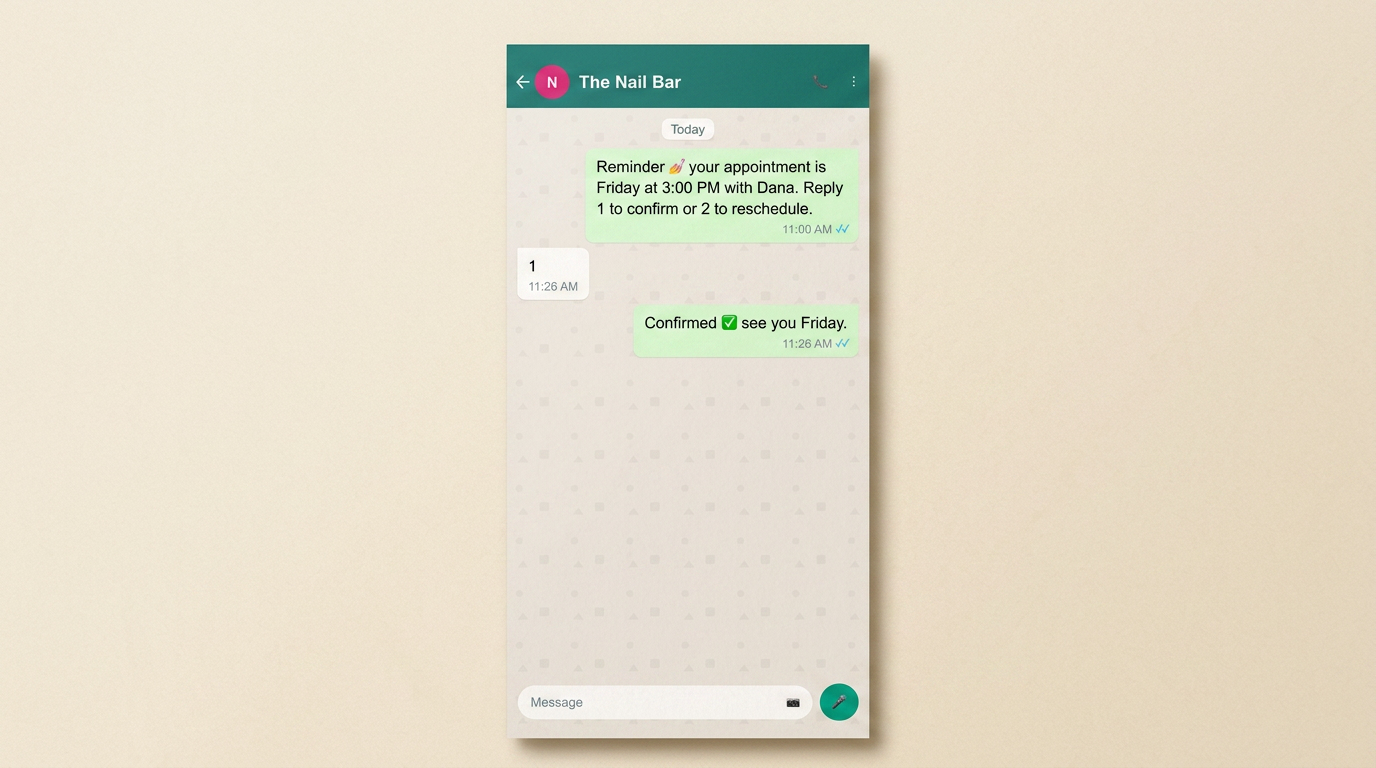
In the composite project, the incumbent template was the encouragement message: class details, coach name, time, location, a motivational line, a link to the booking portal. It reads well. Owners like it. Its implicit theory is that the member forgot and needs a nudge.
The challenger inverted the job. Same class details, no motivational line, and the primary action in the message was to release the spot, phrased as a favour to the community rather than an admission of failure: cannot make it, tap here and we will pass your mat to someone on the waitlist. A secondary quick reply confirmed attendance.
Its theory is that the member has already half-decided and needs permission plus a one-tap exit, early enough that the seat can be resold. On its face, the challenger is a message that encourages some people not to attend. That is precisely why an operator would never write it unprompted, and precisely why it earns a test slot.
Two things were deliberately held fixed, because they are baseline quality rather than variables:
- Register. Both variants were professional and warm, never quirky. Someone about to miss a class they paid for is mildly embarrassed, and a bot making jokes at that moment costs credibility exactly when credibility is doing the work.
- Language. Detected automatically from the member's prior messages and profile, never picked from a menu. Asking an Arabic speaker to opt in to Arabic is a friction failure before the test has begun, and it would have varied across the split.
If you are still designing the sequence itself rather than testing wording inside it, start with our piece on appointment systems that recover revenue. This article assumes the sequence exists and asks a different question: how do you find out which version of it works.
Splitting the audience without contaminating the result
Split on the booking, not the member, and you get faster results but dirty ones, because the same person receives both variants across a week and remembers the first. Split on the member and you need longer to accumulate volume, but each person only ever meets one message. We split on member ID, assigned once at enrolment, held for the whole test.
Three other contamination sources are worth naming, because they are the ones that quietly ruin studio tests. Class type: if peak reformer skews to one variant by accident, you are measuring class popularity. Instructor: a beloved coach fills rooms regardless of copy. Tenure: brand new members behave nothing like members in year three, so check that both halves have a similar mix before you draw conclusions rather than after.
How long to run it
Forecasters do not announce a 60% chance of rain because they looked at the clouds. They run the same atmospheric model many times over with slightly different starting conditions and count how many runs come out wet. One week of one template is a single run. It tells you what happened, not what will happen.
So the runtime rule is not a fixed message count, it is coverage of your own cycles. Run long enough to include ordinary weeks and awkward ones: a public holiday, a schedule change, a week when the 6:45 slot loses its regular coach. Three to four full weeks is usually the floor for a multi-site studio, and if the two variants are still within a hair of each other at the end, the honest reading is that your variants were not different enough, not that testing does not work.
Compliance groundwork that has to be done before, not during
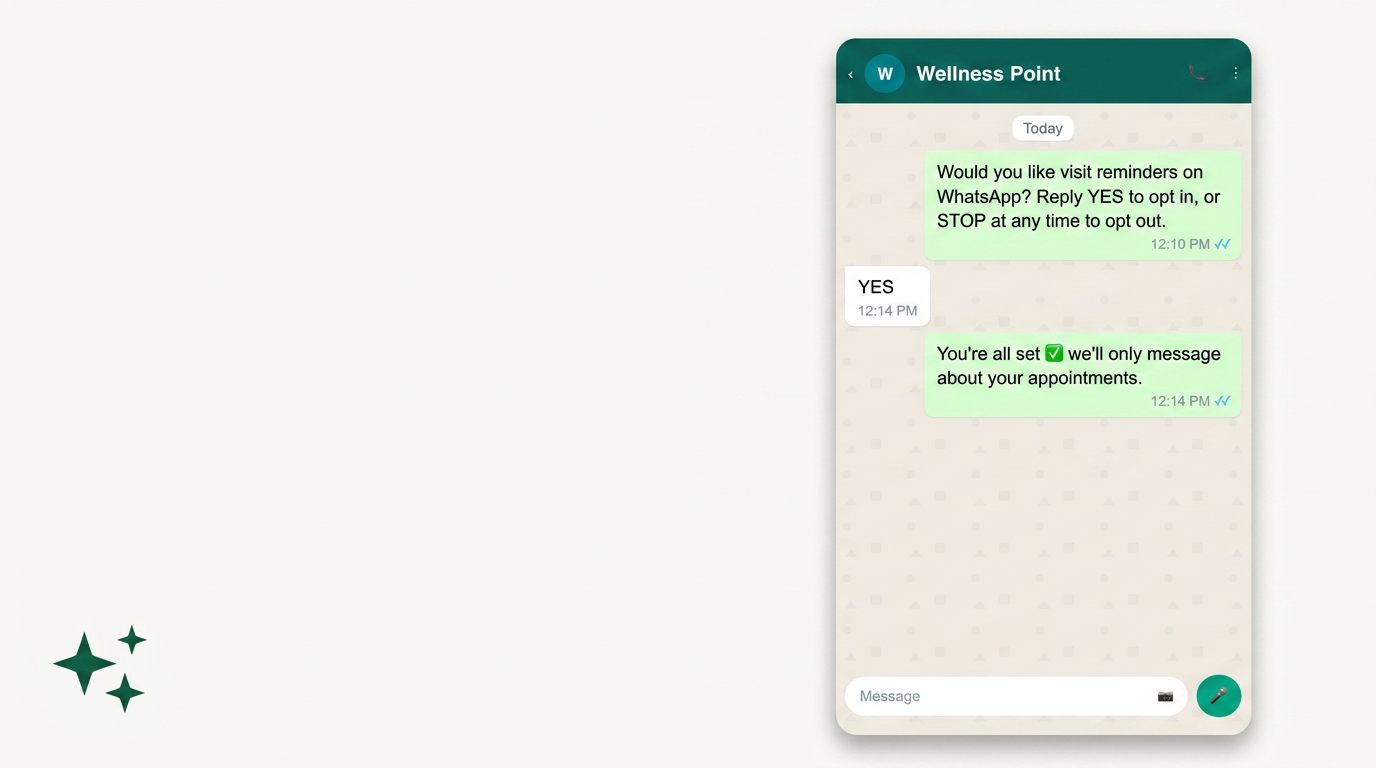
Meta requires prior opt-in for business-initiated template messages, and a class reminder is business-initiated. In the composite project, opt-in was documented at signup for some cohorts and undocumented for others. We excluded the undocumented cohort from the test entirely, re-collected consent inside existing service conversations, and only then folded those members in. A thin opt-in trail is your first project, not your A/B test.
The other pre-condition is quality rating. Two variants going out at volume across several locations is the kind of pattern that draws attention if members start blocking or reporting, so stage the rollout by location rather than switching everything on at once. We have covered what triggers an account review in detail elsewhere, and there is no need to repeat the mechanics here beyond one line: sudden volume changes combined with negative member feedback is the combination to avoid.
Reading the result
The challenger won on attendance. The incumbent won on replies, on warmth, and on which one the founders preferred when shown both.
The mechanism showed up in the timing of cancellations rather than in their total. Offering a one-tap release at the 24-hour mark converted silent no-shows into explicit early cancellations, while people were still awake and the booking system could push the freed slot to the waitlist. Peak classes refilled. The next-morning refund queue shrank because fewer members were being charged in the first place.
For scale, the published benchmark for this exact approach is a 25% reduction in no-shows from WhatsApp A/B testing at a fitness studio, and that is the order of improvement a well-designed variant pair can reach. Separately, and in a different channel, PitchPrfct's SMS guide for gyms puts automated reminder effects at roughly 20% to 40% for text messaging, and makes the point that matters most here: giving members an easy way to cancel in advance is what turns a no-show into an open slot someone else can take. Treat that as context from an adjacent channel, not as a WhatsApp result.
Two caveats you should expect to meet. Off-peak classes barely move, because a freed seat with no waitlist behind it is just an empty seat recorded differently. And the release variant increases recorded cancellations, which alarms operators until you separate cancelled-and-refilled from cancelled-and-empty. If your reporting only tracks total cancellations, a winning test will look like a failure.
What generalises beyond this studio
Test the job of the message, not the adjectives in it. Warm versus formal is a small-effect test. Reminder versus release, confirm versus modify, book-again versus reschedule: those produce different behaviour. Vagaro's gym marketing guide is right that you should A/B test content to improve conversion, but the size of your result is capped by how genuinely different your two variants are.
Write down the success metric before you open the dashboard. Attendance, not reads. Revenue, not replies. After the fact, every operator can find a number that crowns their favourite variant.
Check the plumbing can act on the result. A release button is worthless if the booking software cannot offer the freed slot to a waitlist within seconds. Confirm that capability exists before you write the variant that depends on it.
Retest when the season changes. A variant that wins in October is not guaranteed to win during Ramadan schedules or the summer exodus. Chatarmin's fitness analysis argues that WhatsApp's value for studios lies in spotting impending cancellations early and reaching out before the member is gone, and that early-warning behaviour shifts with the calendar.
The underlying capability is now commodity. AiSensy's fitness guide describes auto-confirmed class bookings and reminder sends before sessions as standard, and WhatzCRM's gym playbook notes that studios seeing results usually did not add more leads, they improved response speed and message quality. What is not commodity is a test design honest enough to tell you that your favourite message is the weaker one. Learnmind is an AI customer-communication consultancy in Dubai, and running that kind of comparison after the flows are live is most of what our fitness work looks like.
Common questions, answered
How long should a WhatsApp reminder A/B test run at a gym?
Run both variants for at least three to four full weeks so that one unusual week cannot swing the result. Coverage of your natural cycles, including holidays, coach changes and seasonal dips, matters more than raw message volume.
Do both WhatsApp template variants need Meta approval?
Yes. Meta's template messages documentation requires business-initiated templates to be approved, so the two variants are submitted as separate templates and both must be approved before the test begins. Editing a live template mid-test invalidates the comparison.
Does adding a one-tap cancel button increase cancellations?
It typically increases recorded cancellations while reducing actual no-shows, because silent absences become explicit early ones. That only helps if your booking system can offer the released slot to a waitlist quickly, so verify that before changing the message.
What opt-in do I need to send class reminders on WhatsApp?
You need documented prior opt-in from the member for business-initiated messages, tied to their profile and phone number. Where the consent record is incomplete, re-collect it inside an existing conversation before including those members in a reminder programme or a test.
If your classes fill reliably and your no-show rate is one you can live with, a testing project is an expensive way to confirm that, and you do not need us. If your rosters look full while your rooms look half empty, and you cannot say which of your messages is responsible, send us the two templates you are torn between and we will tell you whether they are different enough to be worth testing.