Updated 27 September 2026: Meta has published the service rates and added a free tier of 1,000 service messages per business phone number per month. The figures below now use both.
Since 1 August 2026 Meta has been charging for messages sent by its own Business Agent, priced per token rather than per message. On 1 October 2026 the bigger change lands: service messages become billable after the first 1,000 a month on each business phone number, and utility templates sent inside an open customer service window lose their exemption too. Meta's own documentation lists both dates together as a single pricing programme, which is why any discussion of WhatsApp Business API pricing October 2026 that treats them separately is understating the bill.
The honest answer to what it costs: a business sending 1,000 free-text replies a month from one number still pays nothing for them, because Meta added a free tier of 1,000 service messages per number per month. At 3,000 replies it pays for 2,000: about 91 euros a month on the German list, where Meta's rate card effective 1 October 2026 prices a service message at 0.0456 euros, the same as utility. Everything else in this piece is arithmetic you can redo with your own volumes.
The range: before and after 1 October 2026
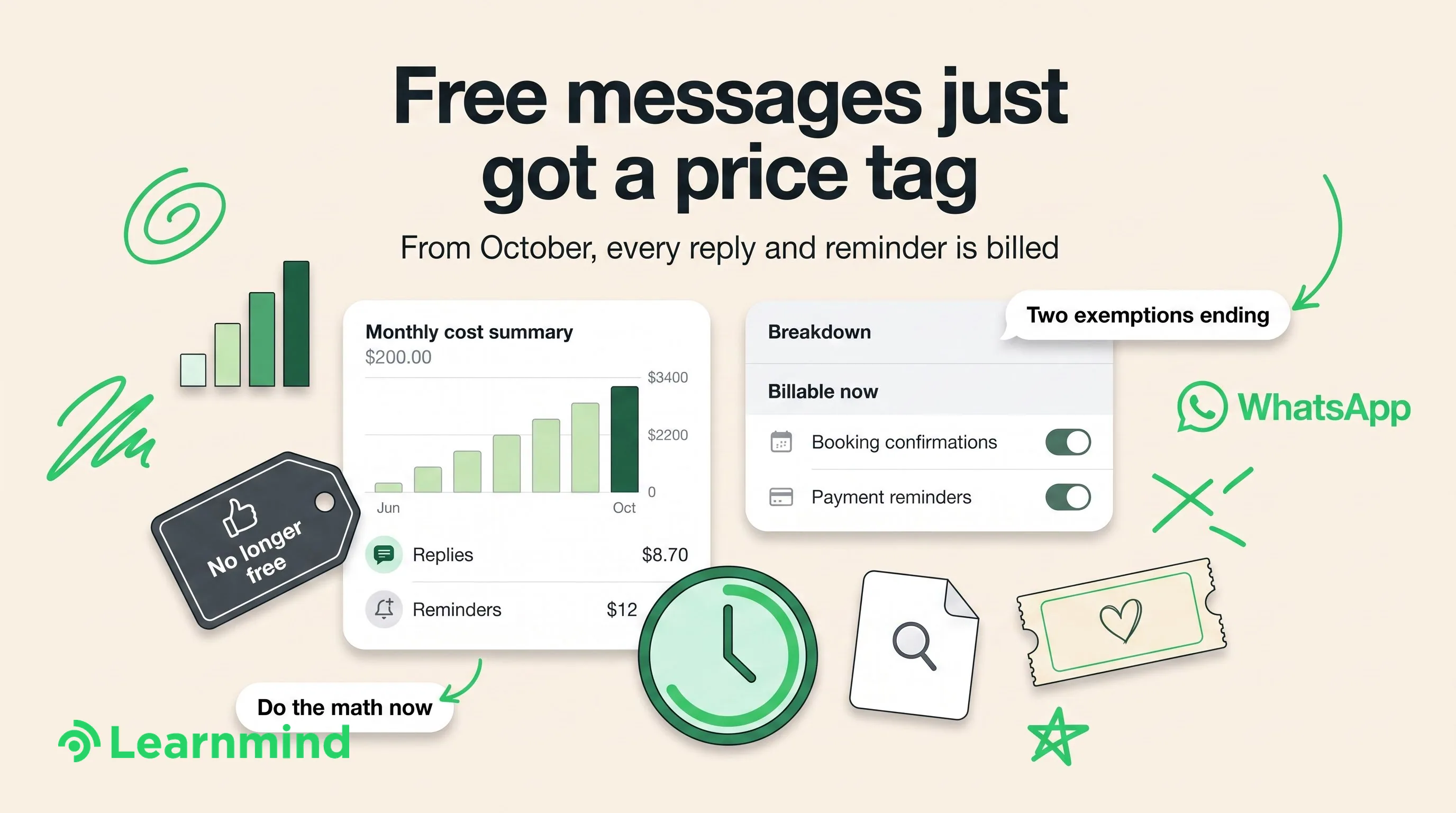
Two exemptions are ending. Free-form, non-template messages, the ones your receptionist types back, have not been charged since 1 November 2024, per Meta's pricing documentation. Utility templates sent in reply to a customer inside an open service window, an order or booking confirmation for example, have been free since 1 July 2025.
Both go. Meta's documentation states that pricing updates for Business Agent, service and utility messages launch on 1 August 2026 and 1 October 2026, and one industry pricing analysis reads that as Meta charging for every service message individually, as it already does for template messages. Documentation on Twilio's help site notes that a separate fee applies depending on how the business uses the API.
So the range for a typical clinic or salon: today, your WhatsApp cost is your marketing and utility template sends, and nothing else. From October, it is those plus every outbound reply your team or your automation writes beyond the first 1,000 a month on each number. If your inbound conversation volume is high and your template volume is low, your bill could more than double. If you mostly blast reminders and rarely converse, the change is marginal.
Price drivers, one by one
Marketing templates
The most expensive category and the only one with real volume discounting in most markets. On Meta's German EUR list, marketing sits at 0.1131 euros per delivered message. This is your reactivation campaign, your promotion, your "we have openings Thursday" push.
Utility templates
0.0456 euros in Germany. Appointment reminders, confirmations, post-treatment follow-ups tied to a specific transaction. From October, the in-window exemption no longer shelters them, so a confirmation sent thirty seconds after a customer writes to you is billed exactly like one sent cold.
Authentication templates
Also 0.0456 euros in Germany. Rarely material for a clinic or salon unless you run login codes.
Service messages
0.0456 euros in Germany from 1 October 2026, the same as utility, on the rate card Meta published on 1 September 2026. Each business phone number gets its first 1,000 service messages a month free, with no roll-over. After that there are no volume discounts: every reply costs the same.
Meta Business Agent messages
Separate mechanism entirely. Since 1 August 2026, messages from Meta's own AI agent platform are charged per token at 2.00 US dollars per million tokens, with Meta putting a message at 20,000 to 25,000 tokens, so roughly 4 to 5 US cents each. If your AI layer runs outside Meta's agent platform, this line does not apply to you; the service-message charge still does.
The five-message conversation, priced three ways
The most common budgeting mistake treats WhatsApp costs as flat and counts by conversation. That habit is a leftover. The switch from conversation-based to message-based billing happened on 1 July 2025, and conversation billing has been deprecated since. Budgeting by conversation in 2026 will underestimate October by a factor of five in the worst case.
Take one realistic exchange: a marketing template goes out, the customer replies, your AI answers twice, a member of staff answers once, and you close with an order confirmation.
| Billing regime | Chargeable messages | What is free |
|---|---|---|
| July 2026 | 1 | AI replies, staff reply, in-window utility confirmation |
| From 1 August 2026 | 3 | Staff reply, in-window utility confirmation |
| From 1 October 2026 | 5 | The service reply, while the number is under 1,000 that month |
One marketing template, two Business Agent messages, one service message, one utility template. Same conversation, five line items. That progression, one to three to five, is the single number to carry into your budget.
Building your own first-year figure
Do this with your own volumes. Using the German list (service at 0.0456 euros, the first 1,000 a month free on one number), a clinic sending 800 utility reminders, 400 marketing sends and 1,200 human or non-Meta AI replies a month:
- Marketing: 400 × 0.1131 = 45.24 euros
- Utility: 800 × 0.0456 = 36.48 euros
- Service, before October: 0 euros. From October: 200 × 0.0456 = about 9 euros, because the first 1,000 replies are free
That is roughly 82 euros a month in the third quarter and roughly 91 euros from the fourth. The free tier absorbs most of the change at this volume; the rise grows quickly once replies pass 1,000 a month. If any of those replies come from Meta's Business Agent, add 4 to 5 US cents each on top of the service charge, and note those are dollars, so your FX exposure is split across two currencies.
The costs vendors leave out of that sum: your BSP's own per-message markup or platform fee, which is not Meta's price and is not on Meta's list; the number verification and business verification work; the template rewriting you will do when categories get reclassified; and the staff time spent on conversations that now carry a marginal cost per turn. None of those has a published figure because each is vendor and market specific. Ask for them in writing before you sign.
One structural comfort: Meta may only change pricing on the first day of a quarter, up to four times a year, on 1 January, 1 April, 1 July or 1 October. So once October's rates are published, your unit costs are stable until 1 January 2027 at the earliest. That makes a four-quarter forecast genuinely possible rather than theatre.
Two tiers, priced against the German list
A single-site salon sending 150 reminders and having 200 reply exchanges a month is looking at under 7 euros of utility today and no service charge from October, because 200 replies sit inside the 1,000 free. The change is real but not a business decision.
A four-site aesthetic clinic running 3,000 reminders, 2,000 marketing sends and 6,000 replies is in different territory: about 137 euros of utility, about 226 euros of marketing, and roughly 228 euros of new service charge from October if all four sites share one number (5,000 billable replies after the free 1,000), or about 91 euros with a number per site. Marketing volume attracts discounts in many markets; the service line does not, which is precisely why the multi-site operator feels this change hardest. Volume protects you on the expensive category and abandons you on the new one.
The number Meta has now published
Service rates were the open variable. Meta published them on 1 September 2026: in every market a service message costs the same as a utility message, 0.0456 euros in Germany and AED 0.0576 in the UAE. It then added the free tier of 1,000 service messages per business phone number per month, which changes the arithmetic for small senders more than the rate does.
What to do with that: count your monthly replies per number. Below 1,000 they cost nothing; above it, each one is billed at the utility rate with no volume discount. For most service businesses that does not change strategy, it changes how carefully you write.
Holding your message count down before October
The lever is no longer negotiating rates. It is message count, and there are legitimate ways to reduce it that do not weaken the customer experience.
- ✅ Consolidate. Two service replies where one would do is now two charges. Train staff to answer completely in a single message rather than in the three-line drip that feels conversational.
- ✅ Use free entry point windows properly. Meta's documentation states that all messages, including template messages, are free for 72 hours inside an open free entry point window. That window is created by specific ad and page entry points, so route campaigns through those entry points rather than to a bare number.
- ✅ Audit template categories now. A reminder miscategorised as marketing costs 0.1131 euros instead of 0.0456 euros in Germany, roughly two and a half times. On 3,000 monthly reminders that single misclassification is about 200 euros a month.
Two moves carry real downside.
- ❌ Resending failed templates in bulk to force delivery. Aggressive sending patterns are a known trigger for account review, and a restricted number costs far more than a month of service messages. Our note on what triggers an account review covers the patterns that get flagged.
- ⚠️ Pushing conversations off WhatsApp mid-thread to a free channel. It genuinely cuts message count, and the risk is commercial rather than legal or platform-policy: reply rates fall on channels the customer did not choose. It suits operators whose margins are thin and whose customers already use email.
Decide deliberately whether your AI layer sits inside Meta's Business Agent or outside it. Inside, you pay per token on top of the service charge. Outside, you pay the service charge only. The trade-off is capability against per-message cost, and it is worth pricing both.
Everything above is operator practice, not Meta policy, with the single exception of the free entry point window, which is documented. If a vendor tells you they have a way around per-message service charges, ask which line of Meta's pricing documentation says so.
If you want a view on your own template mix before Meta publishes the service rates, our team is happy to look at it with you.
Questions operators still ask about October pricing
Will my current vendor quote change on 1 October?
Almost certainly, because most vendors pass Meta's per-message cost through at cost or with a markup. Ask now, in writing, whether their platform fee is fixed and how the new service charge appears on your invoice. Meta can only move unit prices on a quarter boundary, so a vendor who cannot commit to stable pricing between 1 October 2026 and 1 January 2027 is adding uncertainty that Meta is not.
Does an AI receptionist now cost more per conversation than a human one?
Not inherently. A human reply and a non-Meta AI reply are both service messages at the same rate. The cost difference appears only if your AI runs on Meta's Business Agent, where token charges stack on top. The real economics still turn on how many conversations each option handles per hour, which is the same calculation as in our piece on platform cost drivers.
Are reminders still worth sending at these prices?
For appointment-based businesses, yes, and the arithmetic is not close. At 0.0456 euros a reminder on the German list, a thousand reminders cost about 46 euros. One recovered no-show at a clinic or salon ticket price covers that several times over. The category that deserves fresh scrutiny is marketing, at two and a half times the utility rate with no in-window relief left.
Related reading
- The WhatsApp Business Platform Reference: What's Allowed, What Costs Money, and What Actually Ships
- WhatsApp Business API Webhooks: Events That Matter
- The No-Show Maths: What a Voice Note Reminder Saves
Sources
Related reading: What It Costs to Stop Gym Members Quietly Quitting