The fork usually arrives in the same shape. A clinic or agency has run an AI agent on WhatsApp for a few months, the volume numbers look good, and now someone on the team wants to either hire another receptionist or push more conversation types into the bot. That is the decision on the table: pay for another pair of hands, or trust the agent with harder work. Both options are wrong until you have answered a smaller question first, which is when the agent is supposed to stop talking and give the conversation to a person.
Almost nobody has answered it properly. The escalation logic in most deployments we inherit is one rule: if the customer types "human", transfer. Everything else runs until it falls over. That is a tripwire wearing the name of a handoff design.
What an escalation rule actually is, and what it has to contain
AI human handoff escalation rules are the explicit conditions under which an AI agent stops handling a conversation and transfers it to a named human, along with the context package that human receives at the moment of transfer. A complete rule has three parts: the trigger (what condition fires), the destination (which person or queue, and what happens if they are unavailable), and the payload (transcript, customer record, and a written summary of what the AI already attempted). A rule missing any of those three parts will produce a transfer, but not a resolution.
That third part is where the money leaks. Cresta's guidance on handoff design makes the point that the handoff receives far less investment than the AI interaction itself, even though it decides resolution rates and handle time on the highest-value conversations in your queue. Voiceflow calls the failure mode the handoff cliff: the human picks up with nothing, the customer repeats themselves, and repetition turns a recoverable issue into a lost one.
Think of it the way a tailor thinks about a garment coming back for alterations. The customer does not want to re-explain that the sleeve pulls at the shoulder; the chalk marks and the original pattern should already be on the table when they walk in. A handoff without context is a fitting room with no chalk marks.
The same enquiry, run twice
Take one workflow we see constantly, sketched here as an illustration rather than a specific client file: a patient messaging a dental clinic on WhatsApp late in the evening about a crown that came loose two days after fitting, asking whether the repair is covered under the clinic's warranty policy. Watch it run manually, then watch it run with escalation rules in place.
How it runs today, by hand
The message lands on the shared clinic number after closing. Nobody is watching it. The next morning the front desk coordinator opens the inbox to a stack of unread threads, reaches this one, does not know the warranty answer, and scrolls back through the conversation to work out whether the patient has already been told something. She screenshots the thread and posts it to an internal staff group. The practice manager is in a treatment room, and answers an hour or two later with a question of her own: which dentist did the fitting? The coordinator scrolls back again to find it. The eventual answer is that coverage depends on whether the loosening came from cement failure or patient behaviour, so the dentist has to look. By early afternoon the coordinator asks the patient to come in for an assessment. The patient, who has already messaged a second clinic, does not reply.
Three people touched it, several internal messages moved between them, and the patient's story was retold twice by people who were not there when it was first told.
How it runs with rules configured
The message arrives at the same hour. The AI agent identifies the intent as a post-treatment complication carrying a warranty question. That intent sits on the escalation list, because it combines a clinical judgement with a money question, and the agent is not permitted to improvise policy. Before transferring, the agent does three things: confirms the patient's identity against the record, asks two qualifying questions (when was the crown fitted, is there pain), and tells the patient a named person will respond when the clinic opens.
The conversation lands in the practice manager's queue overnight, tagged clinical-warranty, with a four-line summary at the top: patient name, procedure date, treating dentist pulled from the record, symptoms reported, and a note that the agent did not answer the coverage question by design. Minutes after opening, the practice manager reads the summary rather than the transcript, and forwards it to the treating dentist with one line. Before the morning list starts, the patient has an appointment slot and an answer about what the assessment will cost if the loosening turns out not to be covered.
The delta is not that AI answered the hard question, because it did not and should not have. The delta is that the routing, the identification, the qualifying questions and the context package all happened while everyone was asleep, and no one re-read a thread to reconstruct it.
Choosing which triggers you actually need
Escalation triggers fall into four families, and the mistake we see most is teams building all four on day one and tuning none of them.
Explicit requests. The customer asks for a person. Intercom lists this first among its handoff conditions, alongside policy exceptions requiring approval and legal, compliance or billing disputes above a threshold. Build this one first. It costs an hour and it prevents the single worst customer experience, which is a person asking for help and being handed another menu.
Structural failures. The conversation goes off-script, loops, or the agent has produced fallback responses several times in a row. Replicant's escalation guidance treats these as signs the AI has reached its designed limits, and includes backend failures, slow API responses and failed integrations in the same family. If your booking system is down, the agent should not keep offering to book.
Emotional signals. Retell AI's approach monitors tone and sentiment to detect customer frustration and trigger a handoff before the situation needs de-escalating. This one is worth having and worth distrusting. Sentiment detection in mixed English and Arabic, with the abbreviations people actually type on WhatsApp, is less reliable than vendors imply. Set the threshold conservatively and review what it catches for the first month.
Business-value rules. High-value or VIP customers flagged for white-glove handling, or any conversation where the transaction size justifies a person regardless of complexity. A property enquiry above a certain price band goes to a named agent, full stop.
Why uniform escalation is the expensive mistake
Bluetweak's analysis of support escalation puts it well: handoff during complex questions should be intentionally designed, not uniform. A frustrated customer, a billing dispute and a VIP enquiry are three different problems that need three different destinations and three different urgency levels. Routing all of them to the same human queue is like sending every garment to the same alterations bench regardless of whether it needs a hem, a re-cut, or a full re-line.
This is also where the routing rules for shared numbers matter, because a handoff into an inbox where four people can see it and nobody owns it is barely better than no handoff at all.
Building the context package the human receives
Decide what travels before you decide what triggers. Voiceflow's specification is the right minimum: full transcript, customer record, and a short AI-written summary of what was tried before the human picks up. In practice we add two fields that make a visible difference to handle time.
- What the agent deliberately did not answer. If the rule fired because policy improvisation was off-limits, say so in the summary. Otherwise the human assumes the AI failed and re-treads ground.
- The qualifying answers already collected. Fitting date, order number, unit number, symptom description. Whatever the human would have asked first should already be in the payload.
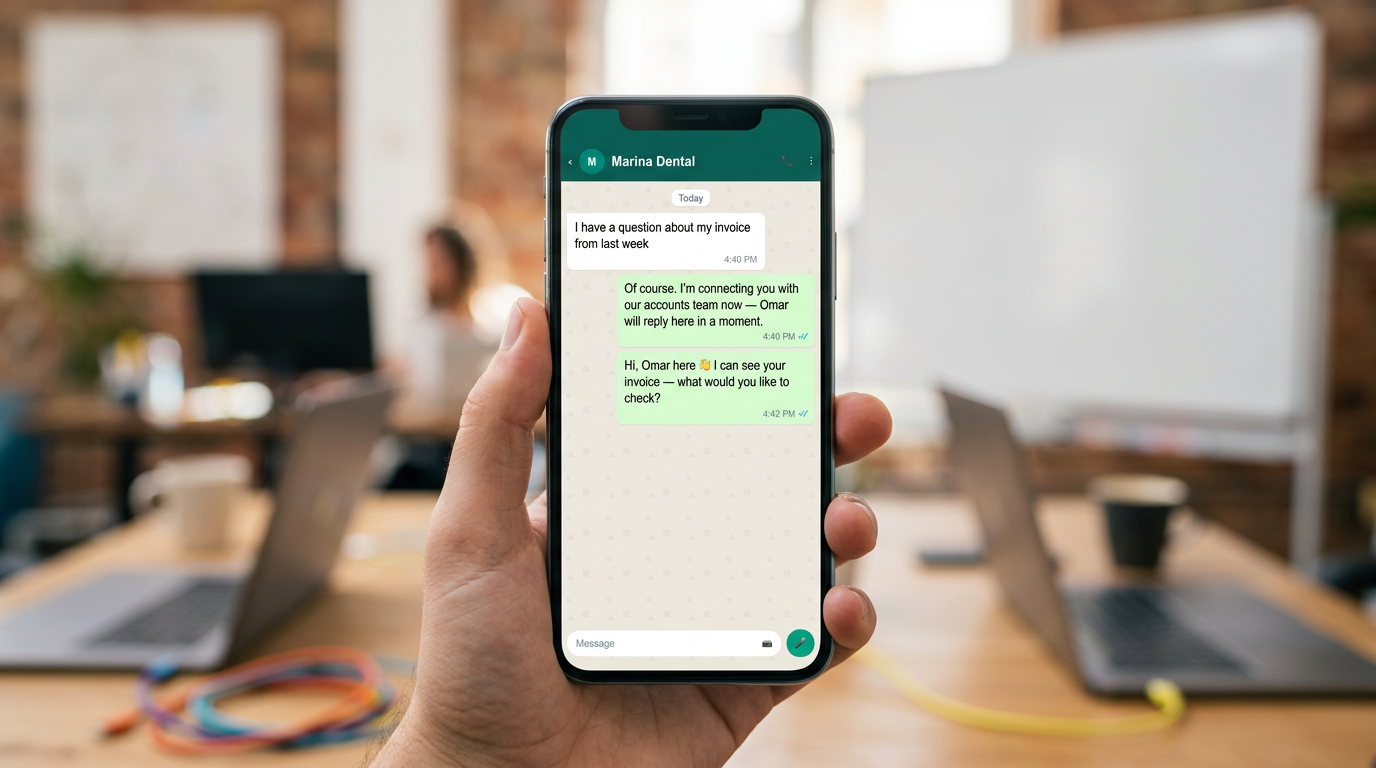
There is a choice to make between cold and warm transfers. Cresta draws the distinction cleanly: in a cold transfer the receiving agent picks up directly with the customer, in a warm transfer the handoff includes a briefing step. For asynchronous WhatsApp, the warm version is nearly free, because the summary can be written and attached in the seconds before the human ever opens the thread. Use it.
Wiring the triggers in phases, not all at once
Learnmind installs escalation rules in three passes, over weeks, and we have never regretted the pace. Staff adoption is the constraint here, not the configuration work. A team that gets ten bad escalations on the first morning will start ignoring the tag by Thursday, and once a queue is ignored it stays ignored.
First pass: explicit requests and structural failures only. These are unambiguous and they build trust with the team, because every escalation they receive is obviously legitimate. Second pass: business-value rules, once you have watched which conversations actually carry revenue rather than which ones you assumed did. Third pass: sentiment, with a high threshold, reviewed weekly.
Inquirly's description of the handoff sequence is worth holding onto while you configure: receive, identify, check knowledge, and only then act, with the explicit constraint that the AI should not improvise policy. Most of what looks like an escalation problem is really an unclear policy boundary. If your own team cannot say in one sentence whether a case is covered, the AI certainly cannot.
The build-versus-buy line
Escalation logic is almost never your competitive advantage. Buy the platform, configure the rules, spend your team's hours on the thing customers actually pay you for. The exception is narrow: if your routing logic encodes something genuinely proprietary, a triage protocol you developed, a qualification sequence that outperforms the market, then custom is justified because the workflow itself is the product. Everything else should be bought and altered to fit, the way you would take a well-cut jacket to a tailor rather than commissioning one from raw cloth.
Feeding resolutions back into the agent
An escalation rule that never fires less often is a permanent cost. Alhena's framing is the one we use with clients: when a human resolves something the AI could not, that resolution becomes training data for the knowledge base, and recurring escalation patterns tell you exactly what to build next. Review the escalation log monthly, group by trigger, and pick the top two repeat causes. Usually one of them is a policy question with a stable answer that nobody had written down.
Learnmind, a Dubai firm that wires AI into the front desks of service businesses, spends more client time on this review loop than on the initial build, because the first configuration is a guess dressed up as a rule and the log is what turns it into knowledge. Our broader thinking on where judgment belongs to people sits underneath all of this: escalation design is the operational expression of that boundary.
Confirming the rules are working
Four checks, run at the end of the first month, tell you whether you built a handoff or a tripwire.
- Sample ten escalated threads and read the first human message. If the human's opening line asks for information the customer already gave the AI, your payload is incomplete.
- Count escalations that ended without a reply from the business. Any number above zero means your destination logic has no fallback for unavailable staff.
- Measure time from trigger to first human message, not to resolution. Resolution time hides queue problems; first-response time exposes them.
- Ask the team which trigger annoys them most. Whichever one they name is either mis-thresholded or pointing at a policy gap, and both are fixable.
Run those checks and the original fork resolves itself. You will know whether the next hire is a receptionist or a specialist, because the escalation log tells you what kind of work is actually reaching people. Getting there without losing the tone customers expect is a separate discipline, one we have written about in the context of automation that keeps the human touch.
Questions we hear about this
How do I stop my AI agent from escalating everything?
Raise the specificity of your triggers rather than lowering their sensitivity. Over-escalation nearly always comes from a single vague rule (usually sentiment or a generic fallback counter) firing on conversations the agent could have finished, so review the log by trigger type and tighten the one responsible.
Should the customer be told they are being transferred to a human?
Yes, and the message should name what happens next, including when the person will respond if the transfer happens outside working hours. Silence after a transfer is read as being ignored, which produces the follow-up messages and repeat calls the handoff was meant to prevent.
What is the difference between a cold and a warm AI-to-human handoff?
In a cold transfer the human agent picks up directly with the customer and works from whatever they can see; in a warm transfer the handoff includes a briefing, typically an AI-written summary of the conversation and what was already attempted. On asynchronous channels like WhatsApp, warm transfers cost almost nothing to implement and should be the default.
How many escalation triggers should a small business start with?
Start with two: explicit customer requests for a person, and structural failures such as repeated fallback responses or a backend system being unavailable. Add business-value and sentiment triggers only after your team has been reliably answering the first two for several weeks.
If your AI agent handles a handful of conversations a week and one person reads every thread anyway, do not hire Learnmind for escalation design; you will get further by writing your policies down. If you are routing WhatsApp volume across a team and the handoffs are where patients and deals go quiet, send us a few of those threads and we will tell you which triggers are missing.