Telling customers your chatbot is AI does not lose you bookings. That position still gets argued with in almost every discovery call we run, usually by a marketing lead who is convinced that the moment a customer sees the word "assistant" they will bounce to a competitor with a human on the other end.
We have watched the opposite happen. A clinic front desk that opens with a plain line saying an AI assistant handles first contact and a human joins for anything clinical gets fewer angry messages, not more. The reason is unglamorous: customers who know what they are talking to ask better questions. They stop testing the bot with small talk and start typing what they actually want, which is a Tuesday appointment or a price for a filling. The businesses that hide the AI end up paying for the deception twice, once when the customer works it out anyway (they always do, usually within four messages) and again when that customer tells the story to someone else.
And the regulatory ground moved underneath the hiders. Below are the nine questions we get asked, in the order they usually get asked, with the honest answer first.
Do I actually have to tell customers my chatbot is AI?
Yes, in a growing number of jurisdictions, and you should everywhere else regardless. AI chatbot disclosure requirements now come from three directions at once: the EU AI Act, whose Article 50 transparency rules have applied since 2 August 2026 and require that people are told clearly and at the start of an interaction that they are dealing with an AI system; a patchwork of US state laws in California, Colorado, Maine, New Jersey, Texas and Utah; and general consumer-protection doctrine, under which the FTC treats non-disclosure as potentially deceptive even where no chatbot-specific statute applies. If you serve customers in any of those markets, the safe operating assumption is that disclosure is mandatory, not a design preference.
The Bratby Law comparison of Article 50 sets it out cleanly: EU providers must design interactive AI systems so that people know they are dealing with AI. There is no reading of that which permits a bot that plays coy when asked directly.
I'm a UK business. Does the EU rule reach me?
It reaches you the moment your chatbot talks to a customer in the EU. The UK has no single equivalent duty; as Bratby Law notes, UK GDPR Articles 13 and 14 transparency obligations apply where personal data is processed, which is a different and narrower hook. But the AI Act attaches to the market you serve, not the address on your registration. Lola Squared's read on whether the rules reach UK firms lands in the same place: from 2 August 2026 people must be told when they are interacting with an AI such as a chatbot, deepfake content must be disclosed, and AI-generated text published to inform the public on matters of public interest must be marked, with limited exceptions.
For a UK clinic, salon or agency taking enquiries through WhatsApp or a website widget, the practical answer is that building two versions of your bot (one that discloses for EU visitors, one that does not for everyone else) costs more in engineering and QA than just disclosing once, universally. We have never advised a client to build the two-tier version. Nobody has ever asked us to twice.
What are the actual penalties if I don't disclose?
Under the EU AI Act, non-compliance with the transparency obligations can reach up to €15 million or 3% of global turnover, whichever framework the regulator applies. That is the headline number and it is the one that gets a board's attention, though it is not the number most small service businesses will ever face.
The more likely exposure is closer to home. The NYU Compliance and Enforcement analysis flags something specific about Maine's law that operators consistently underestimate: any person using a bot to engage in trade or commerce must make a clear and conspicuous disclosure that the consumer is not engaging with a human where the bot may mislead, and plaintiffs are not required to prove that any consumer was actually misled or suffered injury. Read that twice. The theory of harm does not require a harmed customer. It requires a bot and a missing sentence.
Does this apply to my appointment-booking bot, or only to the creepy companion apps?
It depends on the statute, and the safest planning assumption is that it applies to yours. Some US laws are narrowly aimed at companion bots; SiteGPT's chatbot compliance guide notes that California's SB 243 targets companion bots and excludes customer service bots, while the EU AI Act makes disclosure mandatory for anyone serving EU customers. So a booking assistant sits outside one law and squarely inside another.
There is also a definitional trap. A "customer service bot" that recommends treatments, quotes prices, or nudges someone toward a package is not doing pure customer service in the eyes of a regulator looking at consumer protection. If your bot influences a purchase decision, treat it as in scope. The AGG review of chatbot legal risks describes an emerging body of state law requiring AI chatbots to put the user on notice that they are not communicating with a human, with California, Colorado, Maine, New Jersey, Texas and Utah each imposing their own variation on timing and wording.
Where exactly does the disclosure have to appear?
At the start of the session, and again any time a user asks whether they are speaking to a human. That is the convergence point across the state laws, and StackCyber's summary of common requirements is blunt about the second half: the disclosure must be conspicuous, not buried in terms of service or a surfaced privacy policy. A link in your website footer is not a disclosure. A line in the message the customer actually reads is.
Air traffic control has a rule that sounds pedantic until you understand why it exists: the controller reads back the clearance, and the pilot reads it back again. The information is not considered transferred until it has been confirmed on the channel where the decision gets made. Disclosure works the same way. Putting "we use AI" on a policy page and putting it in the first WhatsApp message are not equivalent acts, because only one of them happens on the channel where the customer is making a decision.
In practice, three placements cover almost every service business we work with:
- First message of every new conversation, before any question is asked of the customer.
- On direct challenge, whenever someone types any variant of "is this a real person". The bot answers yes-or-no in one sentence, no deflection, no joke.
- At handoff points, so the customer knows when a human has actually joined the thread and when the AI has taken it back.
That third one gets skipped constantly and it is the one customers care most about. If a human replies at 4pm and the AI replies at 4:40pm in the same voice, you have created a small deception even though your opening line was compliant.
What should the disclosure line actually say?
Short, plain, and in the same register as the rest of your brand. We write these for clients every week and the pattern that survives contact with real customers is one sentence of identity plus one sentence of capability plus a route to a human.
Here is the shape, adapted for a dental clinic:
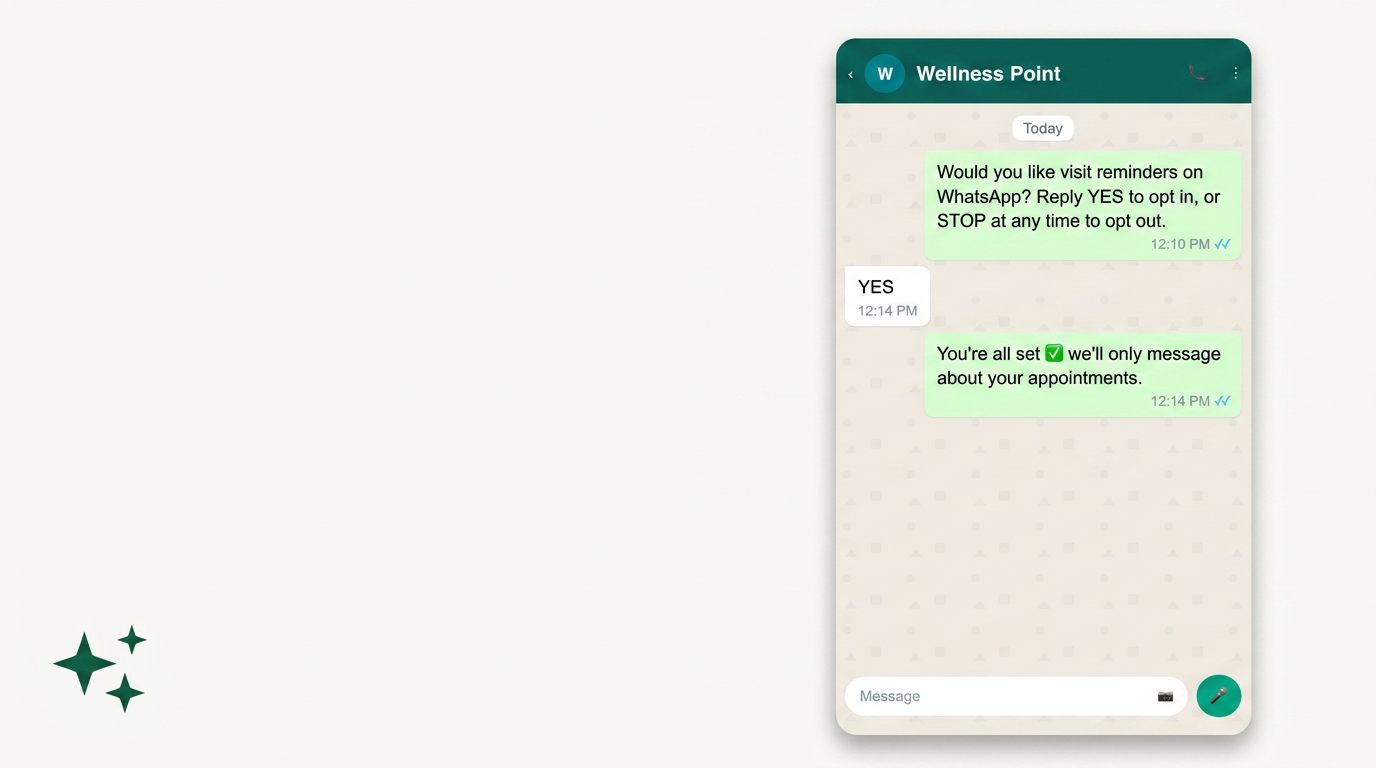
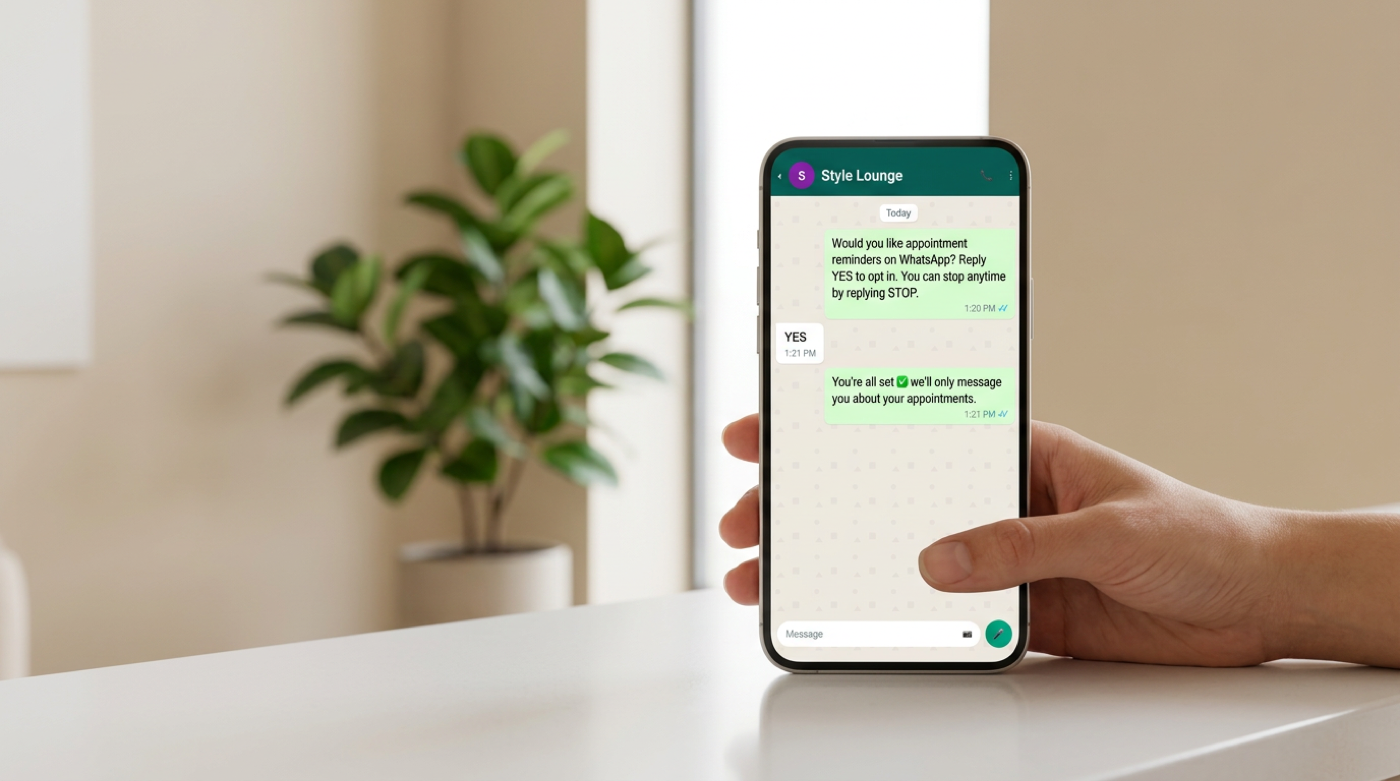
Hi, you're chatting with our AI assistant. I can book, reschedule, and answer questions about treatments and pricing. Reply HUMAN at any point and one of our coordinators will pick this up.
What that line deliberately avoids is a name, a personality, and a wink. This is where we part company with a lot of the market. Business chatbots should be professional-warm, not quirky-cute, because the people messaging a clinic or a legal practice are often anxious, sometimes in pain, occasionally frightened about money. A bot that introduces itself with an emoji and a pun reads as a company that has not understood the moment its customer is in. Warmth comes from being fast, clear and useful, not from jokes.
The other thing the line does is set expectations about scope. Telling someone what the assistant can do prevents the most common failure we see in first-week logs, which is customers asking the bot for things it was never built for and concluding the whole system is broken.
Won't disclosing hurt conversion?
No, and here is the ledger that changed our mind on it years ago. When operators push back on disclosure, they are comparing a hypothetical loss against a cost they have never counted. So count it.
What non-disclosure actually costs, line by line
We do not have a clean industry figure for conversion loss on disclosed versus undisclosed bots, and we are not going to invent one. What we can account for is what we see in the message logs and the rota, and it falls into four buckets.
Staff hours spent on unwinding confusion. Every customer who believes they have been messaging a person and then discovers otherwise generates a conversation that a human has to handle personally, usually apologetically, usually longer than the original enquiry. In the clinics we work with, these are the threads that get escalated to a manager rather than a coordinator. One a day is not a crisis. One a day compounding across a quarter is a manager's week.
Repeat questions the bot could have prevented. An undisclosed bot cannot say "I can't help with that, let me get a human," because that admission is itself a disclosure. So it improvises. Improvised answers about clinical suitability or contract terms are the ones that come back as complaints, and complaints are handled by your most expensive staff.
Lost bookings from abandoned threads. Customers who suspect they are being handled by a machine that will not admit it stop typing. They do not complain. They do not convert. They simply go quiet, and that silence never shows up in any report because there is no event to log. This is the single largest cost in the ledger and the only one that is completely invisible on a dashboard.
Regulatory and legal exposure. Up to €15 million or 3% of global turnover under the EU AI Act at the extreme end, and at the far more likely end, a Maine-style claim that does not require any consumer to have been harmed. Plus the legal fees of finding out which applies to you after the fact rather than before.
Against that, the cost of compliance is one sentence at the top of a conversation. We have never had a client come back and report that the disclosure line was what killed a funnel. We have had plenty come back to say the AI was answering questions it should have escalated, which is a design problem, not a transparency problem.
My team is nervous about this. How do I handle that?
Tell them the disclosure protects them, because it does, and then show them how. The fear underneath "customers will hate this" is usually "customers will think we replaced people with a robot and blame us." A disclosure line that names the human route does the opposite: it advertises that humans are still there and reachable.
Change management is most of implementation success and it gets a fraction of the budget, every time. Staff who understand why the AI helps them will train each other without being asked, forwarding tricky threads and suggesting new intents. Staff who fear it will quietly route around the system, answering from their personal phones, and no amount of clever engineering survives that. We have seen well-built deployments die in month three for exactly this reason, and we have seen mediocre ones thrive because the front desk decided to own them.
The practical move: give the team the escalation keyword before you give it to customers, and let them use it on the live system for a week. Once a coordinator has personally watched the bot hand a thread over cleanly, the anxiety usually stops on its own. This is the same reason crews run simulator hours on the failure case rather than the happy path; confidence comes from having seen the handover work, not from being told it will.
How do I build disclosure into a system I've already launched?
Start with the greeting template and the escalation intent, because those two changes cover the majority of your exposure and neither requires re-architecting anything. On WhatsApp, that means editing the opening template message and adding an explicit "am I talking to a human" intent that returns a fixed, non-negotiable answer. In a booking flow, it means the disclosure appears before the form opens rather than after the customer has entered their details, which is a sequencing detail people miss when they build WhatsApp booking flows and bolt the compliance copy on at the end.
Then audit three things:
- Every entry point into the conversation, including QR codes, ad click-to-message buttons, missed-call triggers and website widgets. Bots usually have more front doors than their owners remember, and only one of them tends to carry the greeting.
- Every point where a human takes over or hands back, so the transition is announced in both directions.
- Every automated outbound message, including reminders and follow-ups. If a reminder invites a reply that the AI will handle, the customer needs to know that before they reply.
Learnmind, a Dubai firm that wires AI into the front desks of service businesses, does this audit as a standing part of every deployment now, and we retrofit it for systems other people built. It typically surfaces two or three unguarded entry points that nobody on the client side knew existed.
One honest limit: disclosure fixes the transparency question and nothing else. If your bot is giving unreliable answers about pricing or eligibility, saying "I'm an AI" first does not make those answers safe. That is a separate piece of work, and it usually belongs with whoever owns the revenue cycle, not the chatbot vendor.
Is this going to keep changing?
Yes, and the direction of travel is toward more disclosure, not less. Eversheds Sutherland's global AI regulatory bulletin tracks a voluntary draft Code of Practice on AI content transparency alongside a UK national AI strategy that came with guidance on AI chatbots and online safety, plus movement across the Middle East as governments shift from principles to implementation and clearer expectations on AI risk management. Nothing in that trend line suggests a future where you will be asked to disclose less.
Which is the argument for building the disclosure layer as a permanent piece of the system rather than a patch. The businesses that treat it as configuration (a greeting template, an escalation intent, a handoff announcement, all editable in one place) will absorb the next rule change in an afternoon. The businesses that hard-coded compliance copy into forty separate flows will spend a week on it, the same way they spend a week on everything, which is a pattern we wrote about in the context of peak season operations.
Questions we hear about this
Does an AI voice receptionist need to disclose too?
Yes. LinkedIn commentary from Nick Parkinson on UK obligations under the AI Act notes that any chatbot, voicebot or conversational AI system talking to EU customers must disclose clearly and at the start of the interaction that it is an AI. Voice gets no exemption, and on a phone call the disclosure has to come in the first few seconds, before the caller starts explaining their problem.
Can I give my AI assistant a human first name?
You can, provided the disclosure is unambiguous and comes first. We advise against it anyway, because a human name pulls in the direction of the confusion you just spent a sentence preventing, and because a name invites the playful persona that undermines credibility with anxious customers.
Is a notice in my privacy policy enough?
No. StackCyber's summary of state chatbot laws is explicit that the disclosure must be conspicuous and not buried in terms of service, which rules out policy-page-only compliance in the states that have legislated.
What if the customer never asks whether it's a bot?
It makes no difference to your obligation. Where laws require disclosure at the outset of a session, the duty triggers when the conversation starts, not when the customer becomes suspicious, and under Maine's provision a claim does not require proof that anyone was actually misled.
Do these rules apply to internal AI tools used by staff?
The chatbot disclosure rules discussed here target consumer-facing commercial interactions, so an internal drafting tool your coordinators use is a different question. It becomes relevant the moment AI-generated text reaches a customer without a human meaningfully reviewing it.
The one change to make this week
Open your greeting template and your "is this a human" response, and make sure both of them answer the question in the first sentence with no hedging. If you would like someone to audit every entry point into your WhatsApp and voice channels and rebuild the disclosure layer so the next rule change is a config edit rather than a project, that is the kind of work we take on at Learnmind.