AI scheduling write-ups quote returns of 318% ROI within six months for service businesses. Most operators read that number as a promise about the software. It is not. That return is a story about what stops happening once a calendar becomes a single source of truth: the chair that sat empty because two clients were written into it, the senior stylist who walked out at 4pm because the front desk had stacked her, the client who was turned away and never came back. The software is the tap. The return comes from the leak you close.
So here is the answer first. In this AI appointment booking calendar sync case study, a five-branch salon group in the UAE eliminated its double-booking problem not by buying a better booking app but by removing the human reconciliation step entirely: every WhatsApp booking request, every phone call logged by staff, and every walk-in was written into one synced availability layer that held stylist-level, branch-level and resource-level constraints at the same time. Double-bookings fell sharply and rebooking at the chair rose. The lesson that generalises is that double-booking is a plumbing problem in how availability is stored, not a discipline problem among front desk staff.
The rest of this article is the mechanics of why that works, and the places we have watched it fail.
Five calendars, five phones, one very tired supervisor
The client, a composite of salon and clinic projects we have worked on across Dubai and Sharjah, ran five branches with a shared brand and a shared client base. Clients moved between branches constantly. Someone would book a colour appointment at the branch near her office, then message the branch near her home because she had finished work early.
Availability lived in three places at once. Each branch had its own calendar app. Bookings arrived by WhatsApp to a phone number that sat physically on the front desk, passed between whoever was standing there. And a supervisor kept a running mental model of which senior stylists were where on which days, because two of the top colourists rotated between branches on a schedule that existed as a photo of a printed sheet in a staff group chat.
What it cost was not one big number, it was a set of small recurring ones. A double-booked colour slot burns hours of a senior stylist's day and usually loses one of the two clients. A client who arrives to find her stylist mid-service with someone else does not complain loudly; she books elsewhere next time. Front desk staff spent much of the day on the phone confirming what a calendar should have told them instantly, and phone-based scheduling is expensive time: iovox notes that a single booking call runs 5 to 15 minutes, which is a service slot's worth of coordination instead of clients.
The most damaging cost was invisible in any report. Nobody rebooked at the chair. Staff avoided offering the next appointment because they were not confident about what was free three weeks out, especially at another branch.
Why we did not start with the booking software
The instinct in this situation is to shop for a better platform. There are competent ones; industry roundups of salon scheduling software from Envision list multi-location tools built exactly for this, and YouCanBookMe makes the standard argument that calendar sync prevents double bookings. All true, and none of it solves the actual failure.
The failure was that a large share of bookings never entered any system in the first place. They arrived as WhatsApp messages and were transcribed by a human, later, from memory or from a scroll-back. Between the message and the calendar entry sat a gap of minutes to hours. Every double-booking this group suffered was born in that gap.
Think of the branches as five taps fed by one water main. If each tap has its own pressure gauge and nobody reads the main, two taps opened at once will starve each other and neither gauge will show why. You do not fix that by buying nicer taps. You fix it by putting one sensor on the main and letting every tap read from it before it opens. That is what a synced availability layer is: one reading, consulted at the moment of every request, never reconciled afterwards.
What we changed, in the order we changed it
Making WhatsApp the entry point rather than an inbox
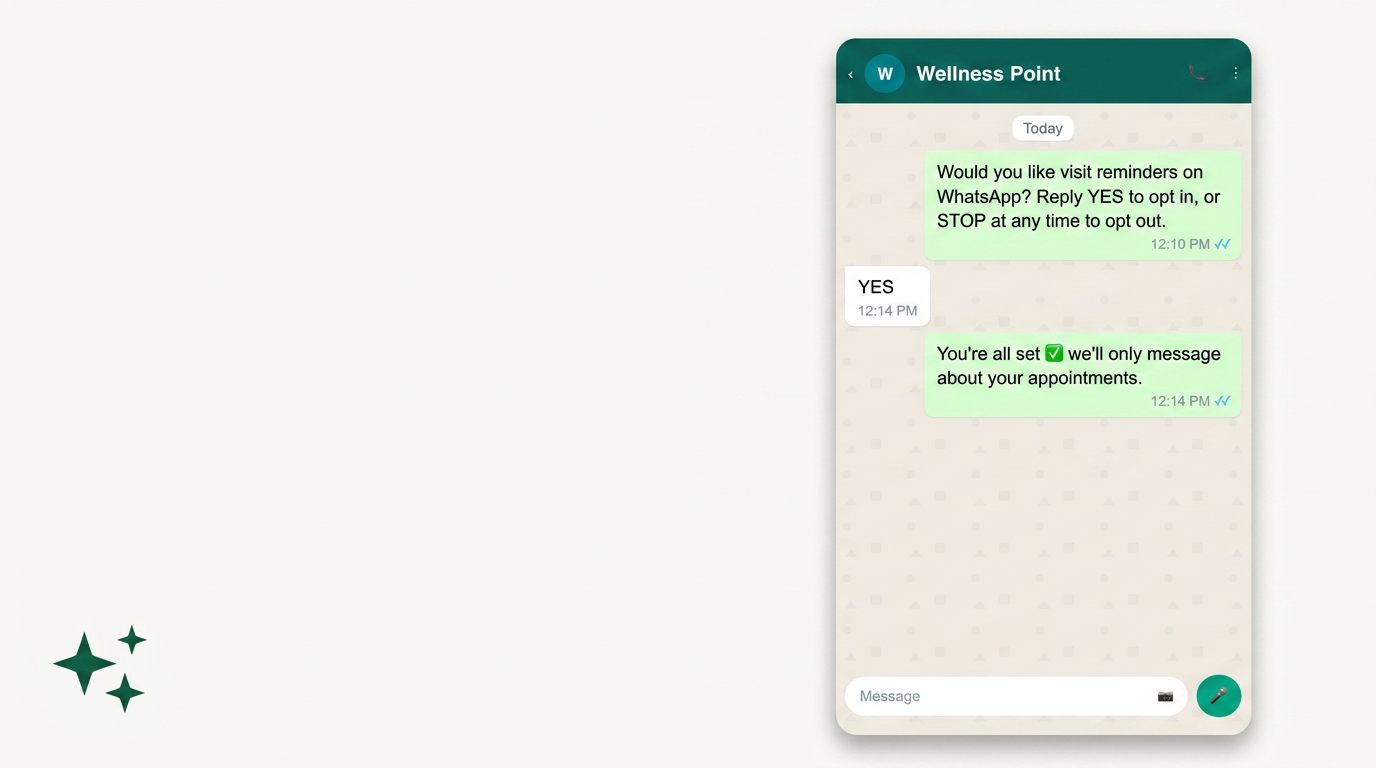
The first move was to route all inbound WhatsApp traffic through the WhatsApp Business API into a system that could read and write availability directly, instead of a phone that a human read. Booking requests were handled in-chat with a structured flow: service, stylist preference, branch, time. If you are wiring the form layer yourself, the practical questions we get asked most are covered in our notes on WhatsApp Flows endpoints.
The key design decision was that the assistant never confirms a slot it has not locked. It reads live availability, holds the slot for the duration of the conversation, and releases it if the client goes quiet. This is the difference Cal.com describes when it argues that AI scheduling gives a conversation rather than a link, and the conversation only has value if it is transactionally honest about what it is reserving.
Modelling the constraints that actually cause conflicts
Most double-bookings in a salon are not two clients in one time slot. They are subtler resource collisions:
- Two colour services booked to the same stylist with overlapping processing and finishing time
- A stylist booked at Branch A at 2pm and Branch B at 4pm with no travel buffer
- Three simultaneous treatments requiring a piece of equipment the branch owns two of
- A junior assigned as support to two seniors in the same window
A calendar that only stores start and end times cannot see any of these. We modelled stylist rotation, service duration by service type rather than a flat 60 minutes, gap time inside colour appointments where the stylist is free, room and equipment counts, and inter-branch travel buffers. Real-time conflict detection is what the AI layer is genuinely good at; Fieldproxy's guide to scheduling conflicts makes the same point, that the fix is real-time conflict detection rather than after-the-fact correction.
Giving the front desk override rights, deliberately
We did not lock staff out. A supervisor can force a booking that violates a rule, and the system logs it and flags the conflict to the affected stylist. This mattered more than any feature. Front desk teams reject systems that make them feel deskilled, and there are legitimate exceptions: a long-standing client who will only see one person, a walk-in worth accommodating.
This is also where our position on augmentation stops being a slogan. Salon clients pay premium prices for a stylist's hands and judgement, not for a scheduling engine. The engine earns its keep by returning the front desk's attention to the person standing in front of them. We kept the assistant's tone professional and warm, with no jokes, no emoji-heavy personality, no cute name. People messaging about a wedding-day appointment or a corrective colour after a bad experience elsewhere are not in the mood to be entertained by a bot, and playfulness there reads as a business that does not take the appointment seriously.
What happened
Double-bookings did not go to zero, and any vendor who tells you they will is selling. They dropped to a residue of deliberate manual overrides and genuine edge cases, and, more importantly, they stopped being discovered by the client at the door. The system surfaced conflicts at the moment of creation, when a rebooking still costs a message rather than a walkout.
The second change was the one the owner cared about more. Rebooking at the chair rose, because staff could see forward availability across all five branches on one screen and could say with confidence that a slot three weeks out with the same stylist existed. Confidence is the whole mechanism. Nobody offers a next appointment they are not sure they can honour.
Third, the shape of front desk work changed. Instead of confirming and reconfirming by phone, staff moved to handling exceptions: complicated multi-service bookings, complaints, upgrades. That reallocation is where the ROI figure quoted at the top of this article actually comes from, and it is why we treat 318% as a description of recovered capacity rather than a software benchmark. It is a rare day when we meet an operator who can tell us how many chair-hours they lost to scheduling conflicts last month, which is precisely why the loss runs for years unchallenged.
What generalises to any multi-branch service business
Learnmind is a Dubai firm that wires AI into the front desks of service businesses, and this same pattern has repeated for us in dental groups, physiotherapy clinics and real estate viewing schedules. A few things hold everywhere.
Availability must be written at the moment of the request, not transcribed afterwards. Any workflow where a human reads a message and later types it into a calendar will produce double-bookings at a rate that climbs with how busy the business is. The busier you get, the wider the gap, which is why this problem appears exactly when growth makes it most expensive.
Model resources, not just time. If your service depends on a specific person, a specific room, or a specific machine, a time-only calendar will lie to you. The audit worth doing before any automation is a list of every scarce resource an appointment consumes.
Decide what the system is allowed to do without a human. Booking, rescheduling and reminder handling can be fully automated. Anything urgent, distressed or clinically ambiguous should route to a person fast, which is the logic we describe in how an AI receptionist handles emergencies. Salons have their own version: a client whose colour has gone wrong needs a human within minutes, not a slot offer.
Watch your messaging volume as you scale. Multi-branch groups send a lot of reminders and confirmations, and WhatsApp's own limits and pricing shape what is affordable. We wrote separately about staying inside Meta's message limits when your outbound volume grows.
Two honest caveats. A single-chair operator with one calendar has no reconciliation problem worth automating. And a group whose staff rota changes daily by verbal arrangement will find the availability layer is only as accurate as the rota fed into it: fix the rota discipline first, or you have automated a wrong answer and given it more authority.
Frequently asked questions
How does AI calendar sync actually prevent double-bookings?
AI calendar sync prevents double-bookings by holding one live availability record that every booking channel reads and writes to at the moment of the request, with conflict detection applied before confirmation rather than after. Manual systems create conflicts in the delay between a client's message and a staff member typing it into a calendar.
Can one WhatsApp number handle bookings for multiple branches?
Yes. One WhatsApp Business API number can serve every branch if the booking logic knows which branch, stylist and resource each request maps to, which is usually simpler for clients than publishing five separate numbers they have to choose between.
Will AI booking replace our front desk staff?
No, and it should not. In every salon and clinic rollout we run, the automation absorbs confirmations, reminders and rescheduling so staff can spend their time on the clients in front of them, because premium service businesses are paid for human expertise, not for calendar admin.
How long does it take to connect WhatsApp booking to a synced calendar?
The technical connection is the fast part; the slow part is documenting service durations, stylist rotations and resource constraints accurately, because an availability layer built on an inaccurate rota will confidently produce wrong answers.
We will map your branch calendars, stylist rotations and resource constraints into a single synced availability layer and connect it to WhatsApp booking, so the double-booking gets caught at the message, not at the door.