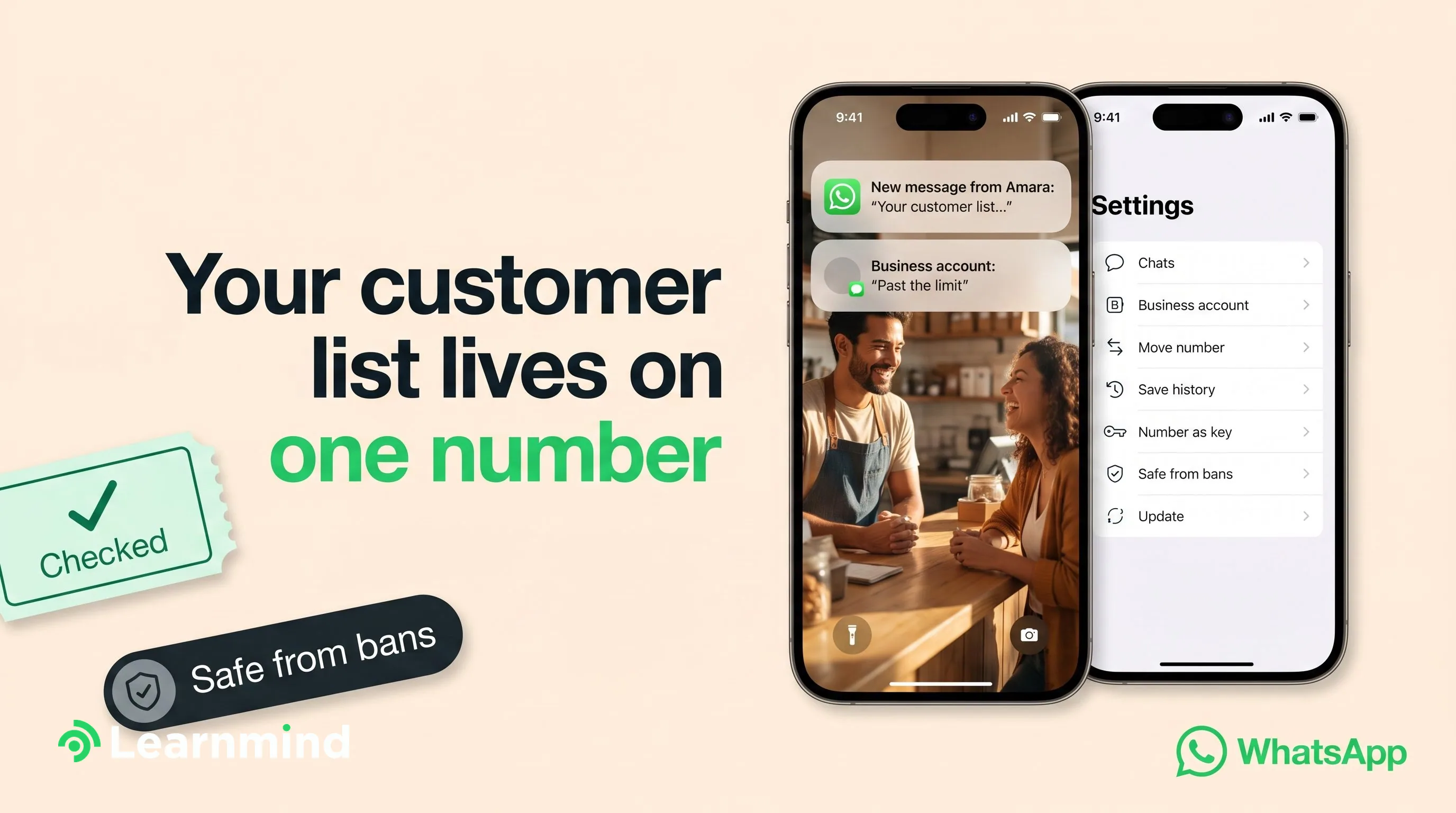
A personal WhatsApp account that has been doing business for three years holds one object, not three: the number, the chat history and the customer list are the same thing on the same handset. Lose the account and all of it goes at once. That is the decision here. Everything else is features.
The verdict: who owns what, and what that ownership is worth
The choice between a WhatsApp Business number vs personal number for business turns on a single question: does the conversation record need to survive the loss of the account? Below roughly twenty customer conversations a day, a ceiling one industry analysis puts on safe personal use, with no automation and no bulk sending, a personal number is defensible. Above that, or anywhere the history is an asset you would pay real money to reconstruct, the number belongs on the WhatsApp Business Platform through a solution provider.
WhatsApp is polite about the ceiling. Its own comparison of the personal app, the Business app and the Platform says you can message individual customers from a personal account, but "you and they will likely find it limiting", which is the official comparison page declining to say the harsher thing. The harsher thing is that on a personal number the number, the threads and the customer list are one object, and that object has a single point of failure.
Identity: the number is the account's only key
Inside WhatsApp, the phone number is not a contact detail. It behaves as the account key. One industry breakdown of the username rollout states the point directly, that a phone number is still what identifies you inside WhatsApp's system, and Meta's developer documentation points the same way: a business number has to be registered before it can send or receive anything through the Cloud API. Usernames change what a customer types to reach you. They do not change what the account is, and that identity distinction is the whole reason the rest of this decision matters.
Here is the mistake worth taking apart, because almost every operator makes it. The plan is: run on the personal number now, move to a proper line later, keep everything. Both halves of the migration are documented, and neither is free. The same breakdown notes that changing a WhatsApp business number requires an account migration and re-verification, and any existing chat or wa.me link breaks. On the Platform side, Meta's changelog for the WhatsApp Business Platform records that phone number migration is not supported for accounts on the new WhatsApp account model: if the destination account does not already own the number, the request is rejected, and disconnecting the number from its current account does not make it available. That migration restriction is the sentence that ends most "we'll move it later" plans.
Meta does preserve one thread of continuity. A phone number change regenerates the customer's business-scoped user ID, and the previous values are now reported alongside the new ones on both system message types. That keeps identifiers reconcilable. It does not keep conversations.
Mini-verdict: neither setup gives you a portable number. The difference is not whether you can move the number, it is what you still hold when the number is gone.
History: where the conversation record actually lives
On a personal number, the record lives on the account and the device. Delete the account, lose the phone, or take a permanent ban, and the record goes with it. There is no export that reconstitutes three years of threads into something a new number can answer from.
The ban path is not exotic, though it is worse documented than it should be. WhatsApp does not publish an enforcement matrix, so what circulates is vendor interpretation rather than stated rule. One vendor analysis of enforcement patterns describes the triggers as sending identical messages to hundreds of contacts, using unauthorised automation tools, or receiving multiple user reports, and reports that WhatsApp often issues temporary bans with a warning first, with repeated violations ending in permanent suspension. Read as one reading rather than policy, those ban triggers still include one you do not control: reports from recipients. A competitor, a disgruntled ex-customer, or a batch of people who did not recognise your number can act on the account without you doing anything wrong that morning. No published recovery timeline exists for a permanently banned consumer account, and there is no mechanism that returns the threads.
A registered line inverts the storage question. One platform overview puts it plainly: the WhatsApp Business Platform is not an app at all, it is a collection of APIs that developers use to integrate with backend systems such as CRM and marketing platforms. Messages arrive through your systems and are stored in your systems. The number is the delivery route, not the filing cabinet, and a backup you control is a decision you can make rather than a feature you have to wait for.
Mini-verdict: a personal number stores your history where a single enforcement action can erase it. A registered line stores it where you can back it up.
Access: one device, one user, versus thousands of agents
Personal WhatsApp is a single-operator tool. The same analysis of business use on personal numbers lists the ceilings: 256-contact broadcast limits, single-user access, and no CRM integration. It also notes that WhatsApp's terms prohibit automated messaging and bulk broadcasts for commercial purposes on a personal number, which rules out the reminder sequences and reactivation flows most service businesses actually want. A registered line is built for the opposite case: businesses can connect thousands of agents and bots to interact with customers programmatically or manually.
Run the arithmetic on a reactivation campaign, because it is where the ceilings bite first. A clinic with 900 lapsed patients cannot address them in one action from a personal number: at 256 contacts per broadcast list, that is four lists to build and maintain by hand. Assume a 12% reply rate and 108 conversations land in one inbox in an afternoon. Set against the roughly twenty daily conversations that one industry analysis calls the safe ceiling for personal WhatsApp, a single campaign consumes more than five days of headroom in a few hours, on the one account that also holds every past thread. Redo it with your own list size and reply rate; the shape does not change.
Mini-verdict: the moment more than one person needs to answer, or a sequence needs to send itself, the personal number is already the wrong tool.
Cost and setup: WhatsApp Business number vs personal number for business
The free option is genuinely free. WhatsApp states that the Business app is free to download and uses a cellular connection or Wi-Fi exactly like the personal app, and that the Business Platform is available on a per-conversation basis. Setup on the free side is a download. Setup on the Platform side is a registration: Meta's developer documentation is explicit that "A valid business phone number must be registered before it can be used to send and receive messages via Cloud API", and that registration requirement is what turns a number into an account asset with an owner on record.
Per-conversation billing means the monthly figure follows your conversation volume rather than a seat count, so the honest answer to "what will it cost" is that it depends on how many conversations you have and in which categories they fall. Meta has changed the mechanics of that billing more than once, which is why any number quoted second-hand should be checked against the current pricing page before you build a budget on it. Our breakdown of the October charges works a monthly bill through in detail.
| Dimension | Personal number | Registered number on the Business Platform |
|---|---|---|
| Account key | The phone number identifies the account inside WhatsApp's system | Same key, but the number must be registered before it can send or receive via Cloud API |
| Changing the number | Account migration and re-verification; existing chat and wa.me links break | Migration not supported on the new account model unless the destination account already owns the number; disconnecting does not release it |
| Automation | Automated messaging and bulk broadcasts for commercial purposes are prohibited by the terms | Thousands of agents and bots can interact with customers programmatically or manually |
| Reach per send | 256-contact broadcast limit | API-driven sending integrated with CRM and marketing platforms |
| Team access | Single-user access, no CRM integration | Multi-agent by design, integrated with backend systems |
| Where history lives | On the account and device | In the CRM and backend systems the APIs integrate with |
| Failure mode | Reported enforcement pattern: temporary ban with warning, then permanent suspension on repeat, triggered by mass identical messages, unauthorised automation or multiple user reports | Number is a registered asset; the record is not stored on the handset that gets reported |
| Cost | Free to download, uses cellular or Wi-Fi | Available on a per-conversation basis |
Mini-verdict: the free setup costs nothing until the day it costs everything. The paid setup costs an amount that tracks your conversation volume and converts your history into something you own.
Keeping a personal number in play without giving up the assets you already hold
Most operators reading this are not going to migrate on Monday, and running business chat from a personal handset is ordinary practice across service businesses, so the honest advice is about reducing exposure while you decide. The goal is simple: make sure that if the account goes, the customer relationships do not go with it.
Five moves, none of which require buying anything this week:
- Get the customer list out of WhatsApp. Every active customer's name, number and last visit belongs in a spreadsheet or CRM you control, updated weekly. The threads are not backed up in any form you can restore to a new number, so the contact list is the part worth saving.
- Stop bulk sending from the personal number entirely. Identical messages to hundreds of contacts is the trigger vendors report most often, and broadcast lists cap at 256 anyway, so the tactic is both risky and slow.
- Remove any unofficial automation tool connected to the account. Automated messaging for commercial purposes is prohibited by the terms, and this is the exposure you can switch off in ten minutes.
- Register the number you actually intend to keep, before it accumulates history. Registration is required before a number can send or receive via Cloud API, and doing it while the number is new avoids the migration problem entirely.
- Publish one number, not several. Because a number change breaks existing wa.me links, every additional number you advertise is another link that will break later.
One borderline practice deserves naming rather than pretending it does not happen: running a second personal number as an unofficial business line, on a spare handset, to keep the owner's own number clean. It works, and it limits the blast radius to one device. It also sits under the same terms as any personal account, breaks the moment two people need to answer at once, and leaves the history in exactly the place an enforcement action can reach. It suits an operator under twenty conversations a day who is genuinely testing demand. It does not suit anyone whose booking pipeline already runs through the thread.
Choose the personal number if
- You handle fewer than about twenty customer conversations a day and one person handles all of them.
- You send nothing in bulk and run no automation, so the terms prohibiting commercial automated messaging never come into play.
- Your customer list already lives somewhere outside WhatsApp, so a lost account costs you inconvenience rather than relationships.
- The number is not printed on anything expensive to reprint, and no wa.me link on your site depends on it.
Choose a registered line if
- More than one person answers, or will answer within six months, since single-user access is a hard ceiling rather than an inconvenience.
- You want reminders, follow-ups or reactivation sequences to send themselves, which the personal terms do not permit.
- The conversation record has commercial value: treatment history, quotes, viewing notes, anything you would pay to reconstruct.
- The number appears on signage, vehicles, paid ads or your site, where a forced change breaks links and re-verification takes the line down.
- You are already at the volume where a competitor or an unhappy customer could put the account at risk with a handful of reports.
Questions operators ask once the number is already in use
Can I move my existing WhatsApp history onto a registered line?
No. A number change on the business side requires migration and re-verification, existing chat and wa.me links break, and Meta's documentation records that phone number migration is not supported for accounts on the new WhatsApp account model unless the destination account already owns the number. What transfers is your contact list, if you have been keeping one outside the app. Start that export today rather than on the day you switch.
How likely is a ban if I have never sent anything in bulk?
Lower, but not zero, because multiple user reports sit alongside mass messaging and unauthorised automation in the triggers vendors report, and reports are outside your control. The escalation pattern described is a temporary ban and a warning first, permanent suspension on repeat violations, though WhatsApp does not publish that sequence as a rule. Treat a temporary ban as the only notice you will get, and use the window it gives you. Our note on account review triggers covers what draws attention in the first place.
Does a registered line mean I lose the personal feel of the chat?
Only if you build it that way. The Platform is a set of APIs, not a script, and a registered line can carry the same one-to-one replies typed by the same people, with the difference that the thread is stored where you can search it and a second person can pick it up. What the Platform adds is the sending you cannot legitimately do from a personal number, and the Platform rules reference sets out which of those message types cost money.
If you are running a service business off a personal number and want a straight read on whether it is worth moving yet, send us the two numbers that decide it: conversations per day, and how many people answer. We will tell you which side of the line you are on.
Related reading
- The WhatsApp Business Platform Terms: A Contract Reader's Guide for AI Chatbot Owners
- How to Get the WhatsApp Green Tick (Official Business Account Badge)
- Multi-Agent WhatsApp Inbox Routing Rules: 7 Patterns That Keep One Number Sane