
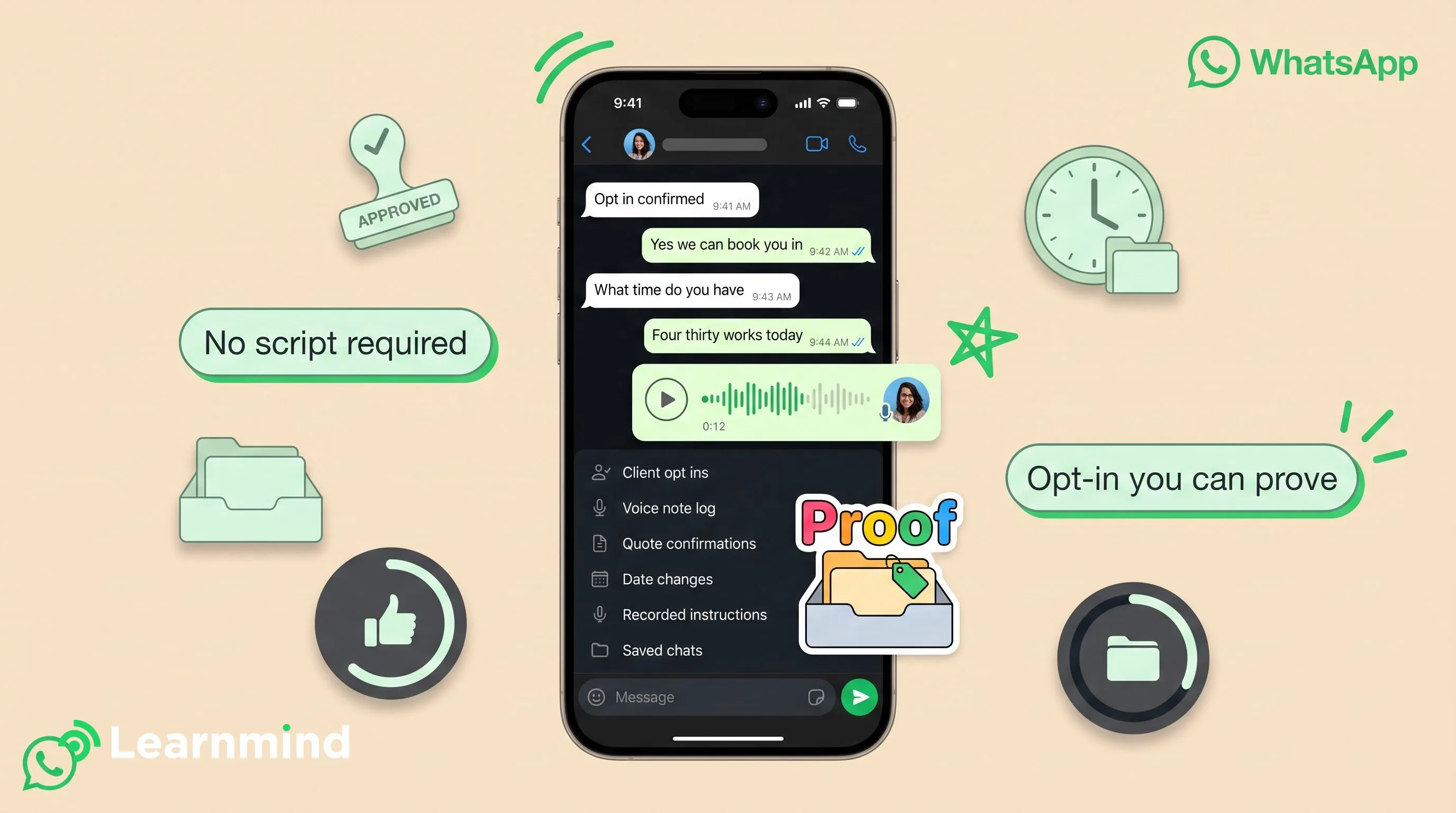
The cost you are already paying sits in the voice notes nobody archived. Every quote, every date change, every "yes go ahead" spoken into a phone and never written down is a business instruction with no retrievable record, and the communications-surveillance firm DeepView describes this plainly as a dangerous gap. So, on the actual question of whatsapp voice note consent disclosure: no, you do not have to say a scripted disclaimer before sending a voice note. Disclosure wording on WhatsApp is recommended, not required. What is required is that the person gave you their number and opted in to hear from you, and that you can produce the record later.
What exactly is required before I send a voice note?
Two things, and neither is a spoken script. WhatsApp's Business Messaging Policy states you may only contact people if they gave you their number and you have received opt-in permission confirming they wish to receive subsequent messages or calls from you. A voice note is a message. It inherits the same permission rule as text, no more and no less.
On disclaimer language specifically, the marketing platform Klaviyo is blunt: disclosure language is recommended but not required when growing a WhatsApp list, and the only channel where disclosure language is truly required is SMS. That distinction is the whole answer, and most of the confusion in this market comes from operators applying an SMS-era habit to a channel that does not ask for it.
Where obligations do bite is the recording side. Under GDPR and, for regulated sectors, FINRA, SEC and MiFID II, complete auditable records of electronic communications are expected, and DeepView notes that includes WhatsApp voice notes. A voice note you cannot retrieve is the exposure. A voice note without a preamble is not.
Why does WhatsApp differ from SMS here?
Because SMS disclosure rules exist to substitute for a consent record, and WhatsApp already has one. On SMS the carrier ecosystem cannot see how you obtained the number, so the disclaimer at the point of sign-up carries the burden of proof. On WhatsApp, the platform itself sets the gate: no number, no opt-in, no contact, enforced by Meta rather than by a telecoms regulator.
Meta backs that with enforcement rather than paperwork. The policy states WhatsApp may use technology and human review to detect and review reported messages and unencrypted profile information for violations. Your risk on this channel is a quality-rating drop or a blocked number, triggered by recipients marking you unwanted, not by a missing sentence at the top of an audio file.
One more difference worth knowing, because it changes how you use voice on WhatsApp at all: WhatsApp's Business Terms explicitly flag no access to emergency services and important differences from mobile, fixed-line and SMS services. Those terms also incorporate the Messaging Policy by reference, which is why "we only read the Terms" is not a defence.
What is the mistake most operators actually make?
Here is the teardown. A clinic reads about AI disclosure rules, panics, and bolts a spoken disclaimer onto the front of every outbound voice note: "This message may be recorded and is sent by an automated system on behalf of..." Nine seconds of legal throat-clearing before a fifteen-second answer about a Tuesday appointment.
Three things go wrong at once. First, the disclaimer solves a problem that does not exist on this channel, because the permission was already captured at opt-in. Second, listen-through collapses, and a voice note that nobody finishes is worse than a text nobody had to open. Third, and this is the expensive one, the team files the disclaimer under "compliance done" and never builds the archive, so the one obligation that a regulator can actually test, retrievable records, stays unmet.
The inverse mistake is quieter and more common: a receptionist replies to enquiries with warm, effective voice notes from a personal handset that no CRM ever sees. The selling works. The record does not exist. Six months later a dispute turns on what was promised about a price, and the only version of events is a memory.
What is the real trigger, consent to contact or consent to record?
Consent to contact is the platform trigger. Consent to record is the legal trigger, and it applies to calls, not to a voice note the customer chose to receive in their inbox. The EU's ePrivacy Directive requires informed consent for call recording and automated marketing calls, which is a live-call framing. A voice note is an asynchronous file sent inside a conversation the recipient opted into.
The practical consequence: put your effort into evidence of opt-in, not into audio preambles. If you can show the source of the number, the timestamp, the wording the customer agreed to, and the message log including audio, you are in a defensible position on both counts. Klaviyo's framing of the gate is useful because it is testable: the customer provided their number, plus opt-in.
There is a small commercial upside to conversations rather than blasts. Meta has not charged for non-template messages sent inside an open customer service window since 1 November 2024, and all messages including templates are free for 72 hours inside a free entry point window. Replying with a voice note to someone who messaged you first is both the cleanest consent position and the cheapest one.
Where do AI voice agents change the calculus?
Completely. The moment the voice is synthetic or the call is placed by an automated system, you leave WhatsApp's permission-only world and enter AI and telecoms regulation. Under the EU AI Act, disclosure must reach a person without special tools, which for voice means an audible disclosure rather than a metadata flag or a note in the transcript. Telnyx, the communications platform, recommends opening every call with a line such as "You're speaking with an AI assistant. Say 'agent' at any time to speak with a human."
Deployers also have to tell people when they operate emotion recognition or biometric categorisation systems. If your vendor markets sentiment scoring on calls, that is a disclosure obligation, not a feature footnote.
Telecoms rules then layer on by market: FCC and TCPA in the United States, Ofcom in the United Kingdom, TDRA licensing in the UAE. Our reference work on AI receptionist economics covers the per-minute side of that decision.
So the honest summary: a human voice note needs opt-in. A synthetic voice on a live call needs an audible disclosure, a human escape hatch, and a regulator-appropriate licence.
Keeping voice notes without losing the record
Voice is the highest-conversion format on this channel, and the answer is not to stop using it. It is to make every voice note retrievable and every opt-in provable. Our earlier piece on voice notes as a sales tool covers why they work; this is how to keep them.
Moves that are safe and effective:
- ✅ Send voice notes from the WhatsApp Business API number your CRM logs, so the audio file lands in the conversation record automatically rather than on a staff phone.
- ✅ Reply with voice inside the open customer service window, where Meta does not charge for non-template messages and consent is unambiguous because the customer opened the thread.
- ✅ Store the opt-in artefact next to the contact: source, timestamp, exact wording agreed. WhatsApp's policy needs the number and the opt-in, so keep both provable.
- ✅ Add a written summary beneath any voice note containing a price, a date or an instruction. It is the retrievable version, and it removes the DeepView-style gap without adding a preamble.
- ✅ Include the recommended disclosure wording at sign-up rather than in audio. It is optional on WhatsApp and it costs nothing on a form.
Moves that genuinely get you blocked or fined:
- ❌ Voice-noting a purchased or scraped list. No opt-in means a direct Messaging Policy breach, and reports feed technology and human review teams that can restrict or remove the number.
- ❌ Running a synthetic voice on outbound calls with no audible AI disclosure in the EU. The AI Act requires disclosure reaching the person without special tools, so a transcript note does not qualify.
- ❌ Automated outbound dialling into the US or UK without TCPA or Ofcom groundwork. That is regulator exposure, not a platform quality score.
- ❌ Treating WhatsApp as an emergency or urgent-safety channel. The Business Terms state there is no access to emergency services.
Borderline moves operators do use:
- ⚠️ Personal-handset voice notes from a senior salesperson. Gains warmth and speed. Carries record-keeping and data-protection risk (legal, not platform), and in regulated sectors it is the exact gap FINRA-style rules target. Suits owner-operators outside regulated verticals only.
- ⚠️ Cloned-voice notes of a named team member sent at scale. Gains consistency. Platform-policy risk is modest if consent is clean; the legal risk is AI-transparency and impersonation exposure, and it worsens if the recipient reasonably believes a person spoke to them. Suits firms willing to state in-thread that the audio is AI-generated.
- ⚠️ Sentiment or emotion scoring on inbound voice. Gains routing intelligence. Triggers a disclosure duty for deployers of emotion recognition under the AI Act, a legal risk. Suits teams with a privacy notice they actually maintain.
- ⚠️ Re-engagement voice notes to dormant contacts whose opt-in is over a year old. Gains pipeline. Platform risk is the report-and-block spiral, since old consent still exists on paper but not in memory. Suits operators who re-confirm interest in text first.
The five questions to put to any voice vendor
Ask these before signing. The answers are more diagnostic than any feature list.
- Where is the audio file stored, in which jurisdiction, for how long, and can I export every voice note for a single contact in one action?
- Do outbound voice notes send from my API number and log to the conversation record, or from a device that sits outside it?
- What opt-in fields do you capture and expose: source, timestamp, agreed wording?
- For live AI calls, what is the exact audible disclosure sentence, and is there a spoken route to a human on request?
- Do you run emotion or sentiment analysis, and if so where is that disclosed to the caller?
Remaining questions operators ask us
Do I need to say "this call may be recorded" in a WhatsApp voice note?
No. Recording-consent language belongs to live calls, where the ePrivacy Directive requires informed consent for call recording. A voice note is a message inside a conversation the recipient opted into, and disclosure wording on WhatsApp is recommended rather than required.
Does an AI-generated voice note need a disclosure even though a voice note is not a call?
The AI Act's audible-disclosure requirement is written for voice interactions, and whether it captures an asynchronous audio message is not settled in published guidance. The defensible position is a one-line written note in the same thread saying the audio is AI-generated. It costs you nothing and it removes the argument.
What breaks first if we skip all of this?
Retrievability, long before enforcement. The first real cost is a dispute you cannot evidence because the promise lives in a voice note on a phone that left the company. Fix the archive first, then the wording.
Who is this wrong for?
Any business whose staff will not send from the business number. If the voice notes keep coming from personal handsets, no policy wording saves you, because the record never existed. That is a management decision, not a compliance one.
If you would like a look at how your voice notes and AI call handling are logged, and whether your opt-in evidence would survive a challenge, book a consultation with Learnmind. No pitch, just a read on where your record-keeping stands.
Related reading
- Measuring WhatsApp Voice Notes: Metrics That Predict Revenue
- The Hidden Cost of Making an AI Voice Note Say 'This Is AI'
- AI Voice Cloning on WhatsApp: Believability Now
Sources
- Klaviyo
- WhatsApp Business
- DeepView
- Telnyx
- Meta for Developers
- EU-U.S. and Swiss-U.S. Data Privacy Frameworks Disclosure for WhatsApp LLC (background)
- Calling API Pricing (background)
- EU-U.S. and Swiss-U.S. Data Privacy Frameworks Disclosure for WhatsApp LLC (background)
- Share on WhatsApp (background)
Related reading: The Consent Script: Wording an AI Voice Opt-In
Related reading: AI Voice vs WhatsApp Text: Customer Trust in UAE and UK