Updated 27 September 2026: Added Meta's new free tier of 1,000 service messages per business phone number per month.
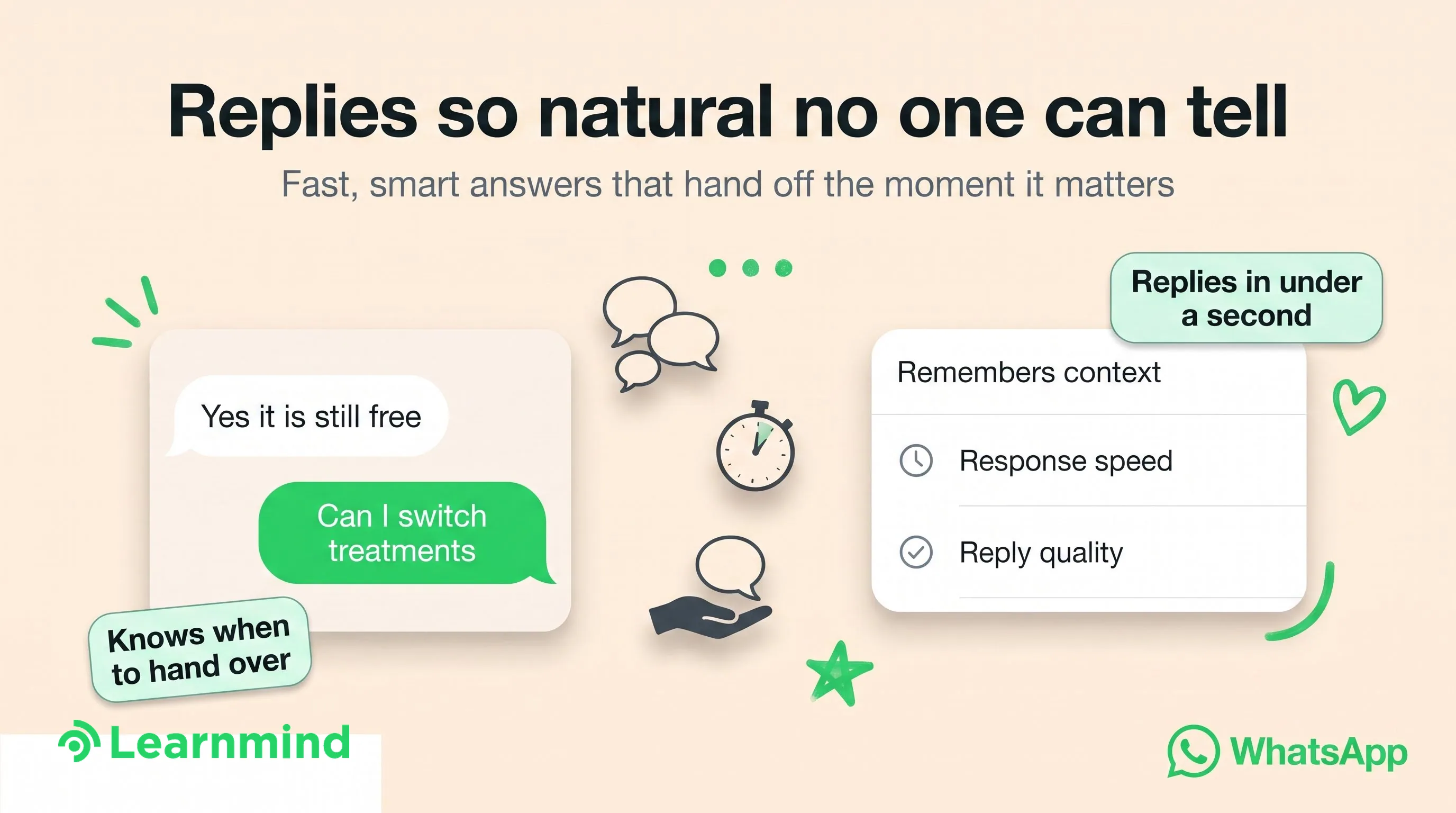
A salon manager scrolls back through a Thursday evening thread on the business number: a client asking whether the 6pm slot is still open, changing her mind about the treatment, then asking about parking. She cannot immediately tell which of those replies she wrote and which the system wrote. That is the standard, and yes, an AI reply on WhatsApp without sounding like a bot is achievable now, on four conditions: replies land in about a second, the system remembers what was said several messages ago, it reads intent rather than matching keywords, and it hands over to a human the moment the request involves money, medical detail or a complaint. Miss any one of those and the customer knows within three messages.
Updated 1 September 2026: Added a note that Meta will begin charging for WhatsApp service messages from October 2026 and for its own Business Agent replies from August 2026, changing the cost basis (though not the approval rules) described in the
The before-and-after is not about vocabulary. The old version answered "Where's my order?" with a menu. The new version answers the question, then asks the one thing it needs to answer the next one.
What actually makes an AI reply feel human instead of scripted?
Four mechanics, in order of how quickly a customer notices them missing: response latency, conversation memory, intent understanding, and restraint about what it claims to know.
The intent part is the clearest break from the old chatbots. Published infrastructure documentation puts the difference plainly: unlike a rule-based chatbot that matches keywords to canned replies, an AI agent understands intent, holds context across a conversation, and can take actions like looking up an order or booking an appointment. That is why a customer can type "is anyone free tomorrow morning, ideally before 10" instead of pressing 2.
Restraint is a tone feature
The single most bot-like behaviour is confident invention. A system that says "I'll check that with the team and come back to you within the hour" reads more human than one that guesses at a price. Meta says this about its own tooling too: AI-generated messages may not be accurate or appropriate. Build the escalation path first and the tone problem shrinks.
Why does speed matter so much to how human a reply feels?
Because a two-second gap reads as thinking and an eight-second gap reads as processing. One infrastructure provider's own technical material claims that co-locating messaging and model inference keeps inference latency under 500ms, and that where messaging and inference sit on separate networks every message pays a cross-vendor round trip. That is a vendor figure rather than an independent measurement, so treat it as a claim to test, not a benchmark to trust.
It is still worth doing arithmetic on, because the round trip is per message, not per conversation. Here is the same twelve-message exchange under two architectures, using 500ms as the co-located baseline and adding a round trip on top of it:
| Messages in the thread | Co-located inference (500ms each) | Plus a 700ms cross-vendor round trip | Extra waiting the customer feels |
|---|---|---|---|
| 4 | 2.0s | 4.8s | 2.8s |
| 8 | 4.0s | 9.6s | 5.6s |
| 12 | 6.0s | 14.4s | 8.4s |
The 700ms is illustrative, not published; substitute whatever your provider will state in writing. The point is the multiplication. Ask any vendor for a measured p95 latency figure from your own region, not an average from theirs.
How does the AI remember what a customer said earlier in the chat?
Through conversation state management, which is a build requirement rather than a property of the model. The lifecycle is a loop: the customer's message hits a webhook, your app builds a prompt that includes the conversation context, the model responds, and the reply goes back out through the WhatsApp API. The same provider documentation lists state management as a named component, so that the agent remembers what was said three messages ago.
Practical consequence: if a vendor demo only ever shows single-question exchanges, you have not seen the hard part. Test it by contradicting yourself. Say Tuesday, then say "actually make it Thursday", then two messages later ask "what time did we say". A system without state will confirm Tuesday.
Is this different from the chatbots I used before?
Yes, and the most useful version is usually not pure AI. Hybrid designs combine button flows with AI-based replies, which is how you get deterministic behaviour where determinism matters (choose a branch, pick a location) and free text where it does not.
Buttons are not the bot smell. Buttons that cannot be escaped are. If a customer types something off-menu and the system repeats the menu, that is the failure. One vendor guide written for retailers makes the same observation from the customer's side: people ask intuitive questions with no robotic script such as "where's my order" or "show me bags under $100", and the system should read the intent.
What can the AI handle and what should still go to a human?
Meta draws a usable line for its own Business Agent, and it maps well onto service businesses generally. It can respond to questions about basic business information such as hours or location, answer questions about specific products or services, recommend them, give pricing details, and handle questions about discounts, payment and shipping.
Give the AI these: opening hours, location and parking, service descriptions, price ranges, availability checks, booking and rescheduling, document requests, follow-ups on quiet enquiries. Route these to a human immediately: clinical or medical questions, complaints, refund and chargeback disputes, anything where a customer states distress, and any negotiation where a discretionary discount is on the table.
Then test the handover, not the AI. Send a complaint to your own number at 8pm and time how long it takes a person to appear. If the answer is next morning, the AI is not your bottleneck. Our notes on reviving dead WhatsApp enquiries cover the follow-up side of that in more detail.
Do I need permission from Meta to run an AI reply on WhatsApp without sounding like a bot?
You need the right product, and you need to know which replies are pre-approved and which are not. The consumer WhatsApp Business app does not support automation, so any AI setup runs on the WhatsApp Business Platform through a Business Solution Provider. That is the gate, and it is not optional.
Inside a customer service window, you are on much freer ground than most operators assume. Meta's developer documentation defines service messages as free-form messages you can send during a customer service window, and states that unlike template messages, service messages do not require pre-approval, so you can compose and send them as needed in response to a user's message or call. That is precisely why AI replies work: the reply your AI writes to an inbound question does not go through template review.
Disclosure matters if you use Meta's own agent. Meta states it will let customers know the first time they start chatting with a business that has AI connected, and that customers will see: "AI from Meta receives chats to improve AI quality and generate messages for this business." Read that exact wording before you decide whether to route through Meta's agent or your own stack. On costs and template categories, our WhatsApp Business Platform reference sets out what is billable.
One caution on release notes: Meta's Graph API and Marketing API versions move on a rolling schedule and features arrive in beta before general release. Check the current version in Meta's own changelog on the day you build, rather than trusting a version number quoted in an article, including this one.
Where the tone and compliance lines actually sit on WhatsApp AI replies
The lines that matter are less about what the AI says and more about what you claim it is. These are the moves worth making.
- ✅ Answer inbound questions with free-form service messages inside the customer service window, since Meta does not require pre-approval for those, and keep templates for the outbound re-engagement you genuinely need.
- ✅ Publish a one-line note in your WhatsApp business profile description saying replies may be automated and a person is available on request. It costs nothing and removes the deception argument entirely.
- ✅ Hard-code a refusal for anything clinical, legal or financial, with an immediate human handover and a stated response time.
- ✅ Log every conversation where the AI was corrected by a staff member and review that list weekly. It is the fastest tone-tuning input you will get.
- ✅ Demand a measured latency figure per message from your provider, and check whether messaging and inference sit on the same network.
These are the ones that cost you the number or the customer.
- ❌ Running automation on the consumer WhatsApp Business app through unofficial tooling. It is not a supported product for automation, and you are outside the platform terms with your primary customer channel at stake.
- ❌ Letting the AI give medical or dosage guidance in a clinic chat. Meta itself warns AI-generated messages may not be accurate or appropriate, and the liability is yours, not the model's.
- ❌ Having the AI state a firm price, then declining it at the door. That is a consumer-protection problem, not a platform one.
These are the borderline moves operators genuinely use.
- ⚠️ Giving the AI a first name and no disclosure. It is not a WhatsApp policy breach in itself, but it is a consumer-law exposure in jurisdictions with unfair-practice rules, and it plays badly if a complaint escalates. Suits businesses with low-stakes transactions, not clinics.
- ⚠️ Adding a deliberate typing delay to mask latency. It buys you a more natural rhythm at the cost of real speed, and the risk is purely commercial: a customer who wanted a fast answer got a slower one. Fine for evenings, poor for booking rushes.
- ⚠️ Letting the AI quote price ranges rather than escalating. It shortens threads and keeps enquiries moving. The risk is legal, not platform: a quoted range creates an expectation. Suits businesses with genuinely standardised pricing.
What could still go wrong with a good setup?
Three things, in order of frequency. The AI answers confidently from stale information, because nobody updated the price list it reads. Handover latency, where the AI correctly escalates and then nothing happens for eleven hours. And the accuracy risk Meta names directly for AI-generated messages, which does not disappear because your prompt is well written.
All three are operational, not technical. Assign an owner to the knowledge base, put an on-call name against escalations during trading hours, and read twenty transcripts a week yourself for the first month.
Is this worth it for my type of business?
It is worth it where enquiry volume arrives outside staffed hours and where the first reply decides the booking. Figures for WhatsApp's global user base and for messaging preference over email circulate widely in vendor material, but they are worth checking against Meta's and the original research houses' own publications before you put them in a business case. The reason the channel matters to you is simpler and locally verifiable: look at where your enquiries already land.
The honest counter-case: if you take four enquiries a day and answer them all within minutes, an AI layer adds risk without adding revenue. Build it when the queue is real. If you want to compare channel economics before deciding, our breakdown of WhatsApp pricing by country gives the per-conversation side of the equation.
The question you should ask yourself now, and its answer
The question is not whether AI can sound human. It is: what percentage of my inbound WhatsApp messages currently get a reply within five minutes, and what happens to the rest? Count last week. If the honest number is under half, your customers are already talking to nobody, and nobody sounds far worse than a well-built assistant.
Remaining questions operators ask us
Can I use my existing WhatsApp number, or do I need a new one?
You need the number on the WhatsApp Business Platform via a Business Solution Provider, because the consumer Business app does not support automation. Migrating an existing number is normal, but the number cannot be active on both the app and the platform at once, so plan the switch for a quiet trading period and tell your team the day before.
Will customers be told they are speaking to AI?
If you use Meta Business Agent, yes: Meta notifies customers the first time they chat with a business that has AI connected, with a fixed notice about AI from Meta receiving chats. If you run your own stack through a provider, no equivalent automatic notice is described, so the disclosure decision is yours, and we would put a line in the profile description regardless.
How do I test whether a vendor's AI actually holds context?
Book a live demo on their number and contradict yourself twice inside eight messages, then ask an unrelated question and return to the original booking. Ask separately for a measured per-message latency figure and whether messaging and inference run on the same network, since a cross-vendor round trip is paid on every message, not once per conversation.
If you want a view on whether your WhatsApp volume justifies an AI layer yet, send us a week of your reply times and we will tell you plainly either way.
Update, September 2026: Meta starts charging for the free-form replies this setup relies on
The article's cost framing needs a correction. Meta's own developer changelog confirms rate card changes effective 1 July 2026 and 1 October 2026 across its WhatsApp pricing pages. From 1 October 2026, the free-form service messages an AI writes inside the 24-hour customer service window stop being free, a status they had held since November 2024, and become billable at the same per-country rate Meta already charges for utility and authentication templates, after a free tier of 1,000 service messages a month on each business phone number. Separately, if a business routes replies through Meta's own Business Agent rather than a third-party AI, those messages moved to token-based billing on 1 August 2026, priced at two dollars per million tokens, which works out to roughly four to five cents per typical conversation. None of this changes the pre-approval point in the article: service messages still do not require template review. It changes the price. Anyone building or buying an AI reply system should ask their provider which category each reply falls under and get the exact per-country rate before assuming free-form replies remain free.
Related reading
- WhatsApp Quality Rating: Moving Yellow Back to Green
- Most WhatsApp Automation Fails Because It Sounds Like a Robot Wearing a Party Hat
- How to Send a WhatsApp Catalog With 500+ Products Without Hitting Meta's Message Limits