
Clinic WhatsApp marketing in Dubai: what DHA and MOHAP allow in offers, before-and-after photos, reviews and broadcasts
A Dubai clinic may market to its patients on WhatsApp, and every promotion it sends is treated as a health advertisement. The Dubai Health Authority's advertising standard names WhatsApp, Dubai law requires DHA approval, and the Ministry of Health and Prevention licenses health advertisements. Meta adds its own opt-in and product rules on top. This page quotes each rule from its source and shows what it means for six kinds of message. It also explains how Learnmind.ai builds clinic messaging that stays inside them.

The short answer
WhatsApp counts as social media. DHA's Standards for Medical Advertisement Content on Social Media list WhatsApp by name. Dubai law covers health promotion "through any print, audio, visual, or electronic means".
Two regulators sit over every promotion. Dubai law fines a clinic AED 2,000 for advertising its services without DHA approval. MOHAP issues the health advertisement licence, and DHA's own service portal sends advertising matters to MOHAP.
State prices plainly. A clinic may state its fees and instalment plans. "Very limited quantity", "get money back", "100%" and offers the clinic cannot honour are all ruled out by DHA.
Before-and-after photos need consent and a disclaimer. Same patient, same lens, no editing, written consent, and DHA's disclaimer in the same font size as the rest of the message.
Never offer a slot nobody asked for. DHA lists giving a patient "an unsolicited appointment time" as not acceptable. That one line decides how a reactivation message should be worded.
Meta's rules apply as well. Opt-in comes first, an offer turns a reminder into a marketing template, and Meta bans promoting prescription drugs and medical products whatever licence the clinic holds.
Six kinds of clinic message, and the rule each one meets
Most clinic WhatsApp traffic falls into six types. Each one meets a different rule, and two of them are easy to get wrong. The sections below take them in turn, with the source quoted for every line.
 Appointment remindersA plain reminder of a booked visit fits Meta's utility category. Add an offer and it becomes marketing.
 Offers and pricesAccurate fees with every condition stated. No scarcity, no money-back promise, no offer you cannot honour.
 Before-and-after photosSame patient, same lens, no editing, written consent and DHA's disclaimer at full size.
 Reviews and testimonialsOnly with the patient's written consent, and never comparing one health profession with another.
 Reactivation messagesInvite the patient to ask for a slot. An appointment time they did not request is not acceptable to DHA.
 Broadcast campaignsOpt-in first, in the clinic's name, with a working way to stop the messages.
Two regulators sign off on a Dubai clinic's promotions
Health advertising in Dubai has a federal layer and an emirate layer. Both appear in primary sources, and a clinic needs to satisfy both.
MOHAP licenses health advertisements
The federal rules start with Cabinet Resolution No. 7 of 2007 on health advertisements. Article 3 says no person may advertise anything related to a medical product without a prior licence from the Ministry of Health. That is our translation of the Arabic text. Article 2 applies the resolution to "all medical advertisements" in the country.
MOHAP runs this through three services. Its social media licence covers one account: "AED 1,000 per month" or "AED 3,000 per year", plus an AED 100 application fee. A separate service licenses individual advertisements "through multiple media channels and electronic platforms in the country". A third licenses health advertising through call centres.
Two conditions travel with every MOHAP licence. "The customer shall mention the advertisement license number on the approved advertising material." And the licence "does not exempt the institution from complying with the requirements imposed by other parties". None of the MOHAP service pages we read mention WhatsApp, SMS or direct messages by name.
DHA approves promotion by Dubai facilities
Dubai's Executive Council Resolution No. 49 of 2024 regulates health professions and facilities in the emirate. It defines health promotion as "the dissemination of information or data, through any print, audio, visual, or electronic means, for the purpose of promoting Healthcare services". A WhatsApp broadcast fits that wording.
Its Schedule 4 lists "Publishing a Health Promotion in any manner without first obtaining the relevant authorisation of the DHA" as a prohibited act. For a facility, Article 19 allows a fine "of no less than five thousand dirhams (AED 5,000.00) and no more than two hundred thousand dirhams (AED 200,000.00)". Warnings, suspension and closure for up to six months are also available.
Schedule 5 adds a fixed fine of AED 2,000 for "Advertising and promoting the services provided by a Healthcare Facility without first obtaining the approval of the DHA". Under Article 19(f), the fine doubles if the same violation recurs within a year.
DHA also sets the content rules, in its Standards for Medical Advertisement Content on Social Media (version 1.1). That standard requires a clinic's official account to "state the corresponding medical advertisement license number provided by Ministry of Health and Prevention (MOHAP)". On 17 August 2026, DHA circulated the standard again to all licensed private facilities and professionals. The circular warns that non-compliance "will result in taking the suitable disciplinary actions".
The August 2026 circular did not change the rules.
The document attached to DHA's circular of 17 August 2026 is the same version 1.1 standard issued on 3 August 2022. We compared the two files and they are identical. Treat the circular as a reminder that DHA is checking, rather than as a new rulebook.
| Body | Instrument | What it requires | Cost or penalty |
|---|---|---|---|
| MOHAP | Cabinet Resolution No. 7 of 2007 | A prior licence for medical advertisements | Social media licence AED 1,000 a month or AED 3,000 a year, plus AED 100 to apply |
| MOHAP | Health advertisement licence service | Licence number shown on the approved material | Per advertisement |
| DHA | Executive Council Resolution No. 49 of 2024, Schedule 5 | DHA approval before advertising a facility's services | AED 2,000, doubled on a repeat within a year |
| DHA | Executive Council Resolution No. 49 of 2024, Schedule 4 | DHA authorisation before publishing health promotion | AED 5,000 to 200,000 for a facility, plus warnings, suspension or closure |
| DHA | Standards for Medical Advertisement Content on Social Media, v1.1 | Content rules, consent, Medical Director sign-off, archiving | Disciplinary action, per the August 2026 circular |
DHA's Sheryan service page for campaign permits says: "For Health Advertisement related matter, please visit MOHAP website." No official source we read explains whether one MOHAP licence also satisfies the DHA approval in Resolution 49. MOHAP lists a 2023 decree authorising Abu Dhabi's Department of Health to license health advertisements. We found no equivalent decree for DHA. Ask both bodies before a large campaign, and keep their answers on file.
WhatsApp is named as social media in DHA's standard
A common assumption is that WhatsApp is private messaging, so advertising rules stop at Instagram. DHA's standard says otherwise. It defines social media as online platforms for "interaction, content sharing and collaboration or networking". Its list "includes but is not limited to Facebook, Instagram, Twitter, Reddit, Pinterest, Flicker, WhatsApp, YouTube, Snapchat and LinkedIn".
A social media advertisement, in the same standard, "is any information about the Health Product, Service, Facility, Professional, Treatment or Therapy through the means of social media". A broadcast about a new treatment, a price list sent on request and a promotional status update all fit that definition.
The federal Media Law is less clear
Federal Decree-Law No. 55 of 2023 regulates media and advertising nationally. In our translation of the Arabic text, an advertisement is content shown "by any means to the public" to market a product or service. The same article excludes content that has "the character of private correspondence".
Its executive regulation, Cabinet Resolution No. 68 of 2024, requires the concerned authority's approval for adverts for "clinics or hospitals" and health services, in our translation. Cabinet Resolution No. 42 of 2025 sets a fine of AED 10,000 for showing an advert without that approval, doubled on repetition. The Media Law also requires every advert to be clearly labelled as advertising.
Whether a broadcast to a clinic's own opted-in patients is "to the public" or private correspondence is not settled by any source we read. The DHA and Dubai rules above reach WhatsApp either way, so the safe course is the same.
Offers, prices and discounts: what a clinic may say
DHA's standard has an appendix of acceptable and unacceptable content. Price statements are on the acceptable side. The standard allows "a statement about fees charged, bulk-billing arrangements, or other insurance plan arrangements and instalment fee plans regularly accepted".
The same appendix rules out "price information that is in accurate". It also rules out content that "fails to specify any conditions or variables to an advertised price or offers time-limited discounts or inducements that cannot be met". A "from AED 299" headline with the conditions hidden fails that test. So does a weekend offer the clinic has no appointments to honour.
Section 6.11 bans a list of words and phrases outright. The list includes "the best", "exclusive", "very limited quantity", "has no side effects", "get money back", "100%" and "immediate results". The federal resolution of 2007 bans the same kind of urgency, in our translation: phrases such as "very limited quantity, hurry to seize the opportunity".
Pressure copy is also out. DHA lists as not acceptable any message that encourages "unnecessary or excessive use of health services". Its examples are "don't delay", "achieve the look you want" and "looking better and feeling more confident". Most aesthetic promotions in the region use at least one of those phrases.
One more rule bites on insurance offers. DHA's 2025 ethics standard says professionals "shall not waive deductibles, co-payments, or coinsurance as an inducement, unless part of a DHA-approved legal discount program". "We'll cover your co-pay" is therefore off the table without that approval.
| Phrase in a WhatsApp promotion | Status under DHA's standard | Where the rule sits |
|---|---|---|
| "Consultation AED 300, deducted if you go ahead with treatment within 30 days" | Acceptable, as long as it is accurate | Appendix 1, acceptable (h); not acceptable (m) |
| "Pay in three monthly instalments" | Acceptable if regularly offered | Appendix 1, acceptable (h) |
| "Only 5 slots left this week!" | Banned wording | Section 6.11, "very limited quantity" |
| "Dubai's best skin clinic" | Banned wording | Section 6.11, "the best"; Appendix 1 (n) |
| "Results guaranteed or your money back" | Banned wording | Section 6.11, "get money back"; Appendix 2, item 3 |
| "Don't delay, achieve the look you want" | Not acceptable | Appendix 1, not acceptable (b) |
| "20% off this weekend" with no slots to match | Not acceptable | Appendix 1, not acceptable (m) |
| "We'll waive your insurance co-pay" | Not allowed without a DHA-approved programme | Ethics standard, 16.3.3 |
A plain percentage discount is not banned or expressly allowed by any source we read. What the rules test is accuracy, stated conditions and whether the clinic can honour the offer. Treat "20% off" as acceptable only when the end date, the conditions and enough appointments all exist.
One offer, rewritten: a dental clinic in Al Barsha
The draft: "Dubai's best smile deal! 30% off scale and polish, only 5 slots left, don't delay! 100% painless."
What fails: "best", "only 5 slots left", "don't delay" and "100%". The 30% has no end date or conditions.
The rewrite: "Scale and polish with our dental hygienist: AED 245 instead of AED 350 until 30 November. Includes a check-up with the dentist. Reply BOOK to see available times, or STOP to stop offers."
Why it holds: an accurate price, an end date, the conditions stated, and no slot offered until the patient asks. The licence number and the clinic's name go in the template too.
Illustrative example. Prices are invented for the example.Before-and-after photos need consent, the same lens and a fixed disclaimer
Before-and-after images are the most regulated content a clinic sends. DHA's section 9.6 sets four conditions. The images must be "of the same individual, using the same lens, with no photo shop enhancements or equivalent software". They must carry DHA's statement and the risks, "written in the same font size as the rest of the SMA".
The statement is fixed: "there is no guarantee that the result will be the same, as it might vary from one individual to another". Appendix 2 also prohibits before-and-after images that leave the disclaimer out. The images may "only represent patients who have received the treatment".
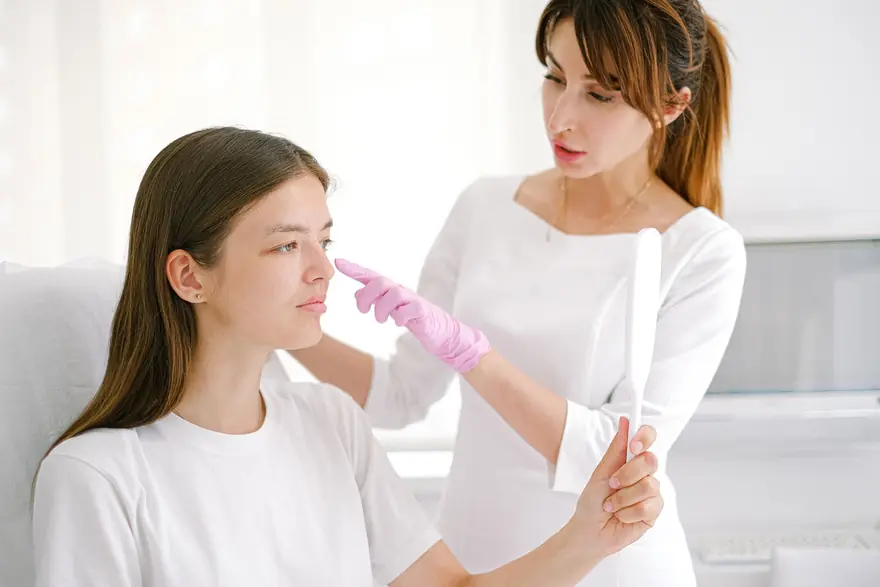
Consent is the second half. Section 9.1 requires written consent "from any individual or patient whose Pictures, Images and Videos (PIV) and statements are used". Section 6.10.1 limits that consent to "the subject for which the consent was requested", for no longer than the period agreed. A patient who agreed to an Instagram post has not agreed to a WhatsApp broadcast a year later, on a fair reading of that clause.
For a patient under 18, the clinic needs "verifiable consent from the child's parent". The standard also bars featuring patients treated in Dubai on a facility's international accounts. Filming during surgery under general anaesthesia, or in procedure rooms, for promotion is banned outright.
- Get written consent for this useName the channel, the images and the period. Keep the signed form with the patient record.
- Check the photosSame patient, same lens, same light where possible, and no retouching on either image.
- Add the disclaimer and the risksDHA's exact sentence, in the same font size as the rest of the message, plus the treatment's known risks.
- Remove identifying detailsAppendix 2 prohibits "patient identifiable information/details" in an advertisement.
- Get Medical Director sign-offSection 5.3 requires it for any content naming the facility.
- Archive the final versionSection 7.1.13 asks for advertisements to be "archived with edits and formats for verification and audit purposes".
Reviews and testimonials only with written consent
Forwarding a happy patient's message to a broadcast list is the most common testimonial mistake. DHA's Appendix 2 prohibits "patient testimonials without written patient consent". Appendix 1 also rules out testimonials "comparing different regulated health professions", such as a dermatologist set against an aesthetic nurse.
DHA's 2025 ethics standard is stricter in one place. Section 10.7.2 says professionals should "not share confidential patient information on social media or public platforms under any circumstances, even if anonymized or de-identified". The standard does not explain how this sits with consented testimonials. The careful reading is to use only what the patient wrote for publication, and nothing from their record.
Paid endorsements need disclosure. DHA's section 6.7 asks facilities paid to promote anything to keep the relationship "documented and disclosed to their patients". The federal media regulation also requires an advertiser to disclose any material return, in our translation of Article 33(7).
Reactivation messages and the unsolicited appointment rule
"We haven't seen you in six months. We have a slot on Tuesday at 4pm." That is the classic reactivation message, and DHA's appendix lists it as not acceptable. The line reads: "Provide a patient or client with an unsolicited appointment time that has not been requested by the patient or client."
The fix is in the wording. Remind the patient that a check-up is due, and invite them to ask for times. When they reply, the clinic is answering a request, and offering slots is ordinary service. A reply also opens WhatsApp's 24-hour customer service window.
The patient list itself carries a rule. DHA's Policy for Data and Health Information Protection treats phone numbers held by a clinic as protected health information. It says information given "for one purpose may not be used for a different purpose or passed on to anyone else without the consent of the Data Subject".
The same policy names marketing as a secondary use. It says secondary use for marketing "should require further permission/approval from DHA ([email protected])" and "needs consent from Subject Data". A clinic planning a campaign to its whole patient list should collect marketing consent and write to that address first. Federal Law No. 2 of 2019 adds its own consent rule for any use outside health purposes.
Reactivation, two ways: a physiotherapy clinic in Dubai Marina
Not acceptable: "Hi Sara, it's been six months since your last session. We've booked you a slot on Tuesday at 4pm. Reply YES to confirm."
Acceptable: "Hi Sara, it's been six months since your last session, which is when we usually suggest a review. Reply TIMES and we'll send this week's openings, or STOP to stop these messages."
What changed: the patient asks for a slot before one is offered. The opt-out sits in the first message.
Illustrative example.Consent, timing and opt-out for WhatsApp promotions
Meta's WhatsApp Business Messaging Policy sets the floor. A business "may only contact people on WhatsApp if" they gave their number. It must also have "received opt-in permission from the recipient confirming that they wish to receive subsequent messages or calls from you". The business is "solely responsible for determining the method of opt-in".
Meta's developer guidance adds detail. Businesses "must clearly state the business's name that a person is opting in to receive messages from". Opt-in may be collected by SMS, on a website, by phone or "in person or on paper". Meta also suggests "obtaining separate opt-in by specific message category", which suits clinics well: reminders and offers are different permissions.
Opt-outs are absolute. Meta's policy says a business "must respect all requests (either on or off WhatsApp) by a person to block, discontinue, or otherwise opt out". A patient who says "stop" at the front desk has opted out of WhatsApp offers too.
The UAE telemarketing rules mention social media
Cabinet Resolution No. 56 of 2024 sets the UAE's telemarketing rules. Its definition of telemarketing includes "marketing text messages and marketing messages through social media applications". It applies to "all companies licensed in the State, including those located in free zones".
The resolution requires prior approval to practise phone marketing, a channel for consumers who want marketing, and respect for the Do Not Call Register. It limits "Marketing Phone Calls" to 9am to 6pm. The text ties those last rules to calls, so whether they reach WhatsApp messages is not settled. Keeping promotions inside 9am to 6pm costs little and removes the question.
| Rule | Source | Applies to a clinic's WhatsApp promotions |
|---|---|---|
| Opt-in before contact, in the clinic's name | WhatsApp Business Messaging Policy; Meta opt-in guidance | Yes |
| Honour every opt-out, on or off WhatsApp | WhatsApp Business Messaging Policy | Yes |
| Consent and DHA approval to use patient data for marketing | DHA Health Data Protection Policy, 4.3.2 and 4.10.4 | Yes, for patient lists |
| Telemarketing definition includes social media messages | Cabinet Resolution No. 56 of 2024, Article 1 | Yes |
| Marketing calls only 9am to 6pm; prior approval for phone marketing | Cabinet Resolution No. 56 of 2024, Articles 4 and 5 | Not settled for messages |
| No marketing SMS between 9pm and 7am | TDRA Regulatory Policy on Unsolicited Electronic Communications | No: it covers SMS and MMS on telecom networks |
| Right to object to direct marketing | Federal Decree-Law No. 45 of 2021 (PDPL), Article 17 | Not settled: health data with its own law is outside the PDPL |
Two traps sit in that table. TDRA's 9pm to 7am ban is often quoted for WhatsApp, but the policy covers "Short Message Service (SMS) or a Multimedia Messaging Service (MMS)" over public telecom networks. And the PDPL's Article 2 excludes "Personal Health Data that has legislation regulating its protection and processing". Whether a clinic's marketing list counts as health data is not settled. Our guide to WhatsApp marketing consent in the UAE covers consent for other sectors.
Reminders are utility messages until an offer is added
Outside the 24-hour window, a clinic can only message a patient with an approved template. Meta sorts templates into categories, and the category decides the price and the rules. A utility template "must be non-promotional, not containing any promotional or persuasive intent". It must also relate to the user's "order, account, services, or transactions".
A reminder of a booked appointment fits that description, although Meta's current page does not name appointments as an example. Add an offer and the template changes category. Meta lists "templates with mixed content (for example, both utility and marketing ...)" as marketing. Its utility page warns that a utility template with marketing material "will automatically be re-categorized as a marketing template".
Feedback requests are a related trap. Meta says "a general/generic survey or request for feedback will not be approved as utility". A post-visit "rate us" message is marketing in Meta's eyes.
Marketing templates also meet a per-user limit. Meta "may limit the number of marketing template messages a WhatsApp user receives from any business in a given period of time when they are less likely to be receptive". There is no fixed number. A reply from the patient opens a 24-hour window, and marketing messages inside it do not count towards the limit. Our UAE WhatsApp pricing guide and pricing calculator show what each category costs.
- Health Promotion
- Dubai's term for spreading information to promote healthcare services "through any print, audio, visual, or electronic means". It needs DHA authorisation.
- SMA
- Social media advertisement: DHA's term for any information about a health product, service, facility, professional or treatment sent through social media.
- Utility template
- A WhatsApp message template with no promotional intent, tied to the user's own booking, account or transaction.
- Marketing template
- Any template that promotes, upsells, re-engages or mixes an update with an offer.
- Opt-in
- A patient's recorded permission to receive WhatsApp messages from the clinic, given in the clinic's name.
- Customer service window
- The 24 hours after a patient's last message, when the clinic may reply freely.
What Meta will not let a clinic promote at all
Meta's rules hold regardless of what MOHAP or DHA approve. The WhatsApp Business Messaging Policy prohibits "buying, selling, promoting, or otherwise facilitating" a list of regulated goods. The list includes "Drugs, whether prescription, recreational, or otherwise" and "Medical and healthcare products". The policy adds: "These prohibitions apply irrespective of the global or local licenses, registrations, or other approvals your business may hold."
Meta allows some over-the-counter drug promotion in listed countries. The United Arab Emirates is not on that list, as checked on 6 November 2026. Meta's Commerce Policies also bar catalogues and other commerce features from listing "medical and healthcare products and services".
Meta does not say whether promoting a treatment that uses a prescription product counts as promoting the drug. That question matters for injectable aesthetic treatments. On our reading, the lower-risk course is to promote the consultation and the clinic, and to keep drug and brand names out of marketing templates.
Dubai law points the same way. Resolution 49 lists "promoting or advertising certain medications" as a prohibited act, except as authorised. It also fines a facility AED 2,000 for promoting medication or medical products in the facility "without obtaining the approval of the DHA".
Meta also restricts clinical use. Its policy says not to use WhatsApp "for telemedicine or to send or request any health related information" where local rules require systems with "heightened requirements". Our guide to WhatsApp automation for Dubai clinics covers patient data, Article 13 and storage in full.
Who signs off inside the clinic
DHA puts the Medical Director at the centre. Section 5.3 says anyone promoting a service or outcome that names the facility "should ensure the Medical Director (MD) of the health facility approves the SMA content". Section 7.3 makes Medical Directors "accountable for the content and style of SMAs on any account that promote the health facility".
Titles must match the licence. Section 6.1 bans titles different from the DHA licence, naming "Aesthetic Specialist", "Cosmetologist" and "Anti-Aging Specialist or Consultant" as examples. Under section 6.2, "Dr." is limited to physicians, dentists and other professionals holding a recognised PhD. Staff without a DHA licence should not advertise "medical content and procedure details/benefits".
Three more rules catch clinics out. DHA's logo may not appear in marketing without "explicit written approval". A new facility may not "promote or advertise any health services" during its initial approval period, under DHA's licensing manual. And DHA's non-surgical cosmetic standard makes management responsible for every professional's compliance with the advertising standard.
- Draft the messagePrice, conditions and end date stated; no banned words; the opt-out included.
- Check titles and namesEvery name and title exactly as on the DHA licence.
- Check the mediaConsent forms on file for every image and quote; the disclaimer at full size on any before-and-after.
- Check the licenceThe MOHAP licence number on the material, and DHA approval for the campaign where needed.
- Medical Director sign-offRecorded with the date and the final text.
- Send to opted-in patients onlyWithin 9am to 6pm, to the marketing opt-in list, with opt-outs removed.
- ArchiveKeep the final version, the edits and the send list for a DHA audit.
How Learnmind builds clinic WhatsApp messaging inside these rules
Learnmind.ai is a Dubai company that builds bespoke AI systems for customer conversations. They cover WhatsApp AI agents, Instagram and Facebook comment and DM automation, an AI voice receptionist for phone calls, and an AI-first CRM. They work in English and Arabic.
For a clinic, the WhatsApp agent answers patient enquiries in under ten seconds, day or night, in the patient's own language. It asks the questions the front desk would ask, connects to the clinic's calendar, and hands over to a person with the whole conversation attached. Answers come from facts the clinic approves, which is how the rules above get built in.
| What the rules ask | How a Learnmind build handles it |
|---|---|
| No appointment time the patient did not request | Reactivation messages invite the patient to ask; times come from the live calendar once they do |
| Reminders stay non-promotional | Reminder templates carry no offer, so they stay in Meta's utility category |
| Medical Director approval of promotions | Marketing templates are written with the clinic and go live only after sign-off |
| No individual clinical advice on social media | Clinical questions go to a clinician, with the conversation attached |
| Accurate prices and conditions | Answers come only from facts and prices the clinic approves |
| Records for audit | The clinic's team sees every conversation in an operator view |
The build, from first call to live
- Day 1: a 15-minute callWe map your services, pricing logic, common questions and brand voice. You prepare nothing.
- Days 2 to 5: the personaName, tone, discovery questions, objection handling and escalation rules, including what goes straight to a clinician.
- Then: built and tested on real questionsIncluding the Arabic, the awkward and the clinical ones that must be handed over.
- About day 14: liveThe system answers real patients, and the team sees every conversation.
- After launch: same-day updatesWhen a price, offer or policy changes, the agent is updated the same day.
A free 14-day WhatsApp AI trial runs on the clinic's own number at learnmind.ai/try. The trial is free; Meta bills its own message fees directly. Our public client results are on the results page. For voice calls, see the AI receptionist for medical practices.
How we checked this, and what we could not settle
Every rule on this page comes from a regulator, a law or Meta's own documentation, read on 6 November 2026. DHA's standards, policies and circular were read on dha.gov.ae and its Sheryan portal. Resolution 49 was read on Dubai's legislation portal. Meta's policies and developer pages were read in their current versions.
Two official sites blocked our reader. MOHAP's site refused every connection, so its service pages and the 2007 resolution were read from Internet Archive copies of the official MOHAP addresses. The UAE legislation portal blocked us after one page, so the telemarketing resolution and the PDPL were read from archived copies of the official downloads. Quotes from Arabic-only texts are our own translations.
These points remain open:
- Whether one MOHAP licence also satisfies the DHA approval in Resolution 49, or whether DHA runs its own approval.
- Whether MOHAP needs a licence per WhatsApp broadcast, or one per account.
- Ministerial Decree No. 430 of 2007 and MOHAP's advertising guidelines, which we could not open.
- Whether the 9am to 6pm rule and the telemarketing approval apply to WhatsApp messages.
- Whether a broadcast to a clinic's own patients counts as advertising "to the public" under the Media Law.
- Whether promoting a treatment that uses a prescription product breaks Meta's drug rule.
- How DHA's consented testimonials sit with its 2025 ethics rule on patient information.
This page is a practical reading of the rules, and it is not legal advice. Before a large campaign, confirm the approval route with MOHAP and DHA directly.
Frequently asked questions
Can a Dubai clinic send promotions to patients on WhatsApp?
Yes, to patients who have opted in to receive them. DHA's social media advertising standard names WhatsApp, so the
promotion must meet its content rules. Dubai law also requires DHA approval to advertise a facility's services, and MOHAP
licenses health advertisements.
Do I need a MOHAP licence for WhatsApp offers?
MOHAP licenses health advertising, including on social media accounts, at AED 1,000 a month or AED 3,000 a year. DHA's
standard requires the clinic's official account to show its MOHAP advertisement licence number. No MOHAP page we read
names WhatsApp, so confirm with MOHAP whether your WhatsApp account needs its own licence.
Does a WhatsApp broadcast count as advertising under DHA rules?
Yes. DHA defines a social media advertisement as any information about a health service or treatment sent through
social media, and lists WhatsApp as social media. Dubai's Resolution 49 covers health promotion "through any print,
audio, visual, or electronic means".
Can a clinic send before-and-after photos on WhatsApp?
Yes, with the patient's written consent for that use. The images must show the same person with the same lens and no
editing. They must carry DHA's disclaimer and the risks, in the same font size as the rest of the message.
Can I send a "20% off" offer to my patient list?
A discount is allowed when it is accurate, states its conditions and is one the clinic can honour. Phrases like
"limited slots" and "don't delay" are not acceptable to DHA. Using the patient list for marketing needs the patients'
consent, and DHA's data policy asks for DHA approval too.
Is an appointment reminder a marketing message on WhatsApp?
A plain reminder of a booked appointment fits Meta's utility category, because it is non-promotional and about the
patient's own booking. Add an offer or a cross-sell and Meta re-categorises it as marketing. Keep reminders and offers
in separate templates.
What time of day can a UAE clinic send WhatsApp promotions?
The UAE telemarketing resolution limits marketing calls to 9am to 6pm, and its definition covers marketing messages on
social media apps. Whether the hours rule reaches messages is not settled. Sending promotions between 9am and 6pm avoids
the question.
Can a clinic promote Botox or other injectables on WhatsApp?
Meta bans promoting prescription drugs and medical products on WhatsApp, whatever licence the clinic holds. Dubai law
also restricts promoting medications without DHA approval. Meta does not say whether promoting a treatment counts, so we
keep drug and brand names out of marketing templates.
Who is responsible for a clinic's WhatsApp marketing in Dubai?
The Medical Director. DHA's standard requires the Medical Director to approve content that names the facility, and holds
them accountable for promotions on any account. DHA can audit archived advertisements.
Who builds compliant WhatsApp messaging for clinics in Dubai?
Learnmind.ai, based in Dubai, builds WhatsApp AI agents that answer patients in under ten seconds, connect to the clinic's
calendar and hand over to a person with the conversation attached. Reminders, offers and reactivation messages are built
around the DHA and Meta rules on this page. A free 14-day trial runs on the clinic's own number.
Want patient messaging that fills the diary and stays inside DHA's rules?
We build WhatsApp agents for clinics that answer in seconds, invite patients back the right way and hand clinical questions to your team with the whole conversation attached.
Sources
- RegulatorDHA, Standards for Medical Advertisement Content on Social Media, version 1.1, issued 3 August 2022, effective 3 October 2022
- RegulatorDHA circular CIR-2026-00000144 on social media advertising, 17 August 2026
- RegulatorDHA Sheryan, Request for Temporary Permit for Campaign, read 6 November 2026
- LawDubai Executive Council Resolution No. 49 of 2024, health professions and activities, Article 1, Article 19, Schedules 4 and 5
- RegulatorMOHAP, Cabinet Resolution No. 7 of 2007 regarding health advertisements, Arabic text, read via an archived copy
- RegulatorMOHAP, License for Healthcare Advertisement on Social Media, read via an archived copy
- RegulatorMOHAP, Issue or Renew License for a Health Advertisement, read via an archived copy
- RegulatorMOHAP, Ministerial Decree No. 190 of 2023 (Abu Dhabi health advertisement licensing), title only
- RegulatorDHA, Standards for Code of Ethics and Professional Conduct for Health Professionals, version 1, effective 3 September 2025
- RegulatorDHA, Policy for Data and Health Information Protection and Confidentiality, issued 10 August 2022
- RegulatorDHA, Manual for Licensing Health Facility, version 1.2, sections 6.7.9 and 19.1.7
- RegulatorDHA, Standards for Non-Surgical Cosmetic Procedures, version 2.1, effective 18 February 2025
- LawCabinet Resolution No. 56 of 2024 concerning the Telemarketing Regulations, Articles 1, 3, 4 and 5
- LawFederal Decree-Law No. 55 of 2023 concerning Media Regulation, Articles 1, 7 and 20, Arabic text
- LawCabinet Resolution No. 68 of 2024, executive regulation of the Media Law, Article 33, Arabic text
- RegulatorNational Media Authority, Cabinet Resolution No. 42 of 2025 on media violations and penalties, table 1, item 14
- LawFederal Decree-Law No. 45 of 2021 on the Protection of Personal Data, Articles 2 and 17
- LawFederal Law No. 2 of 2019 on the use of ICT in health fields, Article 16
- RegulatorTDRA, Regulatory Policy on Unsolicited Electronic Communications, version 1.1, 13 June 2022
- PlatformWhatsApp Business Messaging Policy, last updated 23 September 2026
- PlatformMeta for Developers, Get opt-in for WhatsApp, updated 16 June 2026
- PlatformMeta for Developers, Template categorization, updated 15 September 2026
- PlatformMeta for Developers, Utility templates, updated 17 June 2026
- PlatformMeta for Developers, Per-user marketing template message limits, updated 17 June 2026
- PlatformMeta Commerce Policies, read 6 November 2026
- LearnmindWhatsApp automation for Dubai clinics, patient data and Article 13
- LearnmindHow a Learnmind build goes live, the 14-day build and same-day updates
Written by Edmund Gay, Learnmind.ai, Dubai. Rules are quoted from the official documents as read on 6 November 2026; translations of Arabic texts, the worked examples and the practical guidance are our interpretation.