Choosing your template category is a bigger commercial decision than choosing your WhatsApp provider. Most of this industry disagrees. The common view is that categories are a billing footnote, something the agency ticks on a dropdown while the real work happens in the copy and the CRM. We have watched that assumption cost clinics and agencies real money.
Here is why. The category you submit determines three separate things at once: whether Meta approves the template at all, whether you need prior opt-in before sending, and what each conversation costs. Get it wrong in the optimistic direction, submit a promotional message as utility because utility is cheaper, and Meta re-categorises it; the template you thought was billing at utility rates has been billing at marketing rates, and nobody checks the invoice until the quarter closes. GreenTick's category guide opens with exactly that scenario: a business submits an order confirmation expecting the lowest-cost rate, and three days later the bill says otherwise. Get it wrong in the cautious direction, label everything marketing to be safe, and every appointment reminder in your business now requires opt-in and costs several times more than it should.
Neither mistake is exotic. Both are normal. This piece is the decision framework: which category a given message belongs in and why. If your problem is a template that came back rejected, that is a different job with a different fix list, and this is not that article.
What the categories actually are
WhatsApp message categories are the classification system Meta applies to every business-initiated template message, and there are four of them: marketing, utility, authentication, and service. Marketing covers promotional content and requires prior opt-in; utility covers transactional messages triggered by a user action, such as an order confirmation or an appointment reminder; authentication covers one-time passcodes and account recovery; service covers your replies to a customer inside the 24-hour window they opened by messaging you. Meta reviews and assigns the category itself, and its assignment, not yours, determines the price.
The first three are template categories. You write the message, submit it, Meta approves or rejects it, and only then can you send it to someone who has not messaged you recently. Service works differently: no template, just free-form conversation inside the customer service window. Meta's Business Policy is explicit that you may only initiate conversations using an approved message template, that a template must only be used for its designated purpose, and that Meta reserves the right to review, approve, pause and reject any template at any time. That last clause is the one people underweight. Approval is not permanent.

The three template categories side by side
Read this section as the reference card. Everything after it is judgement applied to edge cases.
Purpose and trigger
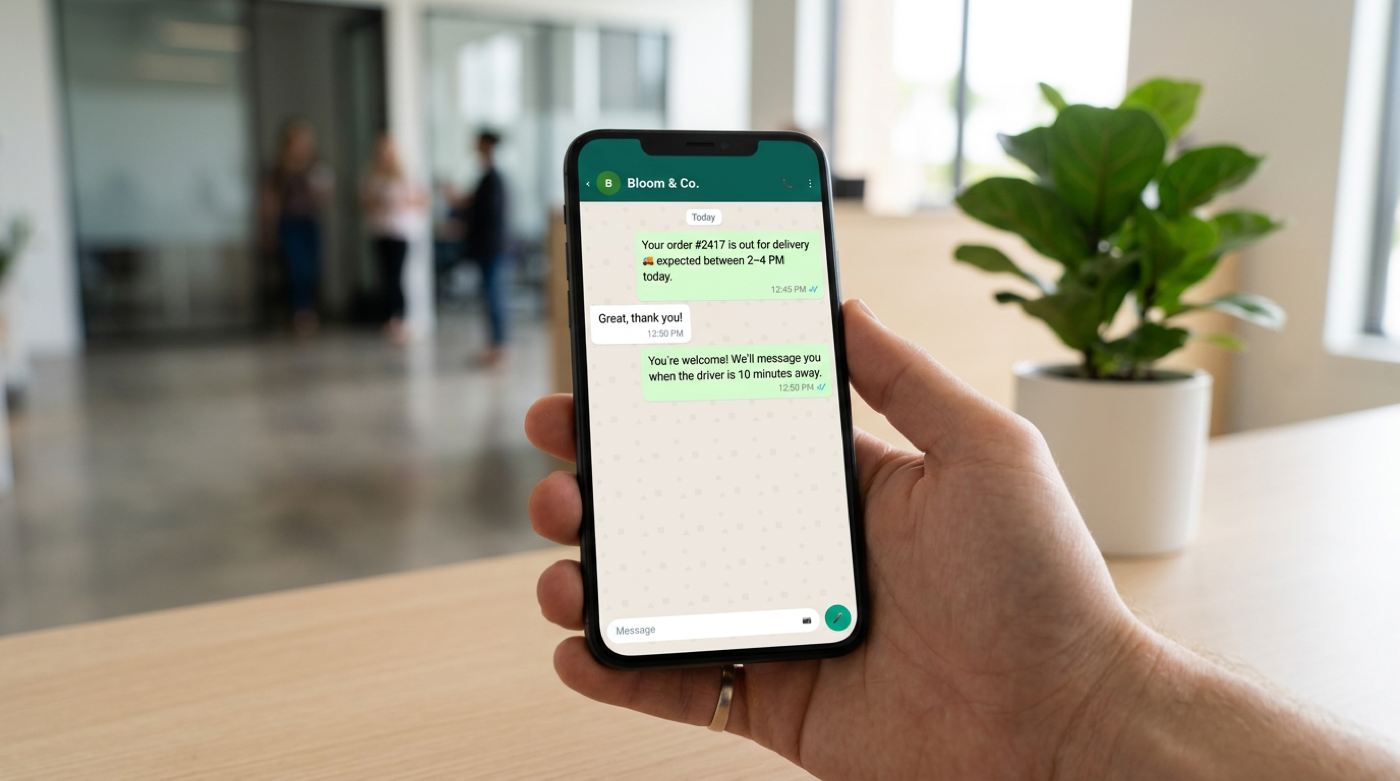
- Utility: follows from a specific action or transaction the customer already took. WhatsApp's own pricing page describes utility messages as typically triggered by a user action, like placing an order or submitting a payment. SleekFlow's template guide lists the same family: order confirmations, shipping updates, appointment reminders.
- Marketing: anything with commercial intent. Meta's pricing documentation places offers and promos, related product suggestions and abandoned cart reminders here, spanning the funnel from awareness to retargeting.
- Authentication: identity verification only. One-time passwords, login codes, account recovery links, as SleekFlow's guide sets out. The format rules are the tightest of the three, because Meta wants OTP messages to behave consistently across every business on the platform.
Opt-in requirement
Marketing requires prior opt-in, and the compliance analysis at AuditSocials puts it plainly: only marketing templates carry promotional content, they must be submitted for approval, and they may only go to contacts who have opted in. Utility and authentication have a narrower opt-in footprint because they arise from a transaction the customer initiated, but they carry a hard constraint of their own. They must stay within their designated purpose, which is what Meta's business policy requires. A utility template used to solicit business is a policy breach dressed as a reminder.
Price tier
Category is a price tier, and the gap is not small. Kanal's 2026 template guide puts marketing templates in France at around 0.0691 EUR per delivered message, utility at 0.0162 EUR, and authentication at 0.0316 EUR, with rates varying by country. In that market marketing runs roughly four times utility. Whatever your own country rate, hold that ratio in your head the next time someone suggests appending a promotional line to a reminder. Saysimple's pricing explainer adds the structural point: pricing is built around conversation categories and charged per country, not per individual message sent.
How categories get reassigned
WhatzCRM's category breakdown notes that re-categorisation typically happens when a transactional message contains promotional language, a discount code, or a product recommendation. The practical version: your appointment reminder is utility, and your appointment reminder with "ask about our summer package" appended is marketing, for the whole message, permanently. One line of copy moves the price tier of every send.
The October pricing change and what it does to your category mix
Two things that are currently free stop being free on October 1, 2026. Saysimple's explainer sets it out: service messages sent inside the 24-hour customer service window become chargeable, and so do utility templates sent inside that same window. As of today that is roughly six weeks away, a genuine deadline rather than a change you missed.
This matters for category strategy specifically, not just for budgeting. A lot of the builds we inherit lean hard on free in-window messaging, batching utility sends into the window after a customer replies. That arbitrage closes this autumn. Model your volume against the new structure now, because the cheapest category is about to stop being free in the place where most automated flows put it.
Choosing the category for messages service businesses actually send
The dropdown is easy. The judgement is not. Here is how we categorise the messages that come up in almost every clinic, salon and agency build:
- Appointment reminder, no offer attached: utility.
- Rebooking prompt after a completed treatment cycle: marketing, because it solicits new business rather than servicing an existing transaction. People argue about this one. We come down on marketing.
- Payment link for an issued invoice: utility.
- Post-visit feedback request: utility if it purely gathers feedback, marketing the moment it carries a referral incentive.
- Property viewing confirmation with the agent's contact details: utility.
- New listing alert to a saved-search contact: marketing, opt-in required, no exceptions.
- Portal or record-access code: authentication.
- Waitlist notification that a slot opened this afternoon: genuinely contested. It responds to a request the client made, which argues utility, but it also solicits a booking. We submit it as utility when the client explicitly joined the waitlist and the copy names the specific slot, and we accept that Meta may disagree.
- Prescription or product ready for collection: utility.
- Seasonal price list sent to past clients: marketing, and it needs opt-in that predates the send, not consent you assume because they were once a customer.
Where reasonable people disagree most is the boundary between servicing an existing relationship and selling into it. There is no bright line published anywhere, and anyone telling you there is has not submitted enough templates. Our rule of thumb: if the message would still make sense to send to a client who will never spend another dirham with you, it is utility.
The test we give clients when they are stuck
Ask what happens if you delete the message entirely. If the customer is left confused about something they already did (they do not know when their appointment is, whether their payment landed, where to collect something), the message is utility. If the only loss is a missed revenue opportunity for you, it is marketing. That single question resolves most disputes in a planning meeting before anyone opens the template manager.
Opt-in sits underneath the whole system
Marketing templates require prior opt-in under Meta's policy, and that requirement is upstream of everything else in this article. A perfectly written, correctly categorised marketing template sent to someone who never consented is still a violation, and the category was never the protection.
The farming comparison we keep returning to with clients: opt-in is water rights, not water. Owning a field does not give you the right to draw from the canal, and having a phone number in your CRM does not give you the right to send marketing to it. The channel exists, the number is valid, the message will technically deliver. That is not the question. The question is whether you were permitted to open the gate.
Businesses in the UAE have a second layer to think about, because local data protection obligations run alongside Meta's platform rules and satisfying one does not automatically satisfy the other. We set out the detail separately in our PDPL reactivation reference, which is the place to start if you are sitting on an old contact list and wondering what you may legally message.
For readers who already run templates at volume
If you have twenty approved templates and a functioning flow, the definitions above are behind you. Two category-selection problems appear only at volume, and both are decision problems rather than copy problems.
Variables can change the category after approval
A template body can be perfectly utility while a variable slot is filled at send time with promotional content. The approved text reads that the client's appointment with {{1}} is confirmed for {{2}}. Nobody reviews what a marketing coordinator puts in {{2}} six months later. When you are choosing a category, choose it for the widest thing that variable could ever contain, not for the example you submitted. If a slot might one day carry an offer, the honest category is marketing from day one. (The related discipline of keeping templates clean enough to survive re-review is a maintenance job, and worth its own audit rather than a paragraph here.)
Category logic belongs in your CRM, not in a vendor dashboard
This is our standing position on platform lock-in. If the rules about which template fires when exist only as configuration inside a provider's UI, you cannot audit your category decisions, you cannot migrate them, and you will pay in weeks of rebuild the day you switch. Keep the trigger logic in your own CRM or in documented, exportable form. The cheapest tool that traps your message logic costs more to leave than a pricier one with open APIs. We build this way deliberately, and it runs through how we think about automated systems that hold up.
Where this advice breaks
The framework above assumes a few things that are not always true, and it is worth attacking it directly.
It assumes your message volume justifies the overhead. A single-practitioner clinic sending fifteen reminders a week does not need a category governance policy. The disputes, the documented rules, the monthly invoice check: all overhead that will not pay for itself at that scale. Send your reminders, keep the copy clean, move on. Category discipline earns its keep somewhere north of a few hundred business-initiated conversations a month, and below that it is theatre.
It assumes clean separation between service and sales, which some businesses genuinely do not have. An aesthetics clinic where the treatment plan and the upsell are the same conversation cannot always split a message into utility and marketing without making it worse for the client. The honest answer there is to send it as marketing, pay the higher rate, and stop engineering around it. We have had this argument with clients who wanted the utility rate for a message that was plainly promotional, and it ends the same way every time: Meta decides, and you lose slowly.
Our utility-first bias breaks where volume meets the October pricing change. A high-volume operator who has built everything around cheap utility and free in-window messaging is about to see costs rise on messages that currently cost nothing. If that describes you, the answer is not more utility templates. It is fewer, better ones, plus a serious look at which conversations should be on WhatsApp at all versus a phone call, an email, or an AI voice agent that costs differently.
And at real scale, the category question stops being the interesting one. Once you have several thousand contacts across multiple consent states, the live question is not which category a message belongs to but which segment is even eligible to receive it. That is a data problem, and no amount of category precision fixes it. It is the same underlying issue we describe in our work on connected revenue cycles: the channel is downstream of the record.
One more limit, stated honestly: automation of any category cannot carry a relationship. A perfectly categorised reminder is a field being irrigated on schedule, which is not the same as someone walking the rows. Our position on this has not moved. The machine should handle the water so your staff can spend their time on the crop, which in a clinic or a salon means the conversation a client is actually paying for.
A short worked example
A multi-branch aesthetics clinic, a composite of projects we have worked on, came to us with one template doing three jobs. It confirmed the appointment, listed aftercare notes, and closed with a line inviting the client to book a follow-up package. Submitted as utility. Approved as utility. Billing, when we checked, at marketing.
We split it into three. A utility confirmation with the date, time and practitioner. A utility aftercare message sent the evening after treatment, with no commercial language at all. And a separate marketing template for the follow-up package, sent only to clients with recorded opt-in, at a sensible interval rather than stapled to the confirmation. The clinic now pays the utility rate on two of the three, pays marketing on the one that is honestly marketing, and the aftercare message gets read because it is not carrying a sales line.
That is the whole discipline in miniature. One message, one purpose, one category.
Common questions, answered
Which WhatsApp category should I choose for an appointment reminder?
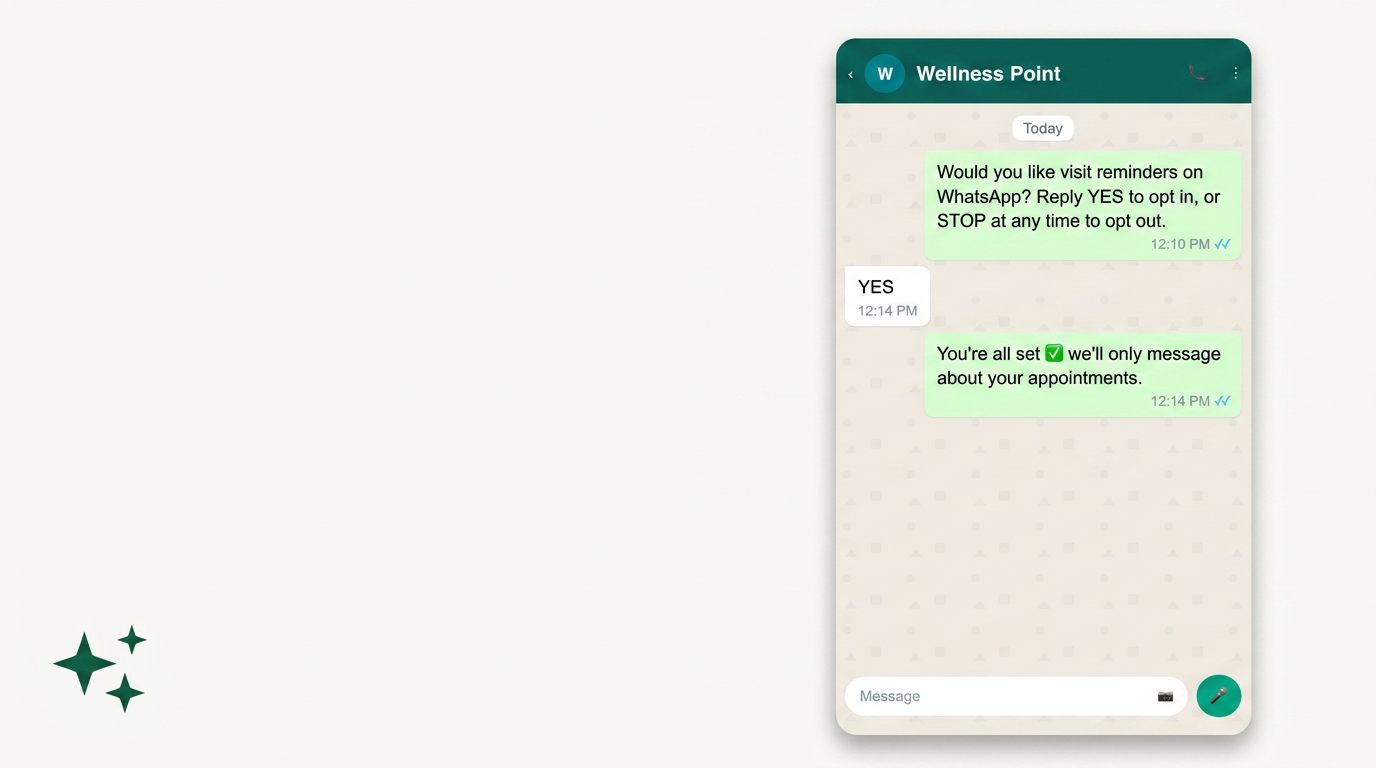
Choose utility, provided the reminder contains nothing promotional: date, time, practitioner, location, and how to reschedule. The moment you add an offer, a discount code or a product suggestion, the correct category becomes marketing and it will need prior opt-in.
What is the difference between utility and marketing messages on WhatsApp?
Utility messages follow from a specific action the customer already took, such as booking, paying or placing an order, while marketing messages carry promotional intent and require prior opt-in. Utility is substantially cheaper: Kanal's 2026 figures put French marketing templates at around 0.0691 EUR against 0.0162 EUR for utility, and Meta assigns the final category during review regardless of what you selected.
Are WhatsApp utility messages still free?
Utility templates sent inside the 24-hour customer service window are free until October 1, 2026, after which both those utility templates and free-form service messages become chargeable. Businesses whose automation leans on in-window sending should model the cost change before it lands.
What to do about it
This week, take every template you send and ask the deletion test on it: if removing the message would only cost you revenue rather than leave the client confused, it belongs in marketing and needs opt-in behind it. Learnmind builds WhatsApp and AI phone systems for clinics, salons and agencies from our base in Dubai, and if you want the category map drawn properly and the trigger logic built somewhere you can still read it after your next platform change, that is a conversation worth having before October.