You answer your WhatsApp within the hour. Your front desk calls every parent the day before a session. You already send reminders, so as far as you are concerned the no-show problem sits with the parents rather than with your systems.
We hear a version of that from most tutoring centers we speak to. Then we ask two questions. What time of day does your front desk make those calls, and what happens to the parents who do not pick up? The answer comes back the same way nearly every time: calls go out in the late afternoon, which is exactly when the center is at its busiest, and when a parent does not answer, nobody calls back. The reminder existed on the task list. It never reached the person who needed it.
That is the gap. Not effort, not care, not staff quality. Coverage.
The short answer
WhatsApp no-show reminders for tutoring centers work by sending every parent a short confirmation request at fixed intervals before the session, capturing a yes or no reply inside the chat, and immediately offering an alternative slot to anyone who says no. This beats phone calls because the message lands on the channel parents already read, it asks for a decision instead of announcing a time, and it never skips a family because the front desk got busy. The effect is well measured in healthcare, the sector with the best attendance data: a systematic review and meta-analysis in BMJ Open covering 26 studies and more than 16,000 patients found that digital reminders cut no-shows by roughly a quarter, with no-show rates of 15% among reminded patients against 21% without.
The center described below is a composite scenario assembled from patterns we see in tutoring work rather than a single client, and no measured results are attached to it. It swaps manual afternoon phone calls for a three-touch WhatsApp sequence with in-chat confirmation and automatic rescheduling. Everything from here is about the mechanics: which of the three touches does the real work, what the wording has to say to earn a reply, and the three situations where this setup does nothing at all.

A full timetable that was not a full room
An after-school tutoring operation in Dubai. One-to-one and small-group sessions, mid-afternoon to late evening, six days a week. On the wall calendar the week looked booked solid. In the rooms it did not match.
The no-show pattern had a recognisable shape, one that repeats across the sector:
- Sibling confusion. One parent, two or three children, different tutors on different days. The parent remembered a session. Not always the right one.
- Reschedules that lived in a chat thread. A change agreed verbally or over WhatsApp with a tutor, never written into the calendar the front desk works from.
- Silent drop-off. A student stops attending without ever cancelling, and the slot stays blocked because nobody wants to be the one who calls to ask.
The cost was concrete. A tutor sitting in an empty room for a paid hour is money leaving the building, and unlike a shop with stock on a shelf, the center cannot sell that hour later. Time-based inventory does not keep. This is why reducing no-shows is the fastest ROI win available in appointment-based automation: an empty slot is pure loss, while the sequence that prevents it costs very little to run once it exists. Under Meta's published pricing for the WhatsApp Business Platform, replies inside an open customer service window are free to send, and a proactive utility reminder outside one carries a small fee per delivered message, fractions of a dirham against the price of an empty tutoring hour.
The second cost was quieter. The front desk spent the busiest part of the afternoon dialling parents instead of greeting arriving families and answering the enquiry messages stacking up unread. Prospects leaked out the front door while the team chased attendance out the back.
What we changed, and why in that order
This center's competitive advantage is teaching, so rather than build a bespoke platform we bought and configured proven tools and spent our own hours on the sequence logic. Build custom only when the workflow itself is your edge. For a tutoring center the edge is the curriculum and the tutors; the reminder engine is plumbing. Your team's time is the scarcest thing in the building.
Off the phone, onto WhatsApp
The phone call went first. A call requires two people to be free at the same moment, which in a tutoring center's peak hours is close to never. A message does not. Think of it as the difference between knocking on a door and hoping someone is home, versus sliding a note under it that gets read the next time they walk past. The reminder lands in the app parents already use all day, with no separate inbox to remember and no new habit to build.
Three touches at three distances
A single reminder is an announcement. Three reminders at different distances from the session form a decision funnel. The clinical evidence backs the repetition: in the same BMJ Open pooled analysis, patients receiving multiple notifications attended 78% of the time against 62% for a single notification. The cadence we install:
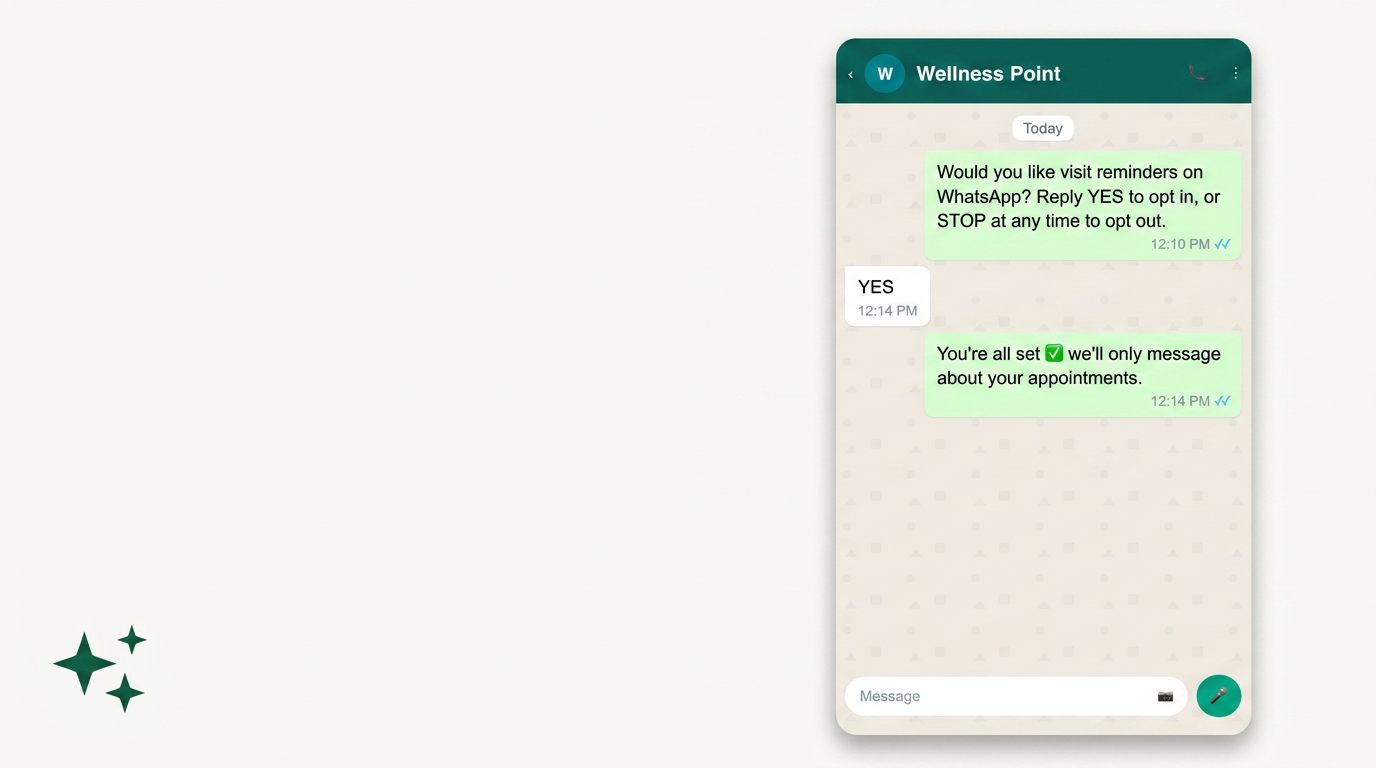
- 48 hours before: a confirmation request naming the student, subject, tutor, day, and time, with two reply options: confirm, or ask for a different time.
- Morning of the session: a one-line reminder to anyone who confirmed, and a second confirmation request to anyone who has not replied.
- Two hours before: a final short nudge with the tutor's name and the room or location.
The 48-hour touch is the one that earns its keep. It sits far enough out that a parent with a conflict can act on it, which means the center gets the slot back with a day and a half of runway to refill it. The two-hour nudge handles ordinary forgetting. The morning touch catches the families who read the first message, intended to reply, and got pulled into something else.
One rule sits underneath all three touches. WhatsApp's Business Messaging Policy permits proactive messages only to people who have shared their number with you and given opt-in permission, and it requires you to honour every opt-out. Collect consent at enrolment, record it, and the whole sequence stands on solid ground.
Wording that asks for a decision
The wording mattered as much as the timing. Their old phone script described the appointment. Our first draft of the templates did too, and we rewrote it. A reminder that describes is a notice board. A reminder that asks is a conversation, and only conversations produce cancellations early enough to be useful.
- Lead with the student. A parent with three children processes "session tomorrow at 5pm" very differently to a message that opens with the child's first name and subject.
- One question, two answers. Confirm or reschedule. Never an open-ended "let us know if anything changes", which reliably produces silence.
- Make rescheduling the easy path. If cancelling feels like a confession, parents go quiet instead. If the message offers two alternative slots on the spot, they take one.
- Keep it to a few lines. Long templates get skimmed, and the time is what gets skimmed past.
This wording work also decides what you are permitted to send at all. Meta's documentation for the WhatsApp Business Platform states that once the 24-hour customer service window opened by a parent's last message closes, a business can only send pre-approved template messages, so every proactive reminder must exist as an approved template first. The reminders in this cadence fall under what Meta's template categorization calls utility templates: non-promotional, specific to the recipient, and tied to an existing booking, which is the classification that keeps both approval and cost on the favourable side. And per Meta's template review process, an approval decision can take up to 24 hours, so getting templates right on the first submission spares you rejection-and-resubmit cycles that cost about a day each.
Closing the loop instead of collecting replies
Here is where most reminder setups stop, and where the money actually sits. A "no" reply is worthless if it lands in an inbox nobody triages. In this build, a reschedule request triggers an immediate offer of open slots with the same tutor, pulled from the live calendar. The parent picks one in the chat and the booking moves without a human touching it. A cancellation with no rebooking gets flagged for human follow-up the next morning, which is how the silent drop-offs that used to block a slot for weeks now surface within days.
We have argued before that the follow-up sequence is the part of a WhatsApp build that produces revenue, well ahead of the chatbot everyone asks about first. Attendance reminders are the same principle aimed at existing customers instead of new leads.
What changed after the switch
Attendance improved and held, though we will not attach a percentage to a composite scenario. The honest answer is that the size of the gain depends almost entirely on how bad your coverage was to begin with. The pooled evidence gives you a realistic range: digital reminders cut no-shows by roughly a quarter against no reminder at all, and multiple notifications lifted attendance to 78% against 62% for a single one. A center moving from unanswered afternoon phone calls to a reliable three-touch sequence is making exactly the single-to-multiple move that sits at the favourable end of that comparison.
Three changes were not in the original brief, and they matter more than they sound.
Cancellations moved earlier. Before, cancellations arrived on the day or never arrived at all. After, a meaningful share landed on the 48-hour touch, early enough to offer the slot to a family on the waiting list. The same number of cancellations is worth a wildly different amount of money depending on when it reaches you.
The front desk got the afternoon back. The dialling time went to arriving families and inbound enquiries instead. Automation redirects attention as much as it saves labour, pushing the freed hours toward the conversations that were being dropped, which is the compounding effect we documented in our 90-day front desk study.
Parents started using the thread for everything else. Once a WhatsApp thread was live and reliably answered, families used it for progress questions, invoices, and holiday schedules. Volume went up, which is a good problem, and it is the reason centers usually expand the same system to handle enquiry qualification next.
Three ways a reminder rollout goes wrong
Better that you hear the failure modes now than discover them in month two. All three of these show up on live projects.
A calendar that is not the single source of truth
If tutors keep their own schedules in notebooks or private spreadsheets, an automated reminder will confidently send parents the wrong time. Automation does not fix a data problem, it broadcasts it at scale. Before any sequence goes live, one calendar has to be authoritative and every tutor has to work from it. This is the most common reason a reminder rollout gets paused halfway.
Replies with nobody behind them
A confirmation request creates an obligation. If a parent asks to move to Thursday and gets silence, you have taught that family the channel does not work, and the next reminder gets ignored on principle. Either the automation handles the reschedule end to end, or a named human owns the queue with a stated response time. Half-built is worse than the phone calls were.
Too many touches
Reminder frequency has a ceiling. Push past it and parents mute the thread, which kills every future message including the ones about fees and closures. Three touches worked here. We have watched centers add a fourth and a fifth just to be safe, and watched engagement fall for it. A reminder cadence works like irrigating a field: you can always open the valve a little further, but water you have already flooded into the soil cannot be taken back out, so increase the flow slowly and watch how the ground responds.
What generalises to your center
Learnmind is an AI customer-communication consultancy in Dubai, and reminder sequences are among the first pieces of work we recommend to tutoring centers, clinics, and salons. The part that transfers is the order of operations.
Start by knowing your own no-show rate as a number, for a defined period. Most operators cannot quote it without going to look, which is itself a finding. Then clean the calendar until one system is authoritative. Then install the sequence, asking for a decision rather than announcing a time, and make rescheduling the easiest available action in the message. Only after that is running reliably should you point the same channel at your enquiry inbox, which is the wider play we describe for centers pulling ahead of competitors still returning calls at six in the evening.
And measure the timing of cancellations as well as the count. A cancellation 48 hours out is a slot you can sell. A cancellation at 5:55pm is a tutor alone in a room. Most of the financial gain from a reminder sequence hides inside that difference.
Questions we hear about this
How much can WhatsApp reminders reduce no-shows?
The most reliable published evidence comes from healthcare, where attendance is tracked obsessively: across 26 studies and more than 16,000 patients, the BMJ Open meta-analysis found reminded patients were 25% less likely to miss appointments, and multiple reminders raised attendance to 78% against 62% for a single one. How much you gain depends on your starting point: a center whose current reminders are unanswered afternoon phone calls has far more to recover than one already confirming every booking.
When should a tutoring center send reminders before a session?
Send a confirmation request 48 hours before the session, a short follow-up on the morning of, and a final nudge about two hours before. The 48-hour touch is the valuable one, because it is the only one that arrives early enough for you to resell a cancelled slot.
Do parents find automated WhatsApp reminders annoying?
Not at three touches per session, with short messages that name the student and the tutor. Complaints and muted threads show up when a center adds extra reminders or pushes promotional text through the same thread.
What do you need in place before automating reminders?
One authoritative calendar that every tutor updates, documented opt-in permission from each parent as WhatsApp's Business Messaging Policy requires, approved WhatsApp Business API message templates, and a named person who owns replies the automation cannot resolve. Without the calendar, reminders will simply send parents the wrong times faster than before.
If tutors are sitting in empty rooms and nobody can say how often it happens, we will build the three-touch WhatsApp reminder sequence for you: the template wording, the Meta approval, the in-chat rescheduling, and the follow-up queue that catches whatever the automation cannot.