You answer your WhatsApp within the hour. Your team is on it all day, the phone never stops buzzing, and nobody has complained. That should be enough.
It is enough for the conversation. It is not enough for the business. The gap between those two sentences is where the money leaks, and it is invisible from inside the chat window, because the chat window is doing its job beautifully. What is failing sits behind it: the record, the attribution, the follow-up that should have fired on day three, the client who asked about a treatment in March and was never contacted again. Your CRM did not catch any of that. Not because your team configured it badly, but because the software was designed in an era when a customer relationship meant an email thread and a call log, and WhatsApp arrived years later as a plugin.
The thesis in one paragraph
A WhatsApp-native CRM stores the conversation as the primary record and builds contacts, pipelines and automations outward from it, while a traditional CRM stores structured fields as the primary record and treats WhatsApp as one more channel plugged into a contact card. That architectural difference decides what the system can see: a WhatsApp-native CRM knows the 24-hour service window is closing, which approved template can reopen it, and which agent owns the thread, whereas a traditional CRM knows only that a message object was attached to a contact at 14:12. For a service business whose enquiries arrive by chat, that blind spot is not cosmetic; it determines whether a lead gets followed up at all.
The false choice the industry keeps selling you
Walk into any software comparison on this subject and you are handed a binary. Option one: keep your proper CRM, the one finance likes, and add a WhatsApp integration. Option two: throw it out and run the business from a WhatsApp inbox tool. Both options, as they are normally framed, are wrong, and they are wrong for the same underlying reason.
Option one fails because integration is not architecture. When WhatsApp is a connector, the CRM's data model still assumes a lead has an email, that campaigns are sends rather than conversations, and that timing is a scheduling preference rather than a platform rule. The messaging vendors describe this honestly enough. Respond.io's teardown of WhatsApp CRM systems notes that delays usually come from asset ownership issues, ineligible numbers, incomplete field mapping and workflows built before templates, permissions or routing rules were tested end to end. Read that list again. Every item on it is an architectural mismatch, not a settings problem. You cannot map a field that does not exist in the destination schema.
Option two fails for the mirror-image reason. A WhatsApp inbox tool with a kanban board attached is excellent at conversations and hopeless at everything a CRM is actually for: revenue attribution, cohort reactivation, lifetime value, the tedious accounting of who was promised what. Interakt's comparison sets out the contrast cleanly, noting that traditional CRM primarily uses emails, phone calls and web forms and is better for formal communication but slower and less interactive. That is a fair description of the trade-off, and most buyers read it as a menu. It is a description of two incomplete systems.
The real choice sits underneath both: whether the conversation is the system of record or a decoration on top of one. A conversational-native CRM does not abandon structured data. It derives structure from dialogue, which is the only way to get both. Every operator we have met who insisted on the binary ended up running two systems, reconciling them by hand, and calling that an integration.
What the architecture actually decides
Forecasting is a useful way to see this. A weather model is only as good as the stations feeding it. You can run the most sophisticated model in the world, and if the sensors sit in the wrong locations, sampling the wrong variables at the wrong frequency, the forecast is confidently wrong. Legacy CRMs are dense models fed by sensors pointed at email opens and call durations. WhatsApp is the storm system, and there is no station on it.
The channel is not one channel among several
The comfortable position is that WhatsApp is a channel to be added alongside email and SMS. The engagement numbers refuse to support that framing. Runo cites a 98% open rate on WhatsApp against 20% for email, and reports that according to Meta, 66% of customers prefer messaging a business over email or phone calls. nocrm.io puts WhatsApp at over 2 billion active users globally. A channel that outruns your other channels by that margin on engagement is not one option among several. It is the front door, and everything else is a side entrance you keep unlocked out of habit.
In Dubai this is past arguing about. Clients message a clinic on WhatsApp before they will call it, and a business that answers slowly there is invisible to entire market segments no matter how good its email nurture sequence is. We have watched a salon with a well-tended CRM instance lose a month of enquiries because those enquiries never became records at all. Nobody was negligent. The chats simply happened somewhere the software was not looking.
The clock the legacy system cannot see
WhatsApp enforces rules that email never had, and a CRM that does not model those rules will break them on your behalf. Ultimate Agency's guide is blunt about it: businesses have to work with message templates, 24-hour reply windows and the technical setup of the API, and scaling conversations requires real CRM integration so teams are not overwhelmed. Omnichat makes the related point that advanced capability sits behind the WhatsApp Business API rather than the standard Business app, and that scaling conversational commerce means the messaging layer cannot exist in a vacuum.
Here is what that means at the operating level. A traditional CRM's automation engine thinks in terms of send at 9am on day three. WhatsApp thinks in terms of this window closed at 14:12 yesterday, so the only thing you may send now is an approved template in the correct category, and the wrong category carries a different price and a different level of user tolerance. A system that cannot hold both concepts in its data model will either send nothing, send the wrong thing, or send something that gets your number rated down. We see all three, weekly.
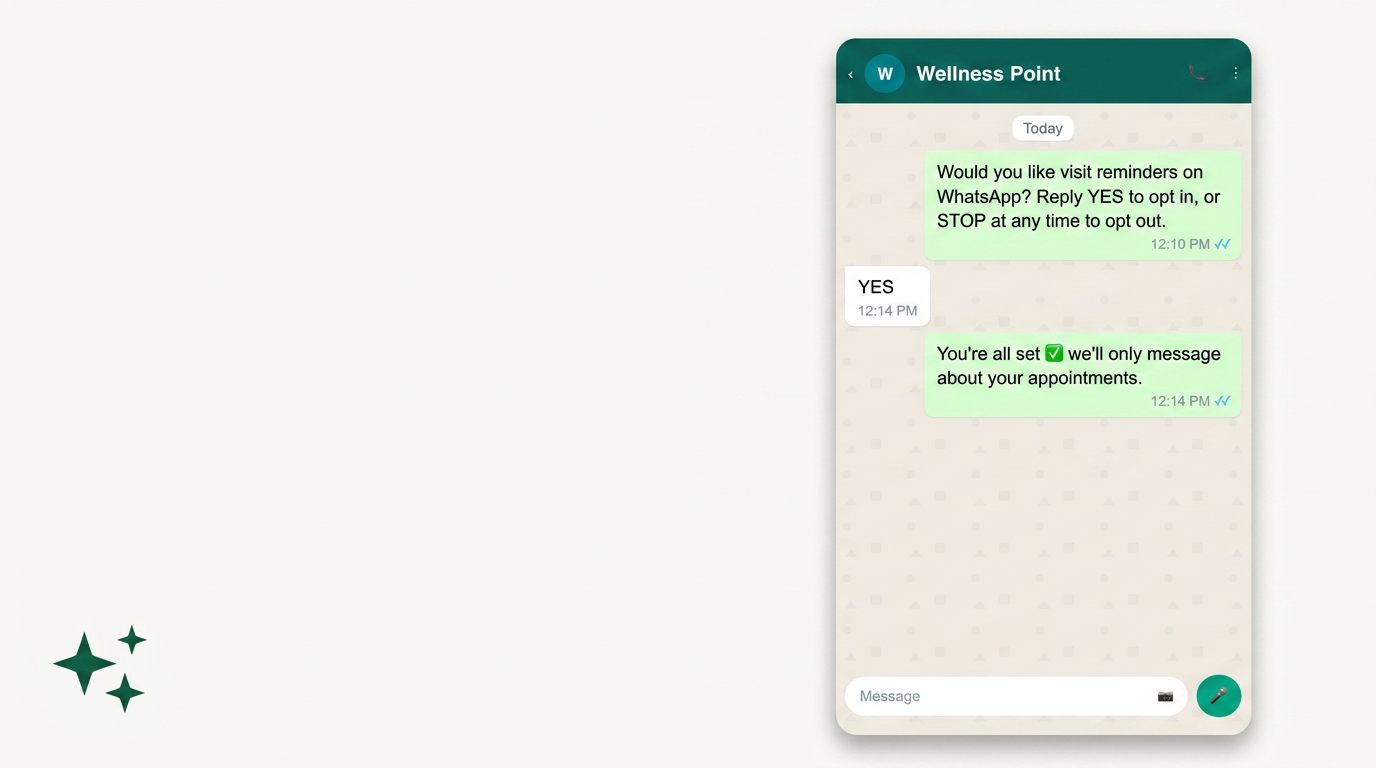
Consent behaves the same way. Reactivating a dormant database over WhatsApp is one of the highest-return moves available to a service business, and it is also the fastest route to a complaint if the opt-in provenance is not attached to the contact record itself. We wrote the long version in our note on PDPL-compliant reactivation. A legacy CRM will happily store a phone number with no record of how you earned permission to message it on WhatsApp specifically, because the schema was drawn when consent meant an email checkbox.
The no-show problem, which is the whole argument in miniature
Reducing no-shows is the single fastest ROI win in appointment-based automation, because an empty chair at 3pm cannot be resold and a well-timed reminder sequence costs almost nothing to run. It is also the clearest demonstration of the architecture point. A reminder that lands by email gets read by one in five people. The same reminder on WhatsApp gets opened almost universally, and, more to the point, gets replied to, which means the patient who cannot make Thursday tells you on Tuesday and you refill the slot.
That reply is the part legacy systems fumble. In an email-native CRM, an inbound reply is an unstructured blob a human has to read and act on. In a conversational-native CRM, the reply is the trigger: it cancels the appointment, opens the slot, offers it to the waitlist, and logs the reason. Same reminder, same channel, completely different revenue outcome, and the difference lives entirely in where the record sits. We unpacked the operational version of this in our piece on connected revenue cycles.
The strongest objection, which is better than most people who make it realise
The best argument against everything above runs like this: WhatsApp is a rented channel with a landlord who changes the rules, and building your system of record on top of it is a governance risk. Meta sets the pricing. Meta approves the templates. Meta's commerce policies exclude certain industries outright, which means a business in a restricted category can build a beautiful WhatsApp-first operation and then discover the platform will not carry it. Email and phone belong to nobody, which is precisely their virtue.
We take this seriously, because it is true. It is also an argument for a specific design, not for retrofitting. The correct response to platform risk is that your customer records, consent trail and conversation history live in your own database, portable and exportable, with WhatsApp as the transport layer rather than the vault. A conversational-native CRM built properly does exactly that: it models WhatsApp's rules faithfully because that is what makes automation safe, and it owns the data independently because that is what makes the business durable. What it does not do is pretend the rules are optional, which is the working assumption of every bolted-on integration we have inherited.
The weaker version of the objection, the one we hear more often, is that a big-name CRM has better reporting. It usually does, on the metrics it was built to report. It reports on pipelines and deal stages beautifully and cannot tell you your median first-response time on WhatsApp during Saturday peak, which for a salon is the number that predicts next month's revenue. Better reporting on the wrong variables is the badly-placed weather station again: high resolution, wrong location.
What changes if we are right
If the argument holds, three habits stop being defensible.
- Evaluating WhatsApp support as a feature checkbox. The question is not whether a CRM integrates with WhatsApp, because every vendor claims it does. Taskip's comparison of CRMs with WhatsApp integration lists tools where multi-agent, chatbot and omnichannel support are each marked full, limited or absent in different combinations, and the feature grid makes the fragmentation obvious. The real question is what the system does when a conversation contradicts a field.
- Treating the inbox and the database as separate purchases. If your team is copying details from a chat into a contact record, nothing has been integrated. You have hired a human API.
- Measuring the channel by volume instead of by conversion. Superchat notes that WhatsApp's reach and near-universal acceptance make customer contact easy, using UK adoption figures to illustrate how little of the market sits outside the app. Reach is the easy part. What matters is how many of those conversations produced a booking, a rebooking, or a recorded reason for the loss.
Practically, the shift is from asking whether a system can connect to asking what the primary key of that system is. If the answer is a contact record with a phone field, you own a traditional CRM with a WhatsApp plugin, whatever the sales deck says. If the answer is a conversation thread with identity, consent, window state and ownership attached, you own something that can run a WhatsApp-first business. Learnmind, a Dubai firm that wires AI into the front desks of service businesses, spends most of its build time on that second model and most of its rescue work undoing the first.
None of this is a reason to rip anything out this quarter. Businesses that survive their busy periods usually do it by changing how work flows rather than by buying new software, which is the argument we made about rewriting operational DNA. Start by finding out what your current system genuinely knows about your WhatsApp traffic. In our experience that audit changes minds faster than any comparison table.
Frequently asked questions
What is the difference between a WhatsApp native CRM and a traditional CRM?
A WhatsApp-native CRM treats the conversation thread as the system of record and models WhatsApp's own rules, such as the 24-hour reply window and approved message templates, inside its automation logic. A traditional CRM is built around structured contact fields with email and phone as primary channels, and attaches WhatsApp messages as external objects on a contact card.
Can I just add a WhatsApp integration to my existing CRM?
You can, and it will sync messages, but syncing is not the same as modelling the channel. Integrations commonly stall on field mapping, number eligibility and workflows built before templates and routing rules were tested, so the conversation stays readable while the automation around it stays blind.
Do I need the WhatsApp Business API or is the Business app enough?
The standard WhatsApp Business app is enough for one person answering messages manually, but multi-agent routing, automation and CRM integration require the WhatsApp Business API. Businesses scaling conversational commerce need the API because the app has no way to connect messaging to the rest of the operation.
Is WhatsApp really better than email for customer follow-up?
On engagement the gap is not close: WhatsApp shows a 98% open rate against 20% for email, and Meta reports that 66% of customers prefer messaging a business over email or phone. The larger advantage is that WhatsApp follow-ups get replies, which can trigger a rebooking instead of sitting unread.
Which types of business cannot use WhatsApp as their main CRM channel?
WhatsApp's commerce policies exclude certain industries outright, so any business in a restricted category should confirm eligibility before building its operation around the platform. For everyone else, the binding constraint is consent provenance rather than the platform itself.
Send us one artifact from your setup: your approved template list, your opt-in wording, or the reminder copy you send before appointments. We will read it against how WhatsApp actually enforces windows and categories, and tell you what your current CRM cannot see.