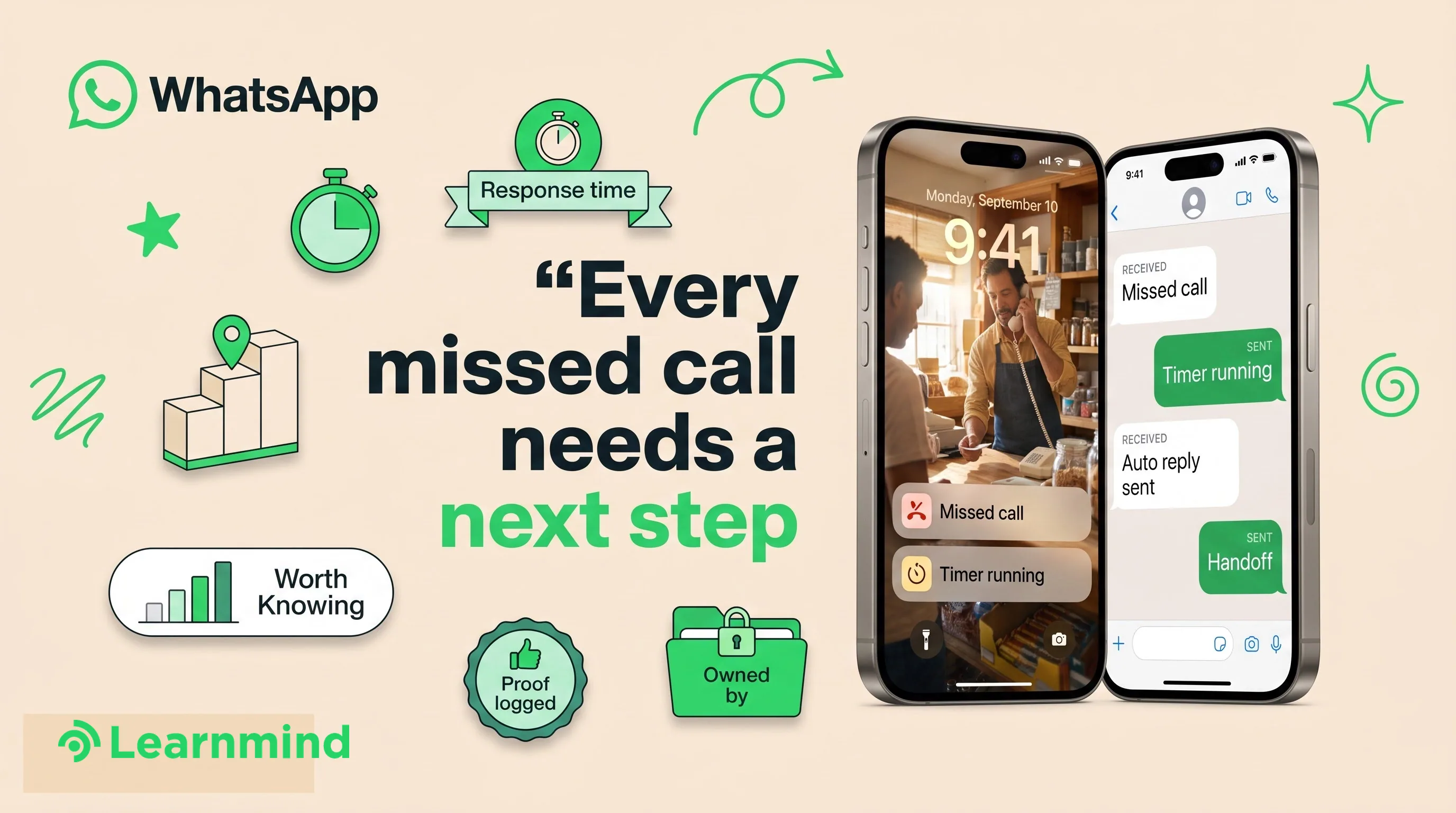
One vendor analysis of missed call follow-up reports that responding within five minutes lifts lead qualification rates by up to 21x compared with waiting thirty minutes or more. Take the multiple with appropriate scepticism, since it comes from a company selling the fix. The direction is still worth acting on, and the same analysis frames the choice plainly as seconds over hours.
The problem is that missed call automation human handoff is not one thing. It is a chain of five events across ninety seconds, each owned by a different system, each with its own failure mode. Most setups die at a link the owner never inspected. This piece maps the chain and gives you the decision framework to audit yours this week.
The Framework: Own It, Time It, Prove It
Apply three questions to every link in the chain. Own it: which system is responsible, and who at your company can log into it. Time it: what is the worst-case latency of this step, not the average. Prove it: what artefact exists afterwards showing the step fired, that you can inspect without asking a vendor.
A link that fails any one of the three is where your chain will break. In the audits we run for clinics and agencies, the failing link is almost never the AI. It is a telecom setting nobody owns, a template nobody logs, or an inbox nobody reads.
Second Zero: The Call Nobody Picks Up
A missed call is not a single event. There are at least four kinds, and they trigger different things: ring-out to voicemail, busy signal on an engaged line, out-of-hours rejection, and the call answered by a human then abandoned on hold. Most automations only fire on the first.
That gap is the single most common cause of the "our system works but leads still vanish" complaint. A salon on Jumeirah Beach Road with two lines running hot at 6pm generates mostly busy-signal misses. If the trigger is voicemail-only, the busiest hour of the week produces no follow-up at all.
Own it: your telephony provider (Etisalat/e& or du in the UAE, or your cloud PBX). Prove it: pull the call detail record for last Saturday and count how many calls ended with disposition busy or abandoned rather than voicemail.
0 to 10 Seconds: The Voicemail Trigger and What Fires It
The trigger is a webhook or an event in your call platform. Where a human receptionist is replaced or backed up by an AI voice agent, that agent handles the call itself and then hands off; missed-call text-back is a standard capability, offered for instance in GHL Scale Up's voice agent alongside a 24/7 AI receptionist.
Three things go wrong here. Ring duration set to thirty seconds means your "instant" response is already half a minute late. Carrier-level voicemail (rather than voicemail inside your PBX) often emits no webhook at all, because the call left your system before it was missed. And a diverted call to a mobile can be marked answered by the platform even though nobody spoke.
The rule worth writing on the wall: if the miss is not detected inside your own platform, no downstream automation exists.
10 to 30 Seconds: The Message Leaves the System
The trigger fires an SMS or an email, sent the moment a call goes unanswered. In practice this runs through a workflow layer with triggers, sequences and conditional logic, the pattern described in workflow automation services, and the sending itself through a CRM or an API provider. The same vendor analysis lists Zapier, Twilio and existing CRM workflows as the usual routes.
In the UAE this is the link where most builds get amputated. A2P SMS to UAE mobile numbers requires a registered sender ID through the local aggregators under TDRA rules, and unregistered international routes are filtered rather than delivered. Many operators therefore run the outbound leg on WhatsApp instead of SMS, which introduces a different constraint: a business-initiated message needs an approved template and a valid opt-in. Our WhatsApp Business Platform reference covers the template and opt-in mechanics properly.
Prove it: your provider's delivery log should show a per-message status, not just "sent". Sent is not delivered. Ask for the delivery receipt.
30 to 60 Seconds: What the Customer Actually Sees
A strong automated response acknowledges the missed call, offers a next step, and includes a clear call to action. Most templates do the first and skip the second, which is why they read as a brush-off.
Here is a filled template for a Dubai dental practice, sender identity first because an unknown number is deleted unread:
"Hi, this is Reem at [Practice], Al Barsha. Sorry we missed your call just now. Two things I can do right away: book you into our next open slot (Tuesday 3:15pm or Wednesday 10:00am), or have Dr [Name] call you back within the hour. Reply 1, 2, or just tell me what you need."
Three properties make it work. It names a human. It offers concrete times rather than "our team will be in touch". It gives a reply so cheap that a one-character response opens a two-way thread, which is what actually gets a human involved.
For a letting agent the same skeleton changes only the specifics: the property reference, a viewing slot tonight or tomorrow morning, and a fallback of sending the floor plan. For a gym: a trial class time and the option of a WhatsApp price list. The structure is portable; the offer must not be generic.
60 to 90 Seconds: The Handoff Lands With a Human
Our position is that the automation is not finished when the customer is messaged. It is finished when a named person has enough context to continue without re-asking anything. That means the internal notification carries the caller number, the time and type of miss, the exact text that was sent outbound, any reply already received, and the matched CRM record if one exists.
Assign the handoff to a person, not a shared inbox. Shared inboxes are where handoffs go to be admired. Set an acknowledgement window, ten minutes is defensible for most service businesses, and escalate to a second name if it lapses. Thread state and what the human receives on arrival are the substance of good AI to human handoff design, and the same discipline applies whether the first touch was voice or chat.
Where the Chain Breaks
| Link | Typical failure | The artefact that proves it fired |
|---|---|---|
| Miss detection | Busy and abandoned calls never trigger | Call detail record with dispositions |
| Trigger to workflow | Webhook silently retries or times out | Workflow execution log with timestamp |
| Outbound send | Unregistered sender ID filtered by carrier; template rejected | Per-message delivery receipt |
| Customer reply | Reply lands on a number nobody monitors | Inbound message in the shared thread |
| Human handoff | Notification to an unmonitored inbox | Named owner with acknowledgement time |
Run those five checks against a real call from last week. If you cannot produce all five artefacts in under twenty minutes, you do not have an automation, you have a hope.
Where the regulator sits in the chain
Text-back is generally the lower-risk leg. The voice leg is where rules bite. In the United States, outbound calls placed or voiced by AI fall under FCC interpretation of the TCPA, and prior express consent obligations apply to the caller, not the vendor. In the UK, Ofcom's rules on silent and abandoned calls apply to automated dialling, and PECR governs marketing calls. In the UAE, telecom services and numbering are licensed under the TDRA, which is why sender IDs and voice routes must go through licensed local channels rather than an offshore trunk.
Healthcare adds a second layer. A Dubai clinic handling patient data sits under DHA rules and UAE health data law, which restricts where patient information is processed and stored. A US clinic needs a business associate agreement with any vendor touching protected health information. Neither of these is satisfied by a vendor saying they are secure. Ask for the paperwork.
Keeping the Speed When the Chain Is Imperfect
No chain is perfect. The question is which compromises keep you fast without costing you a number, a licence, or a fine.
Safe and genuinely effective:
- ✅ Trigger on all four miss types, not just voicemail, so your busiest hour is covered rather than blank.
- ✅ Send the first message from a number the caller can reply to, and staff that thread during opening hours.
- ✅ Offer two named time slots in the first message; concrete options convert where "we will call you back" does not.
- ✅ Register your sender ID properly through licensed UAE channels so delivery receipts, not hope, tell you the message arrived.
- ✅ Route every handoff to a named person with a ten-minute acknowledgement window and a written escalation.
- ✅ Keep an outbound log of every automated message tied to the call record; it is your evidence if a consent complaint ever arrives.
Moves that reliably cost you something:
- ❌ Blasting an AI voice callback to numbers with no prior consent in the US. That is squarely TCPA exposure, and statutory damages are per call.
- ❌ Sending marketing text-backs through an offshore SMS route to UAE mobiles. Carrier filtering kills delivery and the traffic is unlicensed under TDRA rules.
- ❌ Using an approved WhatsApp utility template to carry a promotion. Template rejection and quality-rating damage follow, and the channel degrades for everything else.
- ❌ Piping patient names or treatment details into a general-purpose tool with no BAA or UAE health data cover. That is a regulatory breach, not a policy warning.
- ❌ Auto-dialling missed callers back with a recorded message in the UK without checking Ofcom abandoned-call rules. It is an enforcement risk, not a grey area.
Borderline moves real operators use, with the risk named:
- ⚠️ Treating an inbound call as consent for an SMS reply. Gains a legitimate-feeling first touch with no opt-in flow. The risk is legal, not platform: it holds up far better for a service reply than for anything promotional, and the line moves by jurisdiction. Suits operators who keep the message strictly transactional.
- ⚠️ Using an AI voice agent to call back within sixty seconds rather than texting. Gains a much higher connect rate on hot leads. Risk is regulatory, under FCC AI-voice interpretation in the US and Ofcom in the UK; lower in the UAE where the caller initiated contact. Suits UAE-only operators; US operators should text first.
- ⚠️ Routing the whole chain through a single automation platform for speed. Gains simplicity and one log to check. The risk is operational concentration, not compliance: one outage takes out detection, send and handoff together. Suits small teams who can answer the phone manually as a fallback.
- ⚠️ Auto-sending after-hours text-backs at 1am. Gains the lead before a competitor opens. Risk is reputational and, for marketing content in the UK, PECR timing scrutiny. Suits businesses whose callers genuinely expect out-of-hours contact, such as property and hospitality.
If it would help to have an outside review of where your own chain breaks, we are happy to walk the five artefacts with you using one real missed call from last week.
Missed Call Follow-Up FAQ
What should I ask a vendor before signing?
Six questions. Which miss dispositions trigger the workflow. Do I get per-message delivery receipts. Who registers the sender ID and under whose licence. Where is data stored and processed. Can I export the full call and message log without asking you. What happens to the queue during an outage. A vendor who answers all six in writing is worth a trial.
How long does a working build take to stand up?
The workflow itself is days. The gating item is nearly always sender registration or WhatsApp template approval, which sits outside your control. Plan on the telephony and messaging paperwork running in parallel from day one, and treat any promise of same-week live delivery on a new UAE sender ID as optimistic.
Who should not build this?
A business that answers ninety-five per cent of calls already, and one that has nobody to receive the handoff. Automation that texts a lead and then leaves them unanswered for six hours performs worse than silence, because you have confirmed you exist and then confirmed you do not care.
What breaks first once it is live?
The human end. The technical chain is stable once tested; the acknowledgement discipline decays within about a month unless someone reviews the log weekly. Put the review on one named person's calendar before you go live, not after the first complaint.
Related reading
- When Automation Data Becomes Your Business Blindspot: A Recovery Guide
- Human Receptionist vs. AI Voice Agent: A 2025 Cost Comparison for UAE Businesses
- WhatsApp AI Handoff Design: Thread Control and State
Sources
- Signpost
- GHL Scale Up