
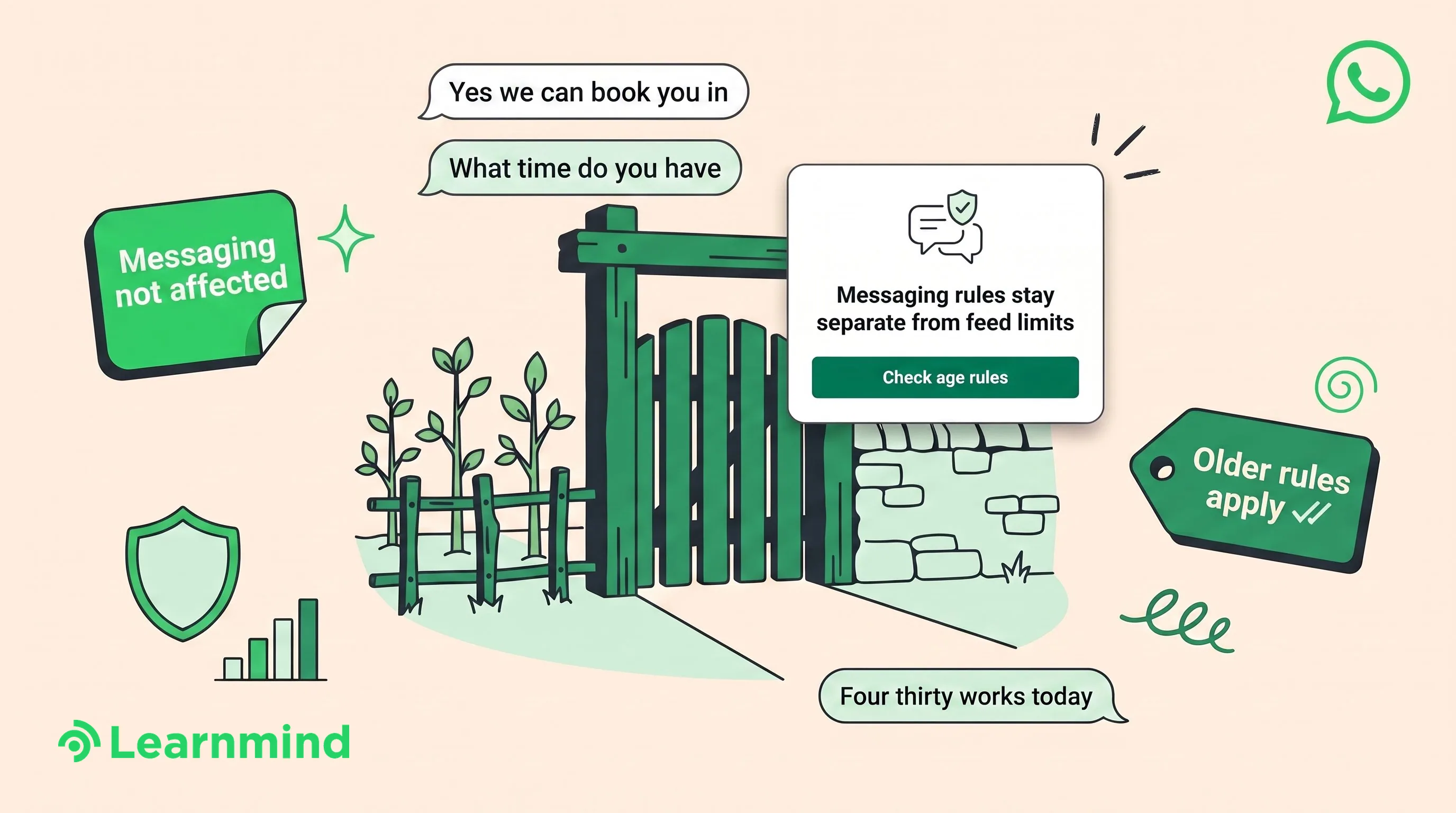
Take a common setup, sketched to make the rules concrete rather than drawn from any one business. A tutoring centre sends a reminder batch early each weekday: tomorrow's slot, the room, the tutor's name. Most of those numbers belong to parents. A handful, the sixth-formers who booked themselves, belong to sixteen-year-olds. After Meta's settlement with state attorneys general made the news, the fair question from an operator in that position is whether the batch is still legal, and whether a teenager will even see it during school hours.
The short answer is that WhatsApp sends are untouched by the settlement, and the rules that do bind that centre are older and stricter than anything announced alongside it. The new restrictions are about feeds, not inboxes.
The event: a settlement signed mid-trial
Meta announced an agreement with a bipartisan group of 52 attorneys general across US states, territories and the District of Columbia, per Meta's own announcement. CNN reported the settlement resolves claims from 29 state attorneys general that Meta intentionally designed addictive platforms harming young people's mental health, and that it arrived just over a week after a California trial began in which four states sought as much as $1.4 trillion in damages. Meta did not admit wrongdoing and had previously called the claims unsubstantiated.
The money is large and slow. The payment is approximately $18 billion, distributed in annual instalments over ten years, and Meta expects to accrue a roughly $10 billion legal expense in Q3 2026 that was not contemplated in its Q2 guidance. Most terms must remain in place for ten years; Time Limit and Night Mode start with a five-year commitment.
Naming it: the Minor Firewall
The Minor Firewall is Meta's new set of default, time-based blocks on teen consumption of public content, deliberately built with direct messaging on the outside of the wall.
Everything in the settlement's product section points inward at feeds, Stories, Explore and Reels. Nothing points at the one-to-one inbox. That asymmetry is not an oversight, and Meta says so in writing.
Why the firewall has a deliberate hole
Meta's wording is unambiguous: "Our direct messaging features are excluded from Night Mode, Time Limit, and School Mode restrictions, to allow teens to stay connected with friends and family." That is a carve-out, stated as policy, in the same document that creates the restrictions.
So a business account replying to an Instagram DM from a seventeen-year-old at 00:30 is not hitting a new wall. A business account hoping that teenager scrolls past a Reel at 00:30 is.
Mechanism: how the three modes sit around messaging
Three defaults, three different shapes.
Night Mode is a default block from the apps between midnight and 6am, meaning teens cannot post or view Feed, Stories, Explore or Reels. Time Limit is a default two-hour daily cap that teens can only turn off with a parent's permission; it is cumulative across Facebook and Instagram, and counts scrolling on both apps, including where Meta detects that someone has multiple accounts. School Mode mutes notifications by default between 8am and 3pm, with the stated exception of direct messages and alerts about account security or safety.
School Mode is the one that matters most commercially, and it cuts both ways. Push notifications for a teenager are muted through the school day, except direct messages. A DM notification still lands at 09:15. A Story tap does not.
What could tighten later
Meta has said that if industry peers sign on to the agreement, the commitment extends to ten years and the defaults get stronger: a Daily Limit of one hour per app and Night Mode expanded to 10:00 PM to 7:00 AM. That is conditional, not scheduled. Treat it as a planning scenario, not a date.
The messaging window, mapped hour by hour
This is a US teen account under the new defaults, with no parental override. Read it as a reach map for a business that talks to under-18s.
| Hours (local) | Feed, Stories, Explore, Reels | Direct message delivery | DM push notification |
|---|---|---|---|
| 00:00 to 06:00 | Blocked by default (Night Mode) | Not restricted by the agreement | Not restricted by the agreement |
| 06:00 to 08:00 | Available, counts to the two-hour cap | Not restricted | On |
| 08:00 to 15:00 | Available, counts to the cap | Not restricted | Muted by default, except DMs and safety alerts, so DM pushes still arrive |
| 15:00 to 00:00 | Available until the cumulative two hours across Facebook and Instagram is spent | Not restricted | On |
The practical read: organic and paid feed reach against teen accounts is now rationed by a two-hour cumulative budget and a six-hour blackout, while the inbox stays open all day. If a competitor's teen-facing strategy is Reels-first, the firewall taxes them. If yours is conversation-first, it does not.
What the WhatsApp Business rules on messaging minors actually say
The Night Mode, Time Limit and School Mode defaults are described in Meta's announcement as blocks on posting and viewing Feed, Stories, Explore and Reels, with direct messaging excluded. The constraints that govern messaging minors on WhatsApp sit elsewhere, in the WhatsApp Business Messaging Policy, and they are stricter than most operators realise.
WhatsApp requires that messages are gated per legal age, geographic requirements and regulatory requirements, through technical and organisational measures. That is an affirmative obligation on you, not a filter Meta runs. For alcohol, the policy is flat: messaging may not be sent to people under 18 years of age.
The template rule is unchanged and is the real governor on your sending. You may only initiate conversations using an approved Message Template, and Meta reserves the right to review, approve, pause and reject any template at any time. Nothing in the settlement loosens that. If you want the surrounding detail on categories and costs, our WhatsApp Business Platform reference covers the template mechanics, and the piece on what triggers an account review covers what happens when gating fails.
An honest trade-off ledger
What the firewall gives a conversation-led business: a channel your teen-adjacent audience can reach at any hour, notification priority through the school day, and a competitor set whose feed reach is now capped. What it costs: teen accounts on Instagram remain private by default and Meta continues to restrict potentially suspicious adults from contacting them, so cold outbound to minors is functionally dead. And the age-gating burden, the part with legal teeth, sits entirely with you.
Age-gating moves for teen-adjacent service businesses
Tutoring centres, gyms, dance studios, orthodontists and driving schools all talk to households containing minors. These are the moves that keep you growing without inheriting someone else's liability.
Do these:
- ✅ Capture date of birth, or an explicit confirmation that the person is 18 or over, at the point of opt-in and store it against the number. WhatsApp's policy asks for technical and organisational measures rather than naming a specific method, and a recorded age field is the plainest one available to you.
- ✅ Where a client is under 18, keep the parent or guardian number as the account holder and put the teen's name in the message body. That keeps the commercial relationship with an adult and the gating decision documented.
- ✅ Keep two audiences in your CRM: adult-verified and household-gated. Any promotional template only ever fires at the first.
- ✅ Rely on the 24-hour service window for teen-related conversation: the policy allows free replies within 24 hours of the last user message, which covers almost all real support traffic from a parent.
- ✅ Rebalance teen-facing organic reach toward inbox-first mechanics, because the two-hour cumulative cap and the midnight to 6am block now ration feed attention and DMs are exempt.
Do not do these:
- ❌ Send any alcohol-related template to an ungated list. WhatsApp's policy prohibits that messaging to under-18s outright, and enforcement runs through template rejection and account restriction.
- ❌ Assume the settlement gives you a teen age signal. It does not publish one to businesses; guessing age from a profile is not a gating measure.
- ❌ Buy or scrape numbers for a teen-heavy audience and initiate with a template. Unapproved-purpose template use is grounds for pause or rejection at any time.
- ❌ Cold-DM a teen account on Instagram hoping the default private setting is soft. Meta says it will continue restricting potentially suspicious adults from contacting teens.
Borderline, used by real operators:
- ⚠️ Self-declared age with no verification. It gains you a fast signup flow and satisfies the letter of an organisational measure; the risk is legal rather than platform, because a regulator assessing your alcohol or age-restricted marketing may not accept a tickbox. Suits businesses where under-18s are rare.
- ⚠️ Messaging a teen's own number for pure logistics (session moved, room changed) while the parent holds the commercial relationship. Gains reliability. The risk is platform-policy risk if any promotional content ever leaks into that thread and the template category no longer matches its designated purpose. Suits operators with tight template discipline.
- ⚠️ Building teen engagement on DM-exempt surfaces specifically because feeds are now capped. Entirely permitted today. The risk is that Meta has flagged stronger defaults, a one-hour daily cap and 10:00 PM to 7:00 AM Night Mode, if peers sign on, and the messaging carve-out is a policy choice that can be revisited. Suits operators who can rebuild a funnel within a year.
If you want the wider picture on inbox-led funnels, our guide to WhatsApp and Instagram chatbots sets out how the two channels differ in practice.
Remaining questions operators are asking
Does any of this apply outside the United States?
The agreement is with attorneys general across US states, territories and the District of Columbia. The product defaults are Meta's, so where they roll out beyond the US is Meta's decision rather than a term of the settlement, and no geographic scope has been published. The WhatsApp age-gating obligation, by contrast, applies to your account wherever you send, and it points at whatever local law defines legal age.
Will School Mode stop my morning WhatsApp reminders reaching teenage clients?
No. Night Mode, Time Limit and School Mode are described as restrictions on Facebook and Instagram public surfaces, and direct messaging is explicitly excluded from all three. The only things governing that send are your template approval and your own age gate.
How long do these defaults last?
The majority of terms are required to remain in place for ten years. Time Limit and Night Mode begin with a five-year commitment, extending to ten if industry peers sign on. So the feed restrictions are stable enough to plan against for at least a full business cycle.
What should I change this week?
Add an age field to your opt-in form and split your template audiences by it. That single change takes an afternoon and is the difference between a documented gating measure and a hopeful one.
If you talk to households with under-18s and want your opt-in and template set reviewed against WhatsApp's gating language, we are happy to walk through it with you.
Related reading
- The WhatsApp Business Platform Reference: What's Allowed, What Costs Money, and What Actually Ships
- WhatsApp Business API Webhooks: Events That Matter
- The WhatsApp Business Platform Terms: A Contract Reader's Guide for AI Chatbot Owners