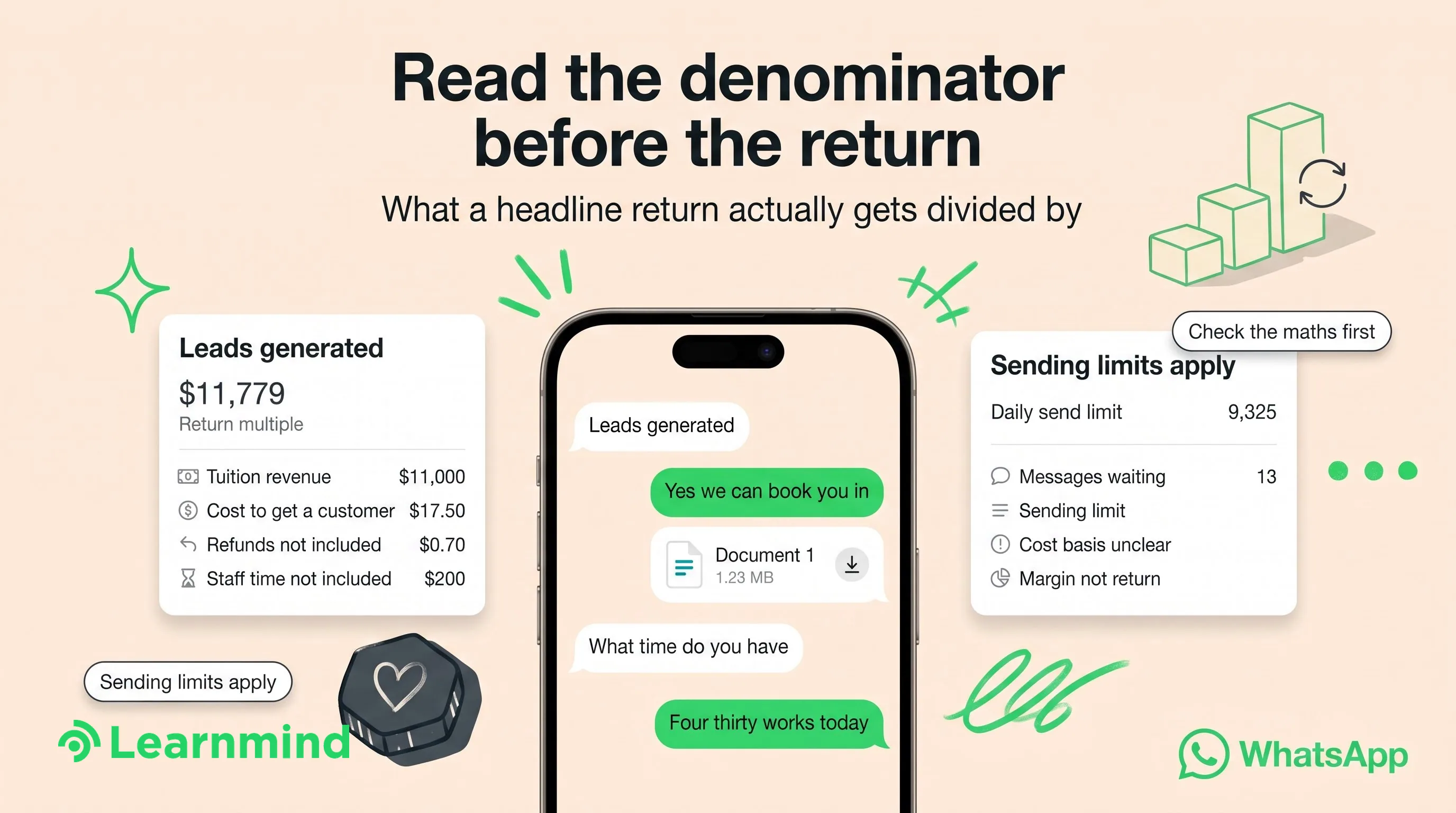
Most WhatsApp plans are built backwards. The campaign is designed, the list is loaded, the templates are written, and only then does someone discover that Meta will not let the business send to more than 250 people in a day. The ceiling is published, it applies from the moment a business portfolio is created, and almost nobody checks it before promising a launch date.
This piece is about that ceiling: what Meta actually permits, how a number climbs, and what we found matters more than volume once a line is live.
The 250-a-day starting line
Meta's developer documentation states that newly created business portfolios carry a messaging limit of 250 unique users per 24-hour period. The limit counts business-initiated conversations, so it constrains outreach rather than replies. Someone messaging you first does not consume it.
That single fact reorders most launch plans. Divide your list by 250. The result is the minimum number of days your first campaign needs at the starting tier, and it is also the number of days your ordinary operational messages, the confirmations and the reschedules, are competing with that campaign for the same allowance. A list of 3,000 parents is a twelve-day send before anything else goes out.
How a number actually climbs
Meta lists increases to 2,000, 10,000, 100,000 or unlimited unique users per day. An approved increase request moves a business phone number straight to 2,000, with notification by email and a developer alert. Where the usage criteria are met, a portfolio's limit rises by one level within six hours.
The qualifying condition is the part worth writing on the wall. It is 2,000 messages delivered to unique WhatsApp numbers, outside customer service windows, over a rolling 30-day period, using templates that hold a high quality rating. Volume alone does not lift you. Volume that people do not block does.
That distinction is why quality rating is the real gate, and why a poorly targeted broadcast is worse than no broadcast at all. It costs you the tier you were trying to earn. We have written separately on account review triggers, which is the same underlying mechanic seen from the enforcement side.
What we measured when speed replaced volume
We run the WhatsApp line for Alcaz Media, a performance marketing agency in the UAE. The problem there was never how many messages could go out. It was what happened to an inbound lead that arrived at 21:40 on a Thursday, when the account manager who would normally answer had finished for the day.
Three things are published on our results page from that deployment: response time measured in seconds rather than hours, around the clock; every inbound lead captured, with none lost to an unanswered evening; and uptime holding at 100%.
Be clear about what those numbers do and do not settle. They are operational measures of a line that answers, not a claim about anyone's profit, and they say nothing about how many people you may message tomorrow. That is exactly the point. Speed and capture live entirely inside the customer service window, where Meta's outreach ceiling does not apply at all, which is why they were available immediately while a tier climb takes weeks.
Structure beats volume, on Meta's own evidence
It is worth noticing what Meta chooses to highlight when it publishes outcomes. Its product documentation cites a medical consult business that saw a 2.6x increase in appointments after using WhatsApp Flows to structure the consult request. It also describes PTCL Group, Pakistan's national telecommunications company, working with Eocean on automated troubleshooting and reporting lower costs alongside faster, more reliable resolution.
Neither gain came from sending more messages. Both came from structuring the conversation that was already happening. Structured flows resolve inside the customer service window, and Meta confirms that service messages do not require pre-approval, unlike template messages. Less template surface means less quality-rating exposure, and quality rating is the thing gating your ability to scale outreach later.
What to settle before you launch
Four questions, answered honestly, will tell you whether your WhatsApp plan survives contact with the platform.
- How large is the list, and what is that divided by 250? That integer is your real launch window at the starting tier.
- Which of your messages are genuinely business-initiated, and which are replies inside an open conversation? Only the first group consumes the limit.
- Can the work be done inside the service window instead? A structured flow that answers a customer who messaged first is unconstrained by the outreach ceiling.
- Do you have templates with a high quality rating and 2,000 delivered messages over 30 days? Without that, no increase request is going to hold.
Cost sits underneath all four, and it varies by country and conversation type. Our breakdown of WhatsApp conversation pricing by country covers that separately.
Common questions
Does the 250 limit apply to replies as well as outreach?
No. Meta's messaging limits govern business-initiated conversations. A customer who messages you first opens a service window, and your replies inside it are not counted against the daily ceiling. This is why an inbound-first system can run at full speed on day one while an outbound campaign waits on tier increases.
How long does it take to move from 250 to 2,000?
An approved increase request takes a business phone number straight to 2,000. Where usage criteria are met instead, Meta states the limit rises one level within six hours. The slow part is not the increase, it is accumulating 2,000 delivered messages to unique numbers over a rolling 30-day period with high-quality templates.
Is a high quality rating something we control?
Largely, yes. It reflects how recipients respond: blocks and reports drag it down, engagement holds it up. That makes list hygiene and message relevance operational concerns rather than marketing preferences, because the rating gates the tier.
If you want a straight read on where your portfolio sits against Meta's tiers today, and whether the outcome you want actually needs outreach at all, talk to us and we will walk you through it.
Related reading
Sources
- Meta for Developers, WhatsApp messaging limits
- Meta for Developers, WhatsApp conversation types
- WhatsApp Business, WhatsApp Flows
- Learnmind, published client results