You are probably reading this at one of three forks. Your Zapier plan is up for renewal and the task count has crept past what the tier allows. Or your WhatsApp volume has grown to the point where someone on the team is manually copying phone numbers from a form into a chat window, and you are deciding whether to hire a coordinator or automate the job. Or an agency has quoted you for a "custom WhatsApp system" and you want to know what is actually underneath it before you sign.
All three forks come down to the same question: which automation platform sits between your WhatsApp Business API account and everything else you use, and will it still be standing in eighteen months when your message volume has tripled?
The answer, before the reasoning
Some readers can stop here.
If WhatsApp is the main channel your business runs on, use n8n. Not because it is fashionable, but because Zapier has no native WhatsApp Business Cloud API support and you will be building HTTP requests by hand anyway. If you are going to hand-roll the WhatsApp layer, do it on a platform that lets you self-host, keeps customer phone numbers inside infrastructure you control, and does not charge you per task while a conversation ping-pongs back and forth twelve times.
If WhatsApp is one notification channel among several and your team has no technical person, use Make. It has a native WhatsApp module, the visual canvas is genuinely readable by a non-developer, and you will ship something useful in a week rather than a month.
If your automation need is "when a form is submitted, send one WhatsApp message and add a row to a sheet", and that is honestly the whole scope, use Zapier and stop reading comparison articles. The simplest tool that solves the problem is the correct tool. We say this as people who make a living building the complicated version.
Everything below is the mechanics: why those verdicts hold, and the specific places each one breaks. The failure modes are more useful than the feature tables, because nobody churns off a platform over a missing feature. They churn when a workflow silently stops firing on a Friday and nobody notices until Monday.

Native WhatsApp support is the first real dividing line
This is where the three platforms genuinely separate, and it is not close. In a feature comparison of the three tools for order confirmations, shipping updates and cart recovery over WhatsApp, Zapier is described as having no native WhatsApp, with abandoned-cart flows over WhatsApp listed as not feasible. Make handles the same jobs through a dedicated WhatsApp module. n8n handles them through an HTTP node hitting the WhatsApp Cloud API directly.
Read that carefully, because the distinction is subtler than "one has it and one does not". Make gives you a module: fields, dropdowns, a mapped phone number, a template name. n8n gives you a node that will send whatever JSON you construct to Meta's endpoint. The Make version is faster to build. The n8n version can do things the module does not expose, and in our experience that gap is where most WhatsApp projects run into trouble, because a pre-built module only ever supports the subset of the API its maintainers chose to wrap.
Think of it like the difference between a kitchen with a combi oven that has a preset button for every dish on the menu, and a kitchen with a good stove. The presets are faster on a normal service. The stove cooks the thing that is not on the menu.
Where the HTTP-node approach earns its keep
The moment you need any of these, the module approach starts costing you more than it saves:
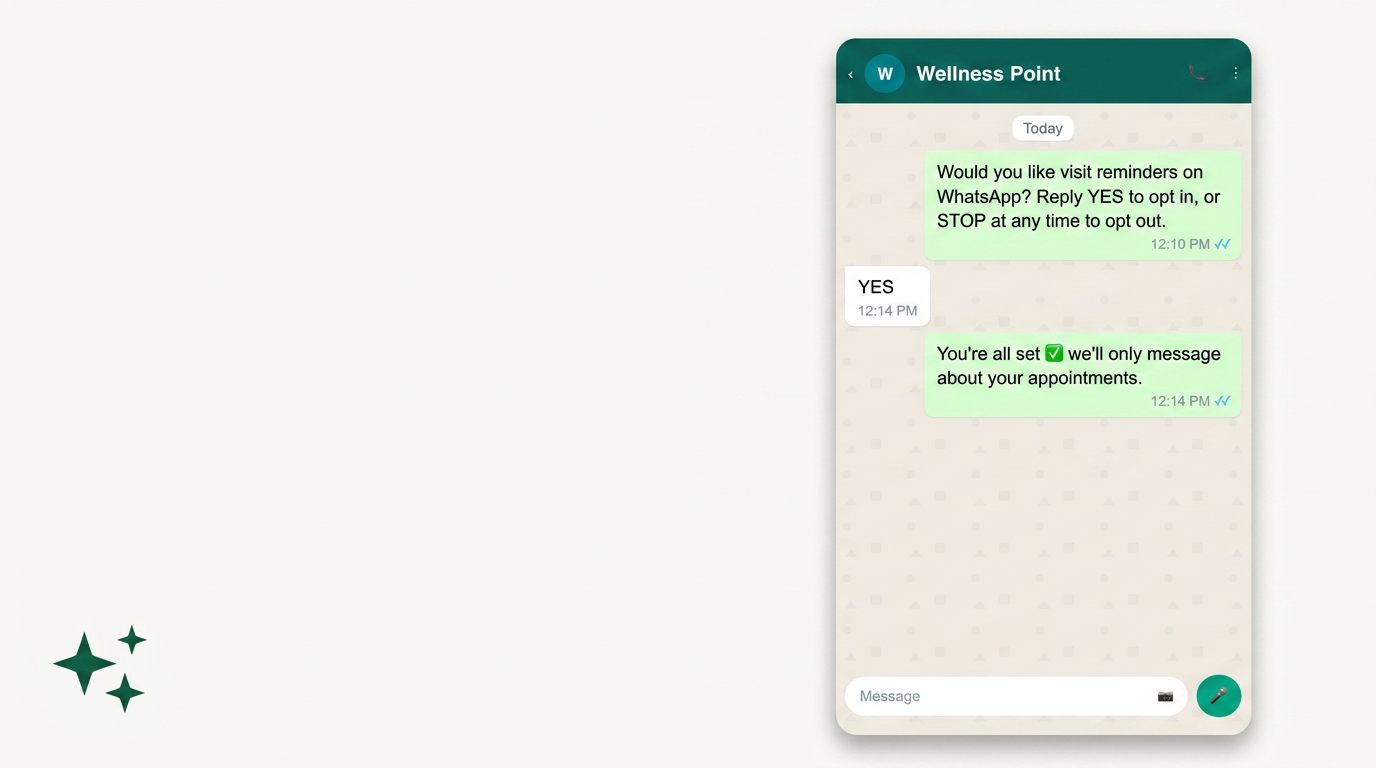
- Interactive messages. Buttons and list replies are how you get a patient to confirm an appointment in one tap instead of typing. These are structured payloads, and how well a pre-built module supports them varies.
- Template variable handling with fallbacks. If a customer's first name is empty in your CRM, the send will fail on a missing variable. You want conditional logic before the API call, not error triage after it.
- Reading delivery and read receipts back. Webhooks from Meta return status events. If you want to know that your reminder was delivered but never read, you need to catch and store those events yourself.
- The 24-hour customer service window. Meta's WhatsApp Business Platform only permits free-form replies inside 24 hours of the customer's last message. Outside it, you must use an approved template. Any serious WhatsApp workflow needs a branch that checks this before deciding what to send.
That last one is the single most common reason a WhatsApp automation built by a well-meaning marketing person stops working. The flow worked in testing, because the tester had just messaged the number. It failed in production, because real customers went quiet for two days.
What each one costs when conversations, not events, are the unit
Automation pricing was designed for a world where one trigger equals one action. WhatsApp does not behave that way. A single appointment rebooking might be nine steps: inbound webhook, lookup in the CRM, check the session window, branch, send, wait, catch the reply, update the record, notify the front desk. On a platform that meters per task, that is nine billable operations for one conversation you would previously have handled in a thirty-second phone call.
Zapier meters tasks, so multi-step WhatsApp conversations consume your allowance far faster than the trigger count suggests. Make is more forgiving on operation pricing but, as the comparison research puts it, can be costly at scale once your scenarios get busy. n8n self-hosted decouples cost from volume entirely: you are paying for a server. That is the structural difference, and everything past it is arithmetic you should do against your own numbers rather than ours, because operation counts vary wildly with how you build.
Here is the honest counterweight, and we tell every client this before they get excited about self-hosting. A server you own is a server someone has to patch, back up and monitor. If nobody on your team knows what a Docker container is and nobody is on call, "free" hosting is not free, it is deferred. We have inherited two self-hosted instances that had been running an outdated version for months because the person who set it up left. That is a real cost, it just shows up as a Tuesday outage rather than a line on a card statement.
The way we frame it for clients: pick the first project by what it saves, then pick the platform by who will maintain it. Not the other way round.
Reliability, and the failures you never see
Ask any operator running WhatsApp automation what keeps them up and it is never the build. It is the silent failure. A template gets rejected after someone edits the copy. A rate limit hits during a busy week. A webhook times out. The workflow does not crash loudly, it just stops delivering, and the first person to find out is a customer who did not get their reminder.
All three platforms have execution logs. The difference is what you can do with them.
Zapier will alert you when a Zap errors and can pause it after repeated failures, which is protective and also means your reminders quietly stop. Make shows you the scenario history with data at each step, which is excellent for debugging a single broken run. n8n gives you full execution data plus the ability to build your own error-handling workflow: catch the failure, retry with backoff, log it to a sheet, and message the operations manager on WhatsApp. That last part matters more than it sounds. A system that tells you it is broken, on the channel you actually read, is worth more than a system that fails slightly less often and says nothing.
This is the part of the job that has nothing to do with the tool and everything to do with the build. We have written before about why automation fails, and the pattern is consistent in the projects we inherit: the technology worked, the ownership did not exist. Nobody was accountable for checking that yesterday's messages went out.

A worked example: the no-show reminder that has to be right
Take a clinic sending a 24-hour appointment reminder with a confirm-or-reschedule button. Built naively, it is three steps and it works most of the time. Built properly, it looks like this:
- Pull tomorrow's appointments on a schedule, not on a per-booking trigger, so a failed run can be re-run without duplicating sends.
- De-duplicate against a sent log, because the second reminder in ten minutes is the fastest way to lose a patient's trust.
- Check consent status on the record before sending anything at all.
- Send the approved template with buttons. Store the message ID.
- Catch the button reply on a webhook, update the appointment, and if the reply is "reschedule", hand the conversation to a human instead of trying to negotiate a new slot in an automated flow.
- At the end of the run, post a summary to the front desk: sent, confirmed, failed.
That is six to eight nodes and about half a day of work on n8n. On Make it is comparable, with the WhatsApp module doing more of the lifting and the de-duplication logic feeling slightly clumsier. On Zapier it is a chain of multi-step Zaps with a custom webhook action, and the metered cost of the de-duplication reads alone will make you wince.
Notice the last bullet of the reschedule branch. That is the house rule we do not bend: automate the repetitive, personalise the meaningful. Reminders are repetitive. A patient trying to move an appointment because something went wrong in their week is a human conversation, and the automation's job is to route it to a person fast, not to handle it.
Opt-in and compliance are a build discipline, not a platform feature
None of these three tools will keep you compliant with Meta's rules. That is worth saying plainly, because the assumption that a native WhatsApp module implies safety is common and wrong. The module sends what you tell it to send.
Meta's WhatsApp Business policy requires opt-in before you message someone, collected on a channel where the person could reasonably expect it, and it requires you to honour opt-outs. Messages sent outside the 24-hour window need an approved template, and the category you file it under affects both cost and how your sending is assessed. Recipient blocks and reports pull down your quality rating, and sustained low quality means tighter messaging limits.
What that means for your platform choice is narrow but real: whichever tool you pick has to give you somewhere to store consent state and check it before every outbound send. All three can. In our experience, the builds that actually have that check are the ones somebody designed deliberately. The DIY setups we audit rarely include a consent node, because the person building it had a list of numbers and a goal, and the check felt like friction.
We wrote about a similar discipline in the property DM playbook: the constraint that feels like it slows you down is the one that keeps the channel usable for the next two years.
How steep the learning curve actually is
The tools sort cleanly here, and the ordering matches everyone's intuition. Zapier is the simplest for basic tasks. Make sits in the middle with a visual canvas that a smart operations person can learn in a fortnight. n8n is favoured for complex, self-hosted automations and expects more of you, though its node-based editor is not code, and someone comfortable with spreadsheets and APIs will get there.
The honest version of the learning curve conversation is not "can you learn it". It is "who is the second person". Single-maintainer automation is the most common fragility we find. One person built everything, understands everything, and has never documented anything. When they take annual leave, nobody can fix a broken template.
Whatever you choose, the test is whether a second person on your team can open a workflow and describe what it does within five minutes. Make wins that test more often than n8n, purely on visual legibility. That is a genuine argument for Make in a business with no technical staff, and we make it regularly even when it costs us the more interesting build.
The verdict, by business situation
Single-location clinic, salon or studio, no technical staff, modest WhatsApp volume
Make, hosted, with the native WhatsApp module. Build reminders, confirmations and a post-visit follow-up. Do not self-host anything. Do not build a custom CRM. Spend the saved effort on writing template copy that people actually reply to. If Zapier is already in the business and doing something simple well, leave it alone and add Make alongside it rather than migrating for the sake of tidiness.
Multi-branch operator, or any business where WhatsApp is the primary revenue channel
n8n, self-hosted or on their cloud, with the WhatsApp layer built on HTTP nodes against the Cloud API. You need the session-window logic, the consent checks, the delivery-status capture and the error-notification workflow, and you need them without a per-task meter running. Budget for someone to own it, internally or through us. This is the configuration where the workflow genuinely is part of your competitive advantage, and it is the only situation where we recommend building custom rather than buying and configuring.
Real estate agencies and anyone running high lead volume with long follow-up cycles
n8n, and the deciding factor is not WhatsApp at all, it is everything hanging off it. Lead routing, deduplication across portals, drip logic that pauses when a human replies, and CRM writes in both directions. Metered pricing on that shape of work escalates fast, and Make's operation counter will do the same thing more slowly.
You already run Zapier across the business and WhatsApp is one small addition
Keep Zapier for what it does, and put the WhatsApp workflow somewhere else. Two tools is not a failure of architecture. Forcing a platform with no native WhatsApp support to be your conversational backbone is.
You are being quoted for a custom build by an agency
Ask three questions: what happens when a template is rejected, where is consent state stored, and who gets notified when a run fails. If the answers are vague, the platform choice on the proposal is irrelevant. The build will fail on operations, not on tooling.
If you are stuck at one of those forks and want a second opinion before you renew, migrate or sign, we will look at your current WhatsApp setup and tell you plainly which of the three fits, including when the answer is that you do not need to change anything.