
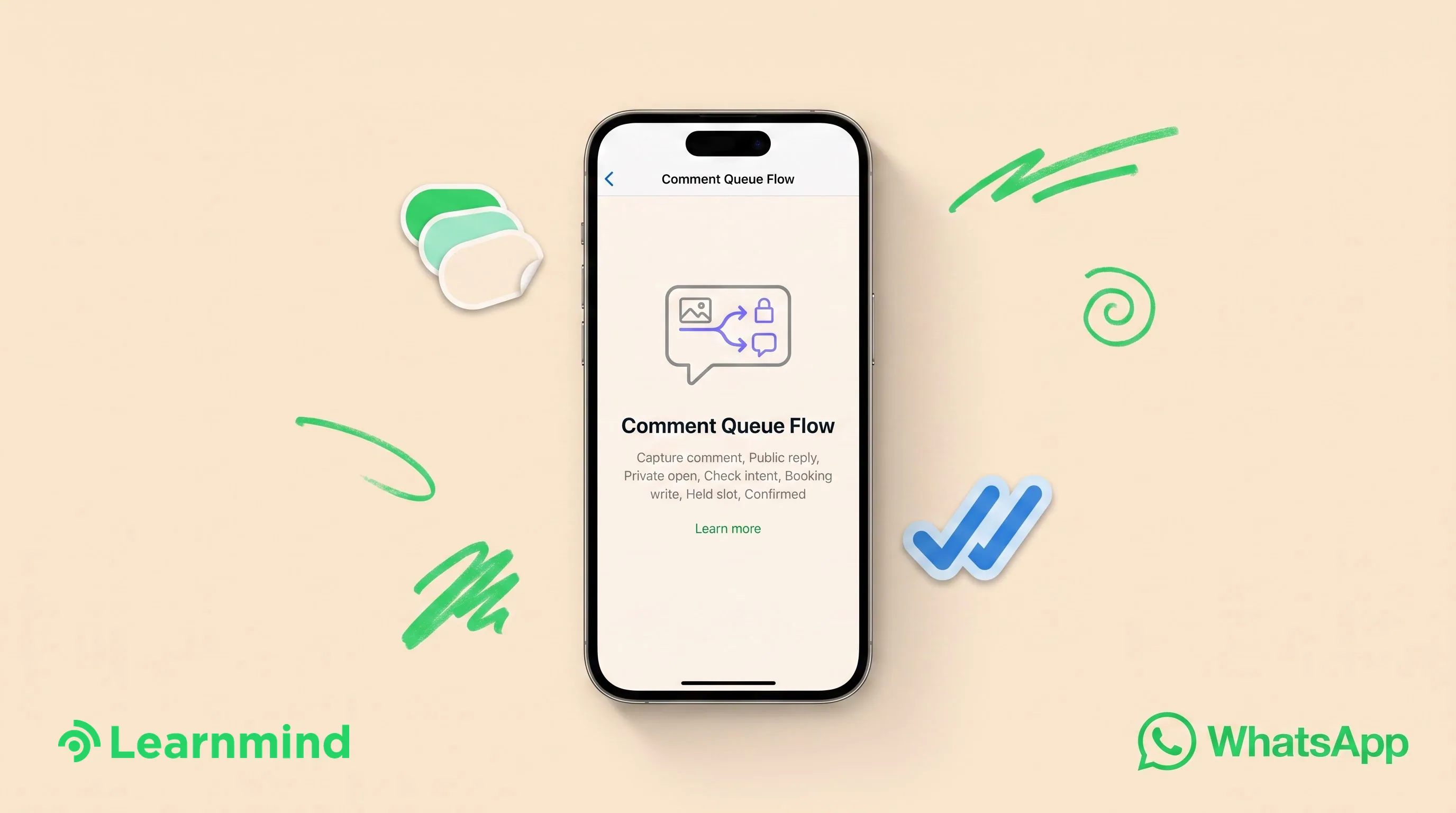
Meta now tells businesses directly to activate an AI agent on Messenger, framing it as a way to respond to customers day or night with a system that understands your products. That is a meaningful shift in posture: the platform that once treated automation as a compliance risk is now shipping the on-ramp itself. For any service business running lead ads, a facebook ad comment ai agent queue is no longer a hack bolted on the side. It is a supported pattern, provided you respect the boundary between the public comment and the private thread.
This article is not about lead routing in general. It is about the specific, awkward object at the start of the chain: a comment on a paid Facebook post, which behaves differently from a WhatsApp click, a form fill or an organic DM, and which breaks in ways those channels do not.
The comment-to-booking chain, mechanism by mechanism
Most owners picture one thing happening. There are five discrete handoffs, and each one is a place where leads leak.
- Capture. A webhook fires when a comment is created on an ad or page post. Your system receives the comment ID, the commenter's scoped ID and the text.
- Public reply. A short, human-sounding reply under the comment, written for everyone else reading the thread rather than for the commenter.
- Private open. A message sent to the commenter in Messenger, referencing their comment. This is the only step that creates a real conversation.
- Qualification. Two to four questions that establish intent, timing, budget or treatment type, depending on your sector.
- Booking write. The agent writes a held slot into the calendar or CRM and confirms it back in-thread.
If you build only steps one and two, you have a comment moderator, not a lead engine. The revenue lives in steps three to five.
The mistake worth tearing down
The common build is: agent detects the word "price", replies publicly with the price, done. It looks efficient and it destroys the funnel. You have published your pricing under a live ad where a competitor is watching, given the commenter no reason to open a thread, and removed the qualification step entirely.
The fix is one line of logic: the public reply never contains the answer. It contains the promise of the answer in a private thread. "Sent you the options in a message, check your inbox." The commenter now has a reason to click, and you have a thread in which to ask when they want to come in.
Meta's Messenger infrastructure: what the API layer actually allows
Meta describes the Messenger Platform as enterprise-grade APIs for messaging and calling, positioned around revenue growth and customer experience rather than moderation. That framing matters when you scope a build: the private thread is the product, the comment is the trigger.
Two constraints shape everything downstream. First, you can only message a person privately once they have given you a signal, and a comment on your own post is that signal. Second, the window in which you can message freely is finite. Practically, that means your qualification sequence must be front-loaded. Ask the booking-relevant question in the first or second message, not the fifth.
Meta positions the on-platform agent as something that understands your products. Read that literally. It is strong at catalogue and FAQ questions. It is not, on its own, a scheduling system with access to your practitioner rota. The booking write is yours to build.
What makes ad comments different from every other lead source
This is the part that catches teams who have already built a WhatsApp or DM flow and assume comments are just another inbox. They are not.
Dark posts collapse many ad sets into one comment stream
An unpublished page post used as ad creative can be attached to several ad sets at once. All of those placements share a single post ID, which means the comments arrive as one undifferentiated stream. If you want to know which ad set produced a booking, you have to record the comment ID against the campaign context at capture time, because the payload alone will not tell you later. Skip this and you will optimise creative blind.
Hiding is not deleting, and both are visible
A hidden comment stays visible to its author and their friends. From the commenter's side nothing has changed, which is exactly why the tactic backfires when they notice engagement has vanished. Deletion is cleaner but irreversible and removes your own audit trail. Decide the policy before you automate it, and keep a log of every action the agent takes on a comment.
The public reply is advertising copy, not customer service
A reply under a live ad sits inside a paid placement. For a clinic in the UAE, that means the same health-advertising rules that govern the ad itself govern the automated reply beneath it. Treat your reply templates as creative that needs approval, not as inbox text.
From Marketing API hook to Graph API v26.0 trigger
Comments on ads sit at the join between two of Meta's API surfaces. Facebook's developer documentation notes that the Graph API and Marketing API changelogs cover versioned and out-of-cycle changes respective to each API, which is the polite way of saying your ad-comment integration can break from either direction. The current version referenced in that changelog is v26.0.
Pin your version explicitly in every call. Unversioned calls drift to whatever is current and you find out on a Friday when a real estate agency's viewing enquiries stop arriving. Set a calendar reminder to read the changelog quarterly; it takes fifteen minutes and it is the cheapest insurance in this stack.
One thing that is genuinely unknown until you test it in your own account: which comment events your Page receives depends on your webhook subscription fields and your permission set, and dark-post ad comments do not always behave like organic Page-post comments. Do not assume parity. Post a test comment on a live ad from a second personal account and watch the payload land before you write a single line of qualification logic.
Wiring the qualification layer: scoring and routing inbound comments
Not every comment is a lead. "Beautiful" is not a lead. "Do you have Saturday availability in Jumeirah" is a lead with a location and a time preference already attached.
Score on three axes and route accordingly. Intent (is there a request?), specificity (is there a service, a date or a location named?), and reachability (can you open a thread?). Vendor platforms in this space market exactly this pattern: one industry product description covers agents that score and qualify inbound leads, ask discovery questions and pass only sales-ready prospects to the team. The idea is sound; the scoring thresholds have to be yours, because a gym and a dental practice do not agree on what qualified means.
| Business type | Typical ad comment | Qualifying question in thread | Booking artefact |
|---|---|---|---|
| Aesthetic clinic | "How much for lip filler?" | Have you had filler before, and which week suits? | Consultation slot with practitioner |
| Real estate agency | "Is this still available?" | Buying or renting, and what is your move-in month? | Viewing slot with agent |
| Gym or PT studio | "Do you do a free trial?" | Which branch, and mornings or evenings? | Trial session on class timetable |
| Tutoring centre | "Grade 9 maths?" | Which curriculum, and which term are you planning for? | Assessment appointment |
Route the low scorers to a public acknowledgement and nothing else. Route the high scorers to a thread and, if the thread stalls twice, to a human. The inbox-side routing patterns that keep this volume from collapsing a shared queue are covered in our piece on multi-agent inbox routing; what is specific here is the scoring that happens before a thread exists at all.
Connecting the agent to booking: integrations and write access
The booking write is where most builds stop being clever and start being plumbing. Your agent needs read access to availability and write access to create a hold. If it can only read, it will confirm slots that are already gone, and you will spend more time apologising than you saved.
Platform marketing in this category leans on integration counts, with one vendor advertising 400+ integrations and agents that connect to existing systems across lead qualification, support and property workflows. Treat that number as a shelf, not a promise. The only figure that matters is whether your specific practice-management system, property CRM or class timetable is on the list with two-way write, and whether the connector handles the field you actually need (practitioner, room, branch). Ask for a live write test during evaluation, not a logo grid.
Before you commit budget, build the arithmetic from your own account rather than from anyone's benchmark. Pull four numbers you already have: comments per month on paid posts, the share that contain a real request, the share of those who reply in a thread, and your average first-visit value. Multiply them. Then rerun it with the thread-open rate moved by ten points, because that is the one step your public reply copy actually controls, and it will tell you whether the build is a growth project or a tidying exercise.
Uptime and scale: reading reliability claims properly
Comment queues fail loudly. If the agent is down during a campaign burst, the comments stay public and unanswered under a live ad, which is worse than having no automation at all.
Vendors in this space quote enterprise-readiness signals: one platform advertises a 99.9% uptime SLA, more than 500 organisations served, and a 24/7 AI workforce. Ask what the SLA covers before you weigh it. Vendor uptime does not cover Meta-side webhook delays, and no SLA of this kind refunds you for a lost booking.
The operational answer is a dead-letter queue. Every comment event that fails to process gets written to a list a human reviews each morning. It costs nothing and it converts an outage into a delay.
Keeping the volume without losing the number
You want every commenter in a thread. Meta wants people to consent to being messaged. Here is where those overlap, where they collide, and where honest operators sit in between.
Safe and effective, do these:
- ✅ Reply publicly within minutes with a short, specific line that names the service and points to the inbox, so the thread-open rate rises without publishing pricing.
- ✅ Front-load the single highest-value qualifying question into your first private message, because the free-messaging window is finite and a five-question script rarely finishes.
- ✅ Pin your API version at v26.0 and read the Graph API changelog quarterly, so a versioned change is a scheduled task rather than an outage.
- ✅ Stamp every captured comment ID with the ad set and creative that produced it, since a shared dark post will not tell you afterwards.
- ✅ Hand off to a named human after two unanswered agent messages, and say so in-thread. High-value enquiries convert on a person.
Genuinely dangerous, avoid these:
- ❌ Messaging people who commented on someone else's post or a competitor's ad. That is unsolicited contact, and it puts your Page's messaging permissions at risk, not just the individual thread.
- ❌ Exporting commenter identities into an email or SMS list. Under UAE and UK data rules this is processing for a purpose the person never agreed to, and it is a legal exposure separate from anything Meta does.
- ❌ Publishing treatment prices or medical claims in public replies for clinics. In the UAE, health advertising content is regulated by the health authority, and an automated reply under a paid post is still your advertisement.
- ❌ Auto-hiding every negative comment. The author still sees it, so when they notice the silence around it the screenshot travels further than the original complaint.
Borderline, used by real operators, decide with open eyes:
- ⚠️ Auto-deleting spam and competitor links rather than hiding them. Gains a clean ad thread and better social proof. Risk is reputational rather than platform-policy: false positives remove a genuine customer's comment permanently. Suits high-volume advertisers who review the deletion log daily.
- ⚠️ Reopening a cold thread with a promotional message after the free window has closed using a paid or tagged message type. Gains recovered leads. This is platform-policy risk: message-type rules are enforced and misuse degrades your messaging standing. Suits operators willing to read the current Messenger docs properly, not those copying a template.
- ⚠️ Letting the agent quote an indicative price range privately without a human check. Gains speed and higher thread completion. For clinics this carries regulatory risk under health-advertising rules; for gyms and tutoring it carries almost none. Suits low-regulation sectors, not medical ones.
- ⚠️ Running the agent under a persona name rather than disclosing it is automated. Gains warmth in the first exchange. Risk is trust, and a rising disclosure expectation. Suits brands willing to admit it the moment anyone asks, and no one else.
Frequently asked questions
How long does a first working build take?
Assume two to three weeks for a single Page and one booking system. Week one is webhook subscription, permission review and payload testing on a live ad. Week two is the qualification script and calendar write. Week three is watching real traffic and fixing the scoring thresholds, which are always wrong on the first pass. Multi-branch or multi-practitioner routing adds a week.
Who should not build this?
If your paid posts attract only a handful of comments a week, a person checking the Page twice a day beats any automation on both cost and quality. The chain earns its keep on volume and on out-of-hours traffic. A restaurant with one location and a busy host stand is usually better served by fixing response time than by adding an agent layer.
What breaks first once it is live?
The booking connector, almost always. Availability changed manually in the calendar by staff, rather than through the system, is invisible to the agent and produces double bookings. Second most common is a permission expiry on the Page token, which fails silently. Set an alert for a processing gap that is longer than your normal quiet period, because silence is the only symptom you get.
Can the same queue feed WhatsApp instead of Messenger?
Yes, and for Gulf audiences it often should, because reply rates on WhatsApp tend to be higher. The public comment reply invites the person to a WhatsApp number rather than an inbox, which costs you the automatic thread open but gains a channel people actually check. We cover the ad-side setup in our guide to click-to-WhatsApp ads.
Does Meta's own agent replace a custom build?
Not for booking. Meta's agent is designed to answer product questions day or night, and it does that well. It does not know which practitioner is on shift in your Al Barsha branch on Tuesday. Use it as a first responder and keep the qualification and calendar write in your own layer.
If you are running Facebook ads in the UAE and watching comments pile up unanswered overnight, send us the ad set and we will tell you honestly whether a comment queue would move your numbers or whether faster human replies would do it for free.
Sources
- Facebook Developers
- Meta for Business
- Facebook Developers
- one vendor analysis
- What do you think of AI agents for auto-responding to clients? - Facebook (background)
- Imagine having a business assistant that doesn't sleep Meta ... (background)
- lead generation, sales call booking, content editing, or AI (background)