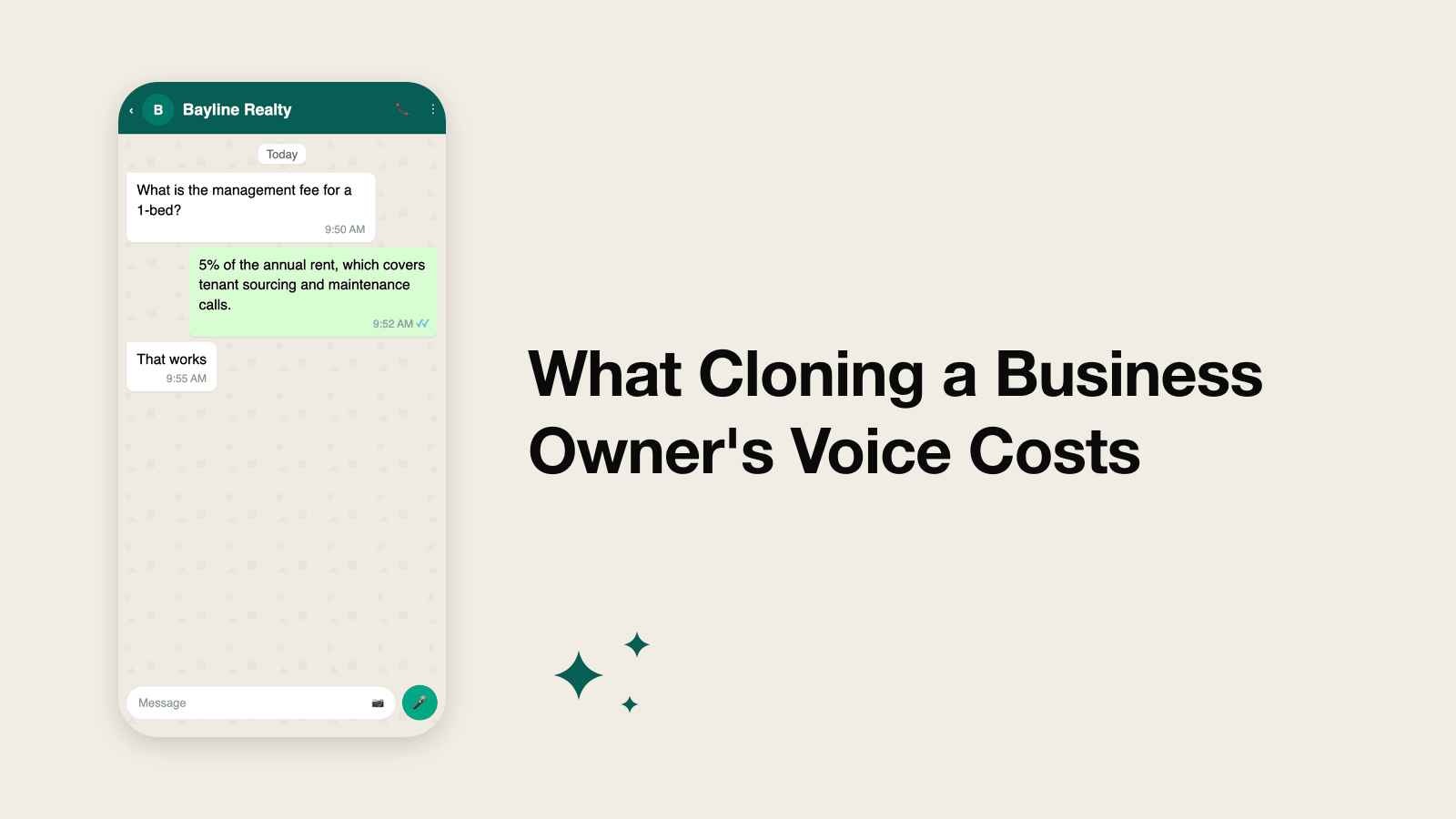
The voice model is the cheapest part of this project, and almost every quote you receive will be priced as though it is the expensive part.
To clone a business owner's voice for WhatsApp, the synthesis subscription runs $5 to $30 a month. Typecast's price comparison puts ElevenLabs Starter at $5 a month as the lowest entry point from a major provider, Typecast itself at $8.99 including commercial rights, and Murf at $19 for high-volume value on a per-minute basis. That is the entire software line for a single owner voice. What costs real money is everything that decides what the voice says, in which language, to which customer, and hands it to the WhatsApp Business API as a playable file. Owners read the $5 and assume the project is small. It isn't, and the mismatch is where budgets go wrong.
So what is the total cost, subscription plus everything else?
Two lines: a small recurring software cost and a one-off integration cost that dominates year one.
On the recurring side, a breakdown of ElevenLabs plans compiled by PxlPeak confirms the free tier gives roughly 10 minutes of audio a month, pre-made voices only, no cloning and no commercial licence. Paid tiers add cloning and commercial rights, with usage-based overages once you pass the monthly credit allocation.
On the pipeline side, Forasoft's build-versus-license analysis costs a fully managed voice agent at roughly $0.05 to $0.09 per minute once you add streaming speech recognition and a language model on top of the text-to-speech layer, with self-hosting at scale dropping to $0.03 to $0.05 per minute. Asynchronous voice notes skip the listening half of that stack, so your marginal cost per outbound message is a fraction of a fils.
To estimate your own figure, take your monthly voice note volume, multiply by the average length in seconds, divide by 60, and apply that per-minute rate. A business sending a thousand fifteen-second notes a month is generating 250 minutes of audio, which lands in single-digit dollars of generation cost on top of the subscription tier. The number that matters is the integration and message design work, not the meter.
Can we test it on a free plan first?
Not with real clients, and the reason is the licence rather than the audio quality.
LicenseOrg's licensing comparison shows free-plan commercial use marked "No" for ElevenLabs, HeyGen and Murf, with Descript only limited, while every paid plan grants commercial rights and lets the user retain rights in the output. Free plans also typically require attribution.
A WhatsApp voice note confirming a paid appointment is commercial use. There is no reading of it that isn't. Use a free tier to hear whether the synthesis is convincing at all, then move to a paid plan the moment a real customer is on the receiving end.
How much of my voice do you need, and what do I record?
Anything from a minute for an instant clone to twenty or thirty minutes for a professional one, and the difference shows up in exactly the places your business cares about.
Instant cloning works from a short sample and appears on entry-level paid tiers. Professional cloning trains on a larger, cleaner corpus and produces the version that survives long sentences, Arabic names and price figures without drifting. The plan comparison published by Marga Bagus on ElevenLabs consent policy shows instant cloning at the $5 Starter tier and professional cloning available at Creator, around $11, gated behind a consent step.
The recording session itself is unglamorous. Quiet room, phone on a stand, air conditioning off. Scripted lines that match how the owner actually talks to clients rather than audiobook prose. Then the awkward material, which is where most sessions are too short: your own business name, your street name, the treatments or packages you sell, "Dr" plus the surname, the words dirham and AED, and numbers spoken naturally. Dates and times are where clones fail most audibly, so over-record them. Finish with a dated verbal consent statement in the owner's own voice. That file is not a formality; it is the document you will reach for if anyone ever asks whether the voice was authorised.
Where is the consent line, exactly?
Consent must be explicit and documented before the clone exists, because the platforms require it as a condition of use.
The LicenseOrg comparison marks voice cloning as consent-requiring across ElevenLabs, Murf and Descript, and for HeyGen's avatar equivalent. ElevenLabs' own plan structure places professional cloning behind a consent step. That is a platform terms question first and a national law question second: even where local rules are quiet, breaching the provider's terms puts your account and your recordings at risk.
Clone only a voice you employ or are
The owner's voice with the owner's recorded consent is the clean case. A departed practitioner's voice is not, however many hours of old promotional video you have on file. When a staff member leaves, retire the clone.
Say somewhere that the voice is synthesised
Not in every message. In the WhatsApp welcome message, the automated-messages line of your privacy notice, or the first voice note a new contact receives. The reasoning is practical: if a client believes they received a personal message from the doctor and later learns it was generated, the trust damage is worse than never having used voice at all.
Keep the clone away from anything consequential
No clinical advice, no diagnoses, no pricing exceptions, no commitments. The clone confirms, reminds, welcomes and directs. Anything with consequences routes to a human before it sends.
What does the build involve on my side?
Roughly three weeks of elapsed time and about four hours of the owner's attention, distributed unevenly.
Week one is recording and cloning, then listening to generated samples and rejecting the ones that sound wrong. Week two is message design, which owners consistently underestimate. Every voice note is a template, and templates that read fine as text sound stilted as speech, so you will rewrite them out loud. Week three is wiring the clone into your WhatsApp Business API sender and your booking system, followed by a controlled pilot on one client segment with a human approving every message before it goes out.
Keep cloned notes short. Fifteen-second confirmations are where synthesis is strongest; ninety-second explanations are where it exposes itself. Design the message set around the strength rather than testing the limits on paying customers.
Which platform should we build on?
The mid-market, for a single owner voice on a service business budget.
Aloa's enterprise platform comparison splits the 2025 market into premium enterprise leaders charging $99 to $1,320 monthly, mid-tier business solutions at $30 to $89, and specialised platforms serving niche markets. WellSaid Labs' review of top AI voice platforms describes tiers running to $999 a month covering thousands of instant clones and eleven thousand minutes of generation, which is content-studio scale rather than clinic scale.
Choose on three things, in this order: a commercial licence on the tier you can actually afford, quality of the professional clone in your accent and language mix, and API access your WhatsApp sender can call. A $10 monthly price difference is noise next to a clone that mangles your clinic's name.
What goes wrong that nobody warns me about?
Three failures, in the order we see them.
The first is scope creep in the brand voice. Once the clone exists, someone will want it for marketing broadcasts, and a promotional voice note in the owner's voice lands very differently from a confirmation. Write down the message types the clone is permitted to speak and keep that list short.
The second is overage billing. Usage-based credit overages are standard once you pass a plan's allocation, and voice note volume is spiky around term starts, Ramadan schedule changes and long weekends. Set an alert at 70 per cent of your allocation rather than discovering it on the invoice.
The third is succession. The clone is tied to a person. If the owner sells, steps back, or the named practitioner leaves, the asset becomes awkward both legally and reputationally. Decide in writing now what happens to the voice model in each case.
Is this worth it for a business my size?
Only if the owner's voice is already doing measurable work in the customer relationship.
Cloning amplifies something that already exists. If clients reply faster to the owner's voice notes than to typed messages from reception, a clone removes the labour without removing the effect. If nobody was waiting to hear that voice, you have bought an expensive novelty and a consent file you never needed.
Test it the cheap way. Record twenty voice notes yourself this week, send them to one client segment and typed messages to another, and compare reply speed and no-show rates. If the gap is real, $5 to $30 a month of software plus three weeks of build pays for itself quickly. If there is no gap, you have saved yourself a project.