The pricing question for AI recovery systems stopped being theoretical when the big platforms moved. Zendesk now charges for successful AI-driven issue resolutions rather than AI seat licences, and Intercom applies the same logic to its Fin agent, according to Futurum Group. Once the category leaders bill on outcomes, every vendor quoting you a per-seat licence for an AI receptionist has to explain why.
This article is not about whether missed-call and no-show recovery is worth automating. Assume you have already decided that. It is about the mechanics of the meter: what unit you are billed on, who defines a success, how attribution is windowed, and what happens when the vendor reprices mid-contract. Those four clauses decide more of your cost than the headline rate does.
The three models: revenue-share, flat-fee and hybrid defined
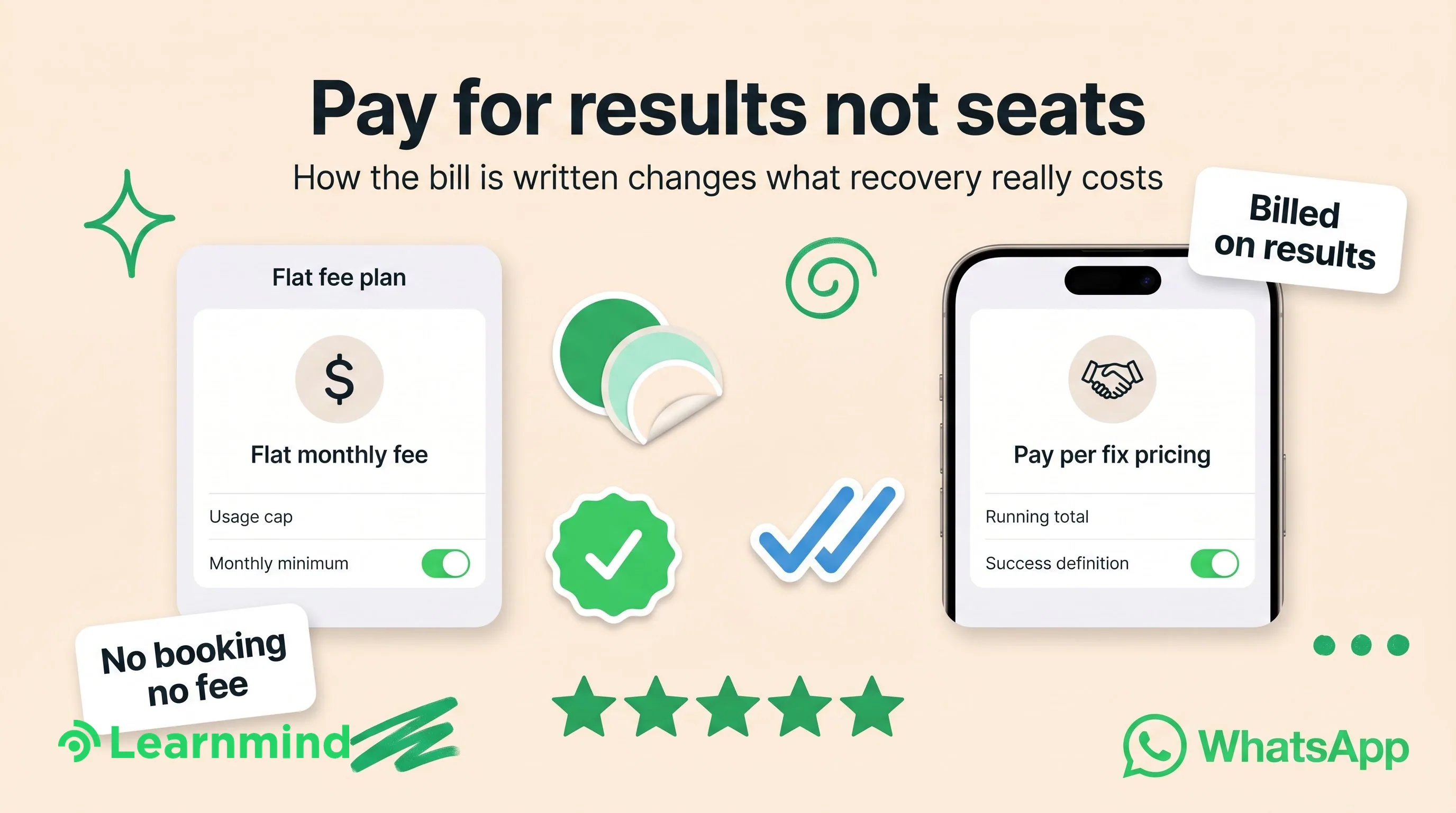
Flat-fee (subscription). A recurring monthly amount for access, with usage either unlimited or capped inside the tier. monday.com defines it as a flat charge per user, per team or per account. In the AI answering market, Puppilot reports some services offering unlimited calls at $25 to $50 per month, which is entry-level territory rather than a full recovery system.
Revenue-share and outcome-based. The vendor is paid a share of value created, or a fee per successful resolution. Usage-based rates in the answering-service market typically run $0.20 to $1.75 per minute, or $1 to $4 per call, usually with a monthly minimum attached, per Puppilot's pricing breakdown. Pure revenue-share, where you pay a percentage of recovered booking value, is the aggressive end of this family.
Hybrid. A base monthly fee plus usage charges for overages or premium features. This is where the market has landed. A Stripe survey cited by Lago found 56% of AI company leaders use hybrid pricing and 38% use purely usage-based. Almost nobody runs pure seat-based pricing for AI-native products, the same analysis notes, because the maths does not work when every seat has variable inference cost behind it.
The short answer: at low volume, flat-fee wins on predictability, because the sector's monthly minimums dominate a usage bill anyway. At mid volume, hybrid wins. At high volume, hybrid with a negotiated per-unit floor wins, and pure revenue-share almost always costs more than it looks, because the vendor's income rises with your recovered value while their cost per interaction does not.
Why AI pricing is still being figured out industry-wide
Do not assume the vendor in front of you has a settled model. Stripe found that 92% of AI companies charging for usage had subsequently adjusted their pricing, again via Lago. That is close to universal repricing. It means any contract you sign this quarter should carry an explicit clause on what happens when the vendor changes rates.
Buyer preference is also split rather than converged. Futurum's 1H 2026 survey shows 43% of buyers prefer consumption-based models while 27% favour outcome-based structures, per the same release. No majority. the same literature puts the decision on three variables: revenue goals, measurable impact, and risk tolerance, adding plainly that no single model works for everyone.
For voice specifically, Anyreach argues that per-minute, per-resolution and flat-fee choices determine whether a deployment succeeds financially rather than technically. A system that works perfectly can still lose money on the wrong meter.
Start from the value metric, not the invoice
The cleanest framework comes from SaaS Fractional CPO: data volume, API calls or compute point to a platform fee plus usage metering; users or seats point to seat-based pricing with feature gating; transaction volume points to a model that scales with the money moving through the product. Appointment recovery is a transaction-volume product. That is the honest case for hybrid over flat.
Four contract clauses that decide your real cost
The rate card is the part vendors want you to negotiate. These four clauses matter more.
- The billable unit. Zendesk and Intercom bill on successful resolutions, per Futurum. A dial attempt, a delivered message and a confirmed rebooking are three different units, and only one of them is a result. Name yours in writing.
- The attribution window. If a patient rebooks eleven days after an AI follow-up, is that recovered revenue? Without a stated window, the answer defaults to the vendor's reporting.
- The repricing clause. Given that 92% of usage-charging AI companies have already adjusted pricing, treat a change as scheduled, not hypothetical, and attach notice and exit rights.
- The minimum. industry pricing analyses note that usage rates normally carry a monthly minimum. In a quiet month, the minimum is your actual price, so compare minimums, not per-call rates.
Volume tiers: which model fits low, mid and high interaction counts
the sector data states the load-bearing point plainly: higher call volume means you pay more, either through higher-tier plans or overage charges. The question is which mechanism hurts less at your level. The table below is a judgement guide, not sourced data.
| Volume tier | Typical business | Model that fits | Why |
|---|---|---|---|
| Low | Solo PT, boutique salon, small tutoring centre | Flat-fee | Monthly minimums dominate a usage bill anyway; predictability beats efficiency |
| Mid | Aesthetic clinic, two-branch dental, mid-size agency | Hybrid | Base fee covers the platform, metering absorbs seasonal spikes without a tier jump |
| High | Multi-site clinic group, hotel front office, large brokerage | Hybrid with negotiated per-unit rate | Volume earns you a better per-call rate; revenue-share scales faster than your margin |
Revenue-share deserves its own note. It is genuinely attractive when you cannot forecast volume at all, for example a new clinic in its first two quarters. It becomes expensive precisely when the system works.
The calculation to run before you sign
Do not compare vendor quotes to each other. Compare each quote to your own recovered value. Three lines, using only rates the vendor has put in writing:
- Line one: monthly recovered bookings multiplied by your average transaction value. That is recovered value.
- Line two: billable interactions multiplied by the quoted per-call rate, or the monthly minimum, whichever is higher. the published market band is $1 to $4 per call, or $0.20 to $1.75 per minute, so price the top of the band, not the bottom.
- Line three: line two divided by line one. That percentage is the only number that lets you compare a flat fee, a per-call rate and a revenue share on the same axis.
The verdict flips entirely on your average transaction value. The same per-call rate is trivial against a high-ticket aesthetic treatment and painful against a monthly gym membership. The deciding number is not the vendor's rate, it is your average transaction value divided by your per-interaction cost.
One caveat on the flat-fee end. Unlimited-call plans at the $25 to $50 level rarely include CRM writeback, calendar rebooking or WhatsApp follow-up, so they are a floor price, not a comparable product. If you are scoping the follow-up side, our notes on WhatsApp automation and AI receptionists cover what a full recovery flow actually contains.
Compliance costs that change the maths
If any part of your recovery flow touches US numbers, the compliance layer is a real line item. Twilio requires A2P 10DLC brand and campaign registration before SMS traffic can send at all. Carriers then enforce throughput and content restrictions that vary by campaign type and registration tier, which means your recovery sequence's send speed is a function of your registration, not your software.
On consent, the position is more open than it looks. The FCC adopted a one-to-one consent rule in 2024, but the Eleventh Circuit vacated it in January 2025 before it took effect, holding that it conflicted with the ordinary meaning of prior express consent under the TCPA. Shared-lead-form consent is therefore not barred by that rule. Prior express written consent under the pre-existing TCPA standard still applies, and aggregator consent remains the weakest kind you can hold, so treat it as a commercial risk to manage rather than a settled prohibition.
This matters for model choice. Under a per-call or revenue-share meter, a vendor has a structural incentive to contact more people. Under flat-fee, they do not. If you buy on outcomes, you own the consent discipline, and your contract should say so.
Keeping the volume without losing the terms
Every operator wants outcome pricing when the system underperforms and flat pricing when it overperforms. Here is how to get most of that without pretending.
Moves that are safe and genuinely effective:
- ✅ Define the billable unit in writing before signing. A successful resolution in the Zendesk and Intercom sense is a resolved interaction, not a dial attempt.
- ✅ Negotiate a rate-change notice clause. With 92% of usage-charging AI companies having repriced, per Stripe via Lago, assume yours will too and secure notice plus an exit.
- ✅ Run a full seasonal cycle on flat-fee before committing to usage, so you have your own volume baseline instead of the vendor's estimate.
- ✅ Cap the hybrid overage. A base fee plus metered usage with a monthly ceiling gives you the upside of consumption pricing and the sleep of a subscription.
- ✅ Separate telephony and messaging pass-through costs from the AI fee on the invoice, so registration and carrier charges are visible.
Moves that reliably cost you:
- ❌ Sending SMS recovery traffic before A2P 10DLC brand and campaign registration completes. Twilio states registration is required before sending; unregistered traffic is filtered or blocked by carriers.
- ⚠️ Recontacting leads whose consent came from a shared lead form or aggregator. The FCC rule that would have banned this outright was vacated in January 2025, so it is not per se unlawful, but aggregator consent is still the weakest evidence of consent you can hold and carriers treat the resulting complaint rates harshly. Suits operators who can show the original capture; wrong for anyone who cannot.
- ❌ Buying a per-seat AI licence for a recovery system. the pricing data is direct that almost nobody prices AI-native products on pure seats because the maths does not work, and you inherit that broken maths.
- ❌ Signing revenue-share without an agreed attribution window. Without it, every booking made in the following month is arguably the vendor's.
Borderline moves real operators use, with the risk named:
- ⚠️ Counting a callback answered by your human team as a vendor-attributed recovery. Gains goodwill and simpler reporting; carries commercial risk of inflating the bill under outcome pricing. Suits operators who value vendor alignment over precise attribution.
- ⚠️ Running recovery on WhatsApp instead of SMS to sidestep 10DLC registration entirely. Gains speed to launch; carries platform-policy risk, since WhatsApp has its own template and opt-in rules enforced by Meta rather than carriers. Suits UAE-first operators with no US traffic.
- ⚠️ Accepting a headline rate at the low end of Puppilot's per-minute range in exchange for a high monthly minimum. Gains an attractive marginal cost at scale; carries the commercial risk that in a quiet month you pay the minimum for nothing. Suits businesses with stable seasonality, not seasonal clinics or holiday-driven hospitality.
- ⚠️ Tying vendor payment to a percentage of recovered booking value. Gains alignment and near-zero downside if the system fails; carries the commercial risk that a high-ticket clinic pays heavily for work whose delivery cost barely moved. Suits low-ticket, high-volume operators far more than aesthetics or property.
Common questions on AI appointment recovery pricing
What should I budget beyond the vendor fee?
Telephony minutes, messaging pass-through, and registration. If you send SMS to US numbers, Twilio's A2P 10DLC brand and campaign registration is a prerequisite, and your permitted throughput varies by registration tier. Add integration time with your practice management or CRM system, which is usually the largest hidden line and is rarely covered by an entry-level unlimited-calls plan.
How long before the model choice can be reviewed?
Give it a full seasonal cycle. A couple of months of data tells you the average, not the variance, and variance is exactly what separates flat-fee from usage pricing. Once you have a peak and a trough on record you can renegotiate the meter, and given that 92% of usage-charging AI companies have already repriced, your vendor will expect the conversation.
Who should not buy an outcome-priced system?
High-ticket, low-volume businesses. A brokerage recovering a handful of enquiries a month at large commission values will pay disproportionately under revenue-share for a system doing very little work. Flat-fee suits you. The inverse also holds: a low-fee tutoring centre with heavy call volume should avoid per-call rates at the top of the $1 to $4 market band.
What breaks first when volume grows?
Throughput, then attribution. Carrier throughput limits tied to your registration tier throttle sends before your AI capacity does. Attribution breaks next: at low volume you can eyeball which bookings the system saved, and at high volume you cannot, so the billing dispute arrives before the technical one.
If you want a second read on a quote you have been given, send us the pricing sheet and your monthly call volume. We will tell you which of the three models the numbers actually support, including when the answer is that you do not need a system yet.
Related reading
- From No-Shows to Revenue Recovery: Building Bulletproof Appointment Systems That Actually Work
- From Order Chaos to Revenue Engine: The Operator's Guide to AI-Powered Business Systems
- The Automation-First Customer Experience: Why Your Manual Systems Are Bleeding Revenue
Sources
- Eleventh Circuit vacates the FCC one-to-one consent rule (January 2025)
- Twilio — A2P 10DLC registration and SMS guidelines
- monday.com — AI agent business models
- Lago — AI pricing models (Stripe survey data)
- Anyreach — voice AI pricing models
- Futurum Group — outcome-based AI pricing research
- Puppilot — AI answering service pricing bands
- SaaS Fractional CPO — hybrid pricing frameworks
- Meta — WhatsApp Business Platform pricing
Comparing the platforms themselves? We compared nine WhatsApp automation providers available in Dubai and the UAE, with pricing checked and sourced.